
-
 by
Emmanuel Okafor
by
Emmanuel Okafor - December 21, 2025
- 0 Comments

Table of Contents
The Question That Changes Everything About “Relaxation”
Picture this:
You’ve tried everything for your stress and anxiety. You’ve downloaded the meditation apps, joined the gentle yoga classes, followed the breathwork videos, and practised the “calming poses.”
You lie in child’s pose. You hold a pigeon. You breathe slowly in savasana.
The instructor’s voice is soothing: “Just relax. Let go. Release the tension.”
And for those 60 minutes, maybe you do feel a little lighter.
But then,
The moment you walk out the door, your jaw clenches again. Your shoulders creep back up to your ears. That knot between your shoulder blades returns.
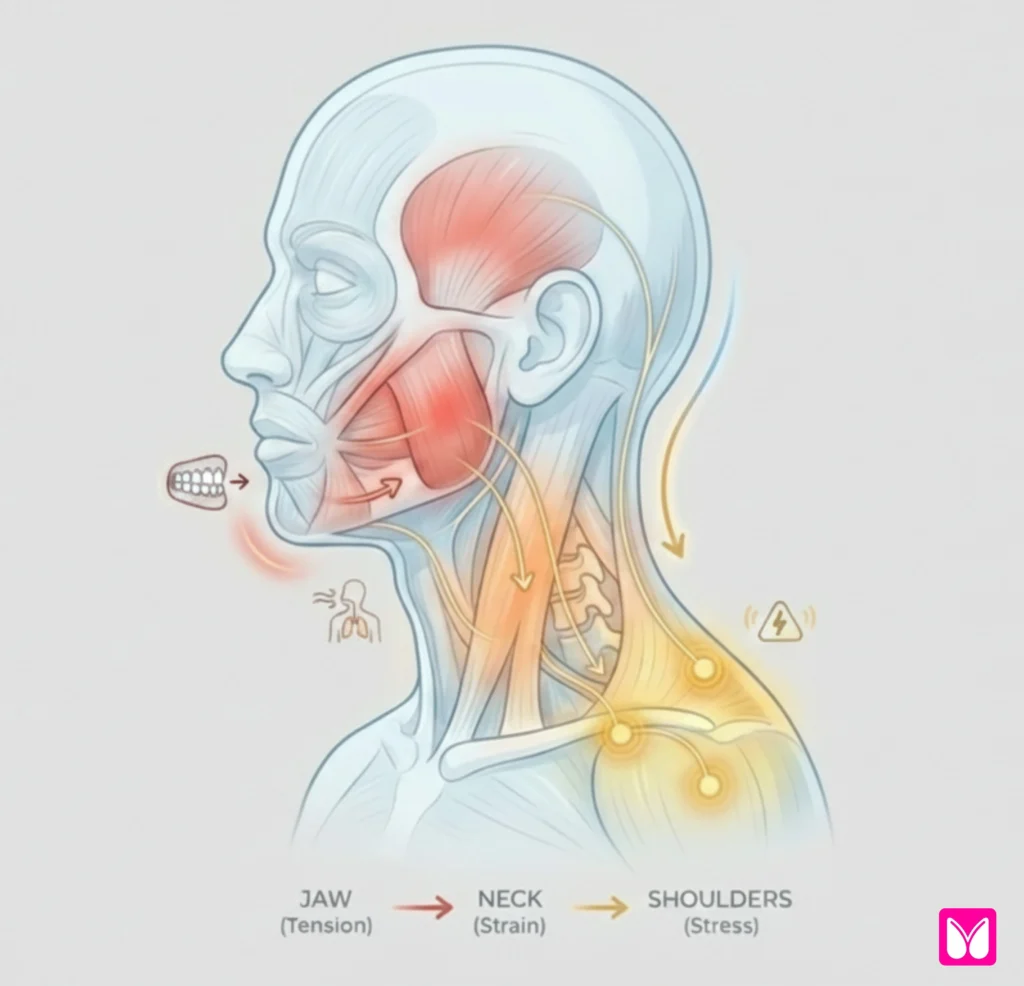
Your sleep is still broken. Your breath is still shallow.
By the next morning, it’s like the class never happened.
You tell yourself: “I just need to practice more. I need to be more consistent. Maybe I’m not doing it right.”
Here’s what nobody wants to tell you in the multi-billion-dollar yoga and wellness industry:
You’re not failing at relaxation. You’re being taught something entirely wrong.
The Uncomfortable Truth Nobody’s Telling You
After a decade of studying somatic movement therapy, fascia research, and polyvagal theory, after watching thousands of people cycle through “gentle yoga” without lasting relief, I need to tell you something that might upset you: According to the scientific framework known as the Polyvagal theory overview, the vagus nerve plays a central role in how the nervous system shifts between safe, vigilance, and shutdown states.
A yoga pose is just a shape.
That’s it. Just a shape your body makes in space.
And without something called somatic intelligence, without engaging your nervous system in a specific way, most “gentle yoga” is simply slow exercise accompanied by calming music.
It’s not nervous system healing. It’s not trauma resolution. It’s not the mind-body awareness you actually need.
Let me show you what’s really happening, and more importantly, what actually works.
The “Pose List” Trap (Why Your Body Still Feels Braced)
You’ve Seen These Lists a Thousand Times
“10 Yoga Poses for Stress Relief”
“Gentle Yoga for Anxiety”
“Calming Yoga Sequence for Better Sleep”
They all show the same things:
You’ve probably seen headlines like “10 Yoga Poses for Stress Relief,” “Gentle Yoga for Anxiety,” or even Is Yin Yoga a Waste of Time?-all promising calm through passive holds and slow breathing.
- Child’s pose (hold for 3 minutes)
- Legs up the wall (breathe deeply)
- Supported bridge (relax the hips)
- Reclining twist (release the spine)
Beautiful photos. Soft lighting. Peaceful music playing in the background.
You try them. You really do.
But here’s the question that haunts you at 3 AM when you’re wide awake with a racing heart:
Why doesn’t it stick?
The Performance Flaw: You’re Doing Yoga FOR Your Body, Not WITH It
Here’s what most yoga—even “gentle” yoga—teaches you to do:
✓ Get into the correct shape
✓ Count your breaths (inhale for 4, exhale for 6)
✓ Hold the position
✓ “Try to relax.”
✓ Think calming thoughts
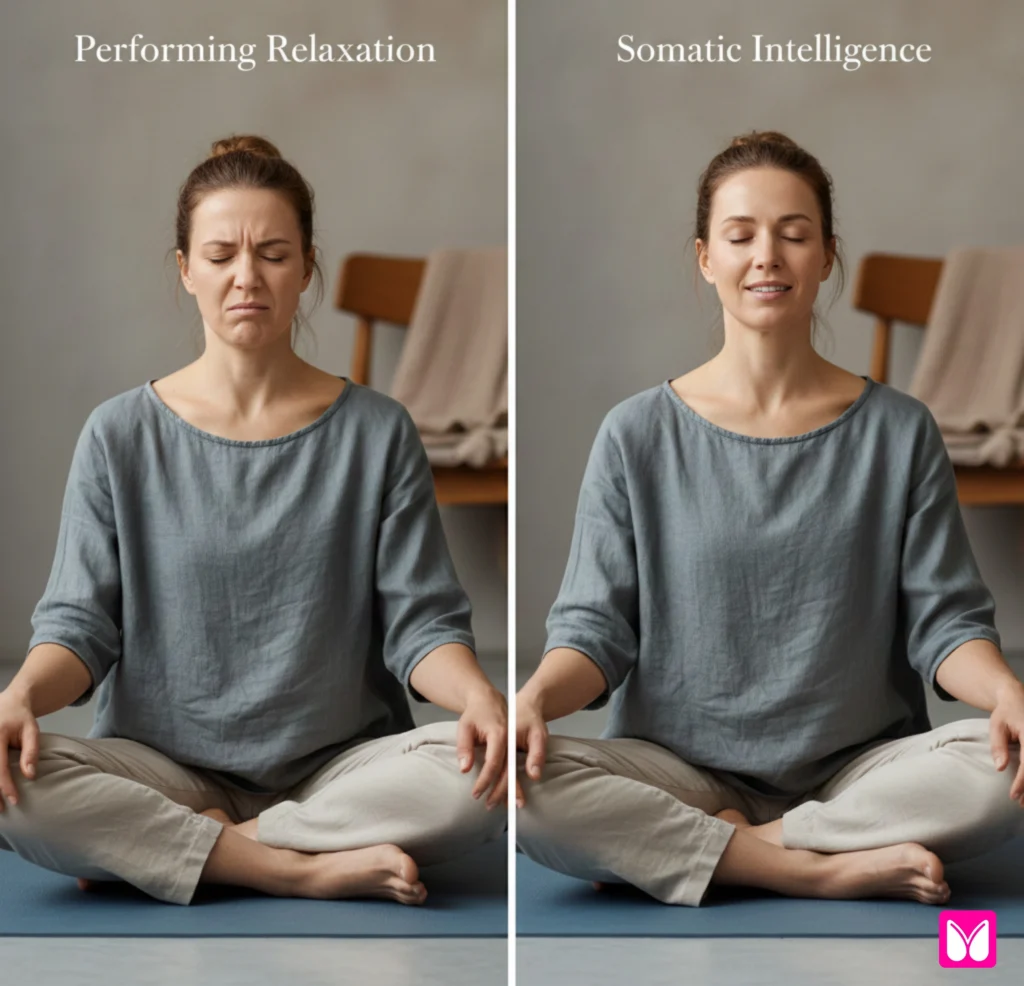
This is yoga as performance. You’re performing relaxation for an external standard.
Somatic yoga is the opposite. It’s not about how the pose looks. It’s about what’s happening inside—the internal sensory feedback your nervous system receives and sends.
Think of it this way:
Traditional gentle yoga says, “Get into child’s pose and relax.”
Somatic yoga asks: “What does your body feel right now? Where are you still holding? What wants to move? What doesn’t feel safe yet?”
One tells you what to do.
The other teaches you how to listen.
The Brutal Reality: Your Nervous System Doesn’t Care How “Gentle” It Looks
You can move slowly. You can use props. You can have the softest music and the dimmest lights.
But if your nervous system is still perceiving threat—if your jaw is clenched, your psoas is braced, your breath is held, your mind is racing, you are not regulating.
You’re just uncomfortable slowly.
This is the lie of “gentle” yoga:
Slow ≠ Somatic
Just as slow doesn’t automatically mean safe, intensity doesn’t automatically mean harmful either, a misconception also explored around hot yoga benefits versus nervous system regulation.
Relaxing music ≠ Nervous system healing
Mind-Body Awareness vs. Mind-Body Distraction
Let me show you the difference:
Commercial “gentle” yoga teaches:
- Count your breaths mechanically
- Hold shapes for time
- “Relax” mentally (while your body screams)
- Follow external cues
- Achieve the “correct” form
Somatic practice teaches:
- Track internal sensation moment-to-moment
- Notice micro-holding patterns
- Respond to what your body actually needs right now
- Follow internal impulses
- Let form emerge from safety
One numbs you out.
The other wakes you up from the inside.
Here’s the painful truth: You can spend years in gentle yoga classes, checking all the boxes, doing all the “right” poses, and never once actually communicate with your nervous system.
You’re going through the motions while your survival system stays on high alert.
The Science Nobody Explains Clearly (The Engineering Truth)
Somatic Yoga = Nervous System Interface, Not Flexibility Routine
If this distinction feels new, especially if you’re coming from a pose-based class, understanding the foundations of somatic yoga for beginners is the true practice.
Let’s get technical for a moment, but I’ll make it simple:
Your nervous system has a specific nerve called the vagus nerve—think of it as the main communication highway between your brain and your body. It has two branches:
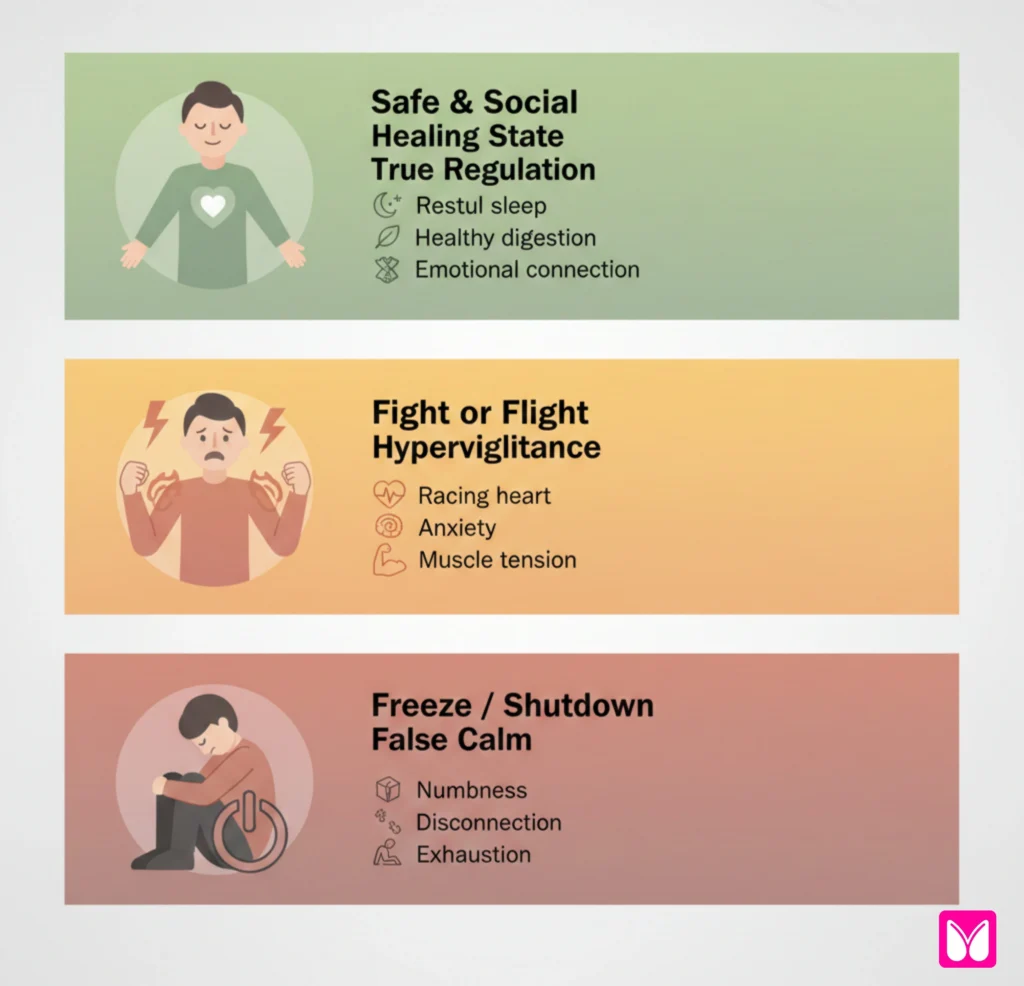
Ventral Vagal (Safe & Social):
↓ This is where healing happens
↓ Heart rate variable and healthy
↓ Digestion works
↓ You can connect with others
↓ Sleep is restorative
↓ Muscles can truly release
Dorsal Vagal (Shutdown/Freeze):
↓ This is where you feel numb
↓ Energy crashes
↓ Disconnection from the body
↓ “Dead” calm that isn’t actually restful
↓ Depression-like states
Sympathetic (Fight/Flight):
↓ Hypervigilance
↓ Racing heart
↓ Anxiety
↓ Muscle tension
↓ Sleep disruption
Here’s what most people don’t understand:
Traditional “gentle yoga” often pushes you into dorsal vagal shutdown; that numb, collapsed “calm” that feels like relief but is actually your nervous system giving up, not healing.
Real somatic yoga engages the ventral vagal state, a state of true safety, where your body can actually reorganise.
Pandiculation: The Reset Button Your Body Already Knows
Have you ever watched a cat wake up from a nap?
They don’t stretch. They do something else:
They contract their muscles fully, pause, then slowly, almost luxuriously, release.
That’s called pandiculation. It’s how animals naturally reset their nervous system. And it’s completely different from stretching.
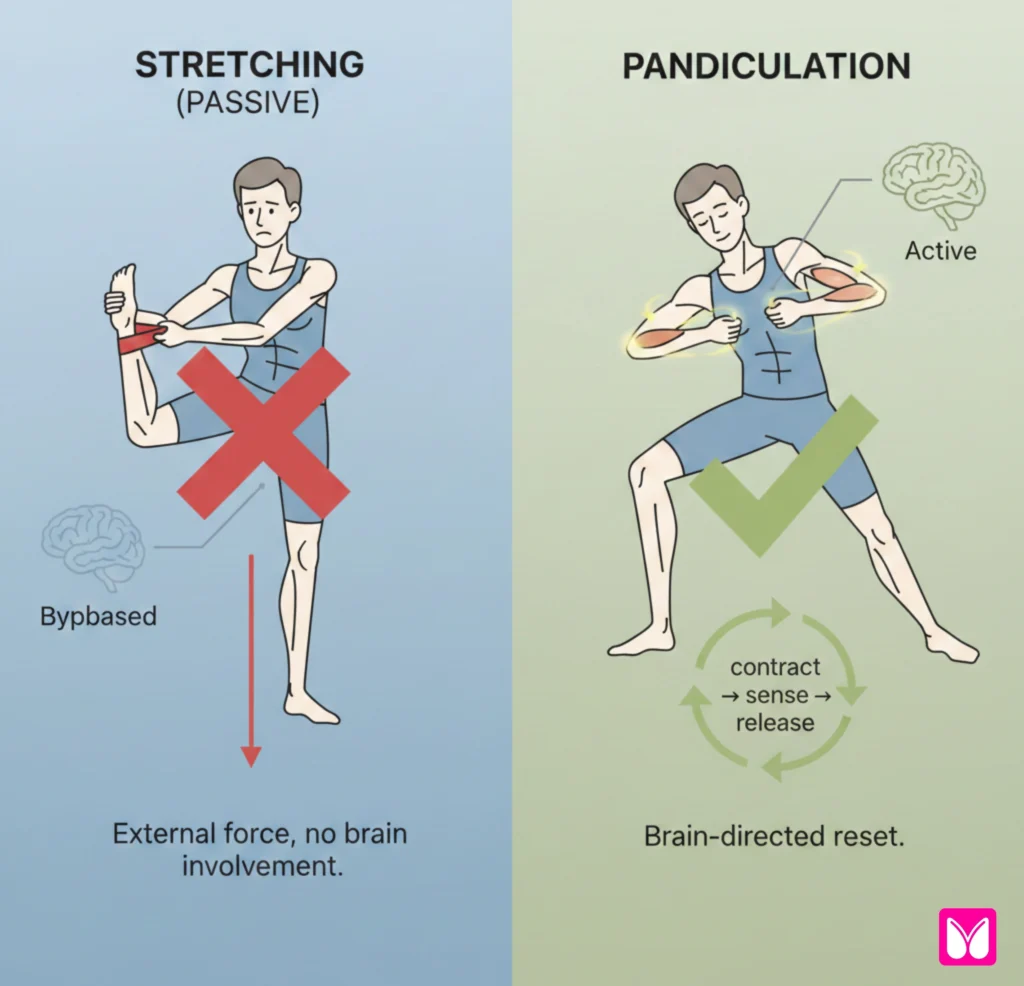
Stretching:
- Pulls on muscles from the outside
- Bypasses the brain’s control
- Can trigger protective bracing
- Works on length, not the nervous system
Pandiculation (Somatic Movement):
- Contract muscles deliberately
- The brain senses the contraction
- Slowly releases with full awareness
- Retrains the brain’s motor control
- Actually updates your nervous system software
This is why your cat is more relaxed than you are. They pandiculate multiple times a day. You stretch and wonder why you’re still tense.
Why “Pushing Through” Always Backfires
Here’s what happens in your body when you try to force relaxation:
You think: “I need to stretch deeper to release this tension.”
Your nervous system interprets: “We’re being forced into vulnerability. THREAT DETECTED.”
Your body responds: Activates the startle reflex, contracts muscles MORE, reinforces protective patterns.
Result: You’re practising tension, not releasing it.
For a nervous system that’s stressed, traumatised, or chronically activated:
Forcing depth = triggers defence
Holding long = activates freeze
Ignoring discomfort = teaches dissociation
Following external cues = abandoning internal wisdom
This is why people with trauma or chronic stress often feel WORSE after “relaxing” yoga classes. The poses themselves are triggering a protective response
The False Calm Problem (What Everyone Misses)
“But I Feel Relaxed After Class!” (Do You Really?)
I hear this all the time:
“But I do feel better after gentle yoga. I feel calm. How can you say it’s not working?”
Let me ask you something:
- How long does that calm last? Hours? Days? Or does it evaporate by bedtime?
- Do you feel energised afterwards or exhausted?
- Does your sleep improve, or do you still wake up at 3 AM?
- Are you processing emotions, or avoiding them?
- Does the tension stay gone, or return within 24 hours?
There’s a crucial difference between relief and regulation.
Relief = Temporary suppression of symptoms
Regulation = Your nervous system learned something new and can maintain balance on its own
Most “gentle yoga” provides relief. Brief. Temporary. Surface-level.
Real somatic practice creates regulation.
Lasting.
Deep.
Structural.
The Collapse Trap: When “Calm” Is Actually Shutdown
Here’s something most yoga teachers don’t understand about trauma and the nervous system:
Lying still can trigger a freeze response, not a safety response.
When your body goes into dorsal vagal shutdown, it feels like:
- Heavy limbs
- Emotional numbness
- Foggy mind
- “I don’t care” feeling
- Exhaustion that sleep doesn’t fix
- Disconnect from your body
Many people mistakenly believe this to be a form of “deep relaxation.”
It’s not. It’s your nervous system giving up.
True regulation occurs in ventral vagal safety, where you’re calm but alert, grounded yet engaged, relaxed yet responsive.
If you’ve ever experienced:
- Feeling depleted after a “restorative” class
- Emotional numbness during savasana
- Increased anxiety hours after a gentle session
- Crying suddenly during or after class (without feeling better)
- Tightness returning within hours
You weren’t regulating. You were triggering a freeze response, and your system is still trying to complete it.
Why the Tension Always Comes Back
Your body is trying to tell you something.
That chronic shoulder tension? That tight jaw? That shallow breath?
They’re not random. They’re protective patterns your nervous system created to keep you safe—often years or decades ago.
A pose can’t release them. A breath count can’t override them. Telling yourself to “just relax” definitely can’t fix them.
What can?
Teaching your nervous system that it’s safe enough to let go.
And that requires somatic intelligence—not pose shapes.
The Ancient Wisdom Everyone Misinterprets (The Scholar’s Truth)
Patanjali Never Taught Asana for Flexibility
Let’s return to the foundational text of yoga, the Yoga Sutras.
When viewed through the lens of the eight limbs of yoga, it becomes clear that modern posture-obsessed yoga is only a small fragment of the original system.
Patanjali’s definition of yoga: Yogaś citta-vṛtti-nirodhaḥ-“Yoga is the cessation of mental fluctuations.”
Notice what’s NOT in that definition:
- No mention of flexibility
- No instruction to “get into shapes.”
- No goal of achieving specific poses
- No emphasis on physical performance
The goal was always stillness of mind.
But here’s what modern yoga forgot:
The mind doesn’t settle if the body is still signalling a threat.
Your thoughts can’t quiet if:
- Your jaw is clenched (signalling danger to the brainstem)
- Your psoas is contracted (preparing for fight or flight)
- Your breath is held (oxygen deprivation stress)
- Your shoulders are braced (protecting your heart and throat)
Vṛtti Nirodha—the stilling of mental fluctuations happens in the body first.
This is why all the meditation, mindfulness, and “calming thoughts” in the world won’t work if your body is still broadcasting “DANGER” to your brain 24/7.
Somatic Practice as True Pratyahara
Pratyahara is the fifth limb of yoga. It’s usually translated as “withdrawal of the senses” or “turning inward.”
But most people think this means:
- Close your eyes
- Block out external stimuli
- “Go internal” mentally
That’s not what it is.
True pratyahara is sensing the internal landscape of your body with precision:
- Where is my jaw gripping?
- Where are my hips guarding?
- Where is my psoas holding?
- Where is my breath suspended?
- Where am I bracing without knowing it?
This is where awareness becomes regulation.
You’re not trying to force your body to relax. You’re developing the sensitivity to notice what’s actually happening—and that awareness itself begins to change the pattern.
The Tapas of Stillness: Why Less Is More
Tapas in yoga philosophy is often translated as “discipline” or “heat.”
But there’s a deeper meaning: the intense focus required to stay present with discomfort without reacting.
Here’s the counterintuitive truth:
It’s harder—and more transformative—to move one inch with full somatic awareness than to do 60 minutes of flowing shapes on autopilot.
Stillness is not passive. It’s neurologically demanding.
When you hold child’s pose while actually tracking every micro-sensation, every impulse to shift, every moment of resistance, that’s when change happens.
Most people in “gentle yoga” are dissociating, checking out mentally while holding shapes. They think they’re relaxing, but they’re practising the opposite of embodiment.
Real somatic yoga demands:
- Fierce presence
- Continuous internal awareness
- Willingness to feel discomfort without fixing it
- Patience with your nervous system’s pace
This is the tapas modern yoga forgot.
What Actually Works (The “Real Truth” Sequence)
Let me be clear about something:
These are not poses to collect. These are somatic interventions.
The shapes don’t matter. What matters is how you engage with your internal experience while doing them.
1. Somatic Neck Release: Where Safety Actually Begins
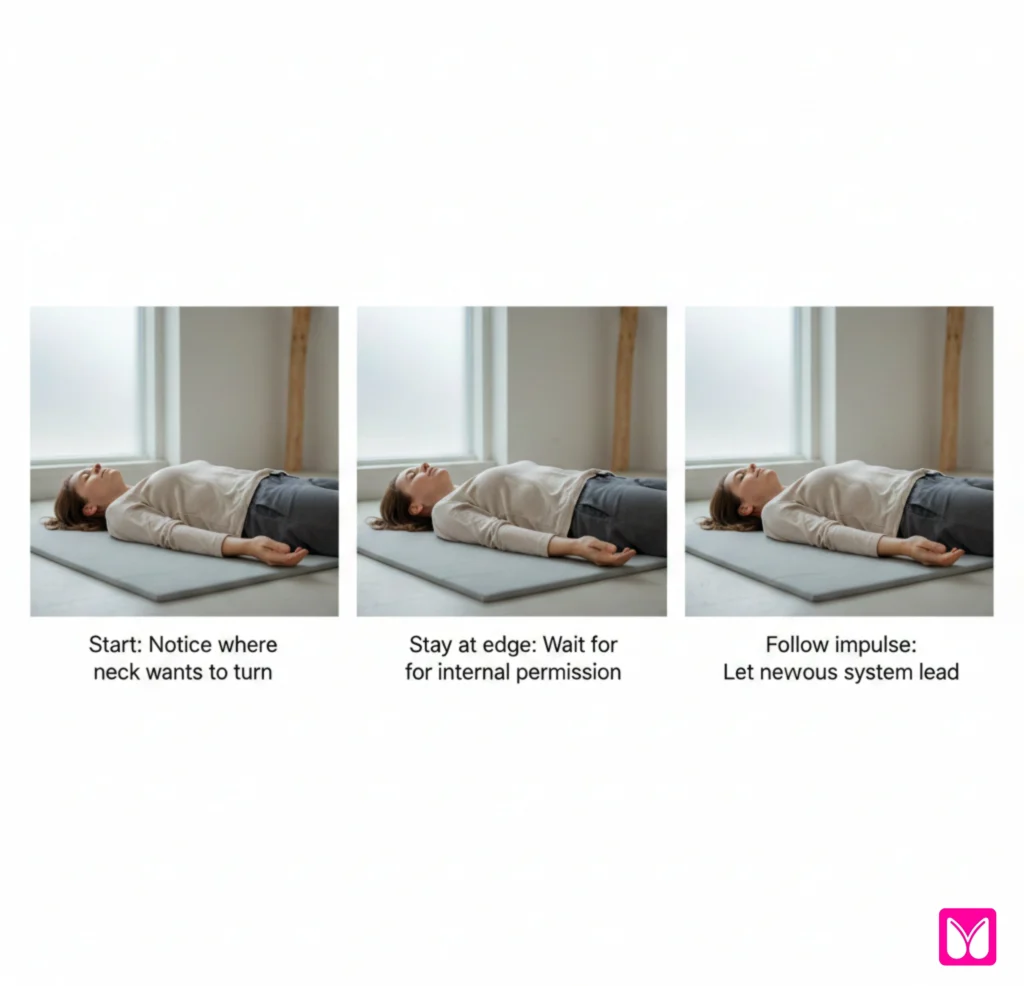
Not a neck stretch. A neural reset.
Your upper cervical spine (the top of your neck) houses part of the vagus nerve. Your jaw, neck, and breath are intimately connected through fascia and nerve pathways.
Why this matters:
When your neck is chronically tight, it’s not just a matter of muscle tension. It’s your nervous system maintaining a protective brace—often from years of stress, trauma, or hypervigilance.
The somatic approach:
Instead of stretching your neck (which triggers more bracing), you:
- Gently turn your head and notice where it wants to stop
- Stay at that edge, not past it
- Breathe softly and track the sensation
- Wait for your nervous system to give permission to move further
- Maybe it does, maybe it doesn’t, you follow internal signals, not external goals
What’s happening internally:
You’re teaching your brainstem: “We’re safe enough to soften the vigilance guard.” This is where ventral vagal safety begins.
2. Trauma-Informed Psoas Release: The Survival Tissue Nobody Understands
The psoas doesn’t relax when pulled. It relaxes when the nervous system receives a clear signal of safety.
Your psoas is the deepest core muscle in your body. It connects your spine to your legs.
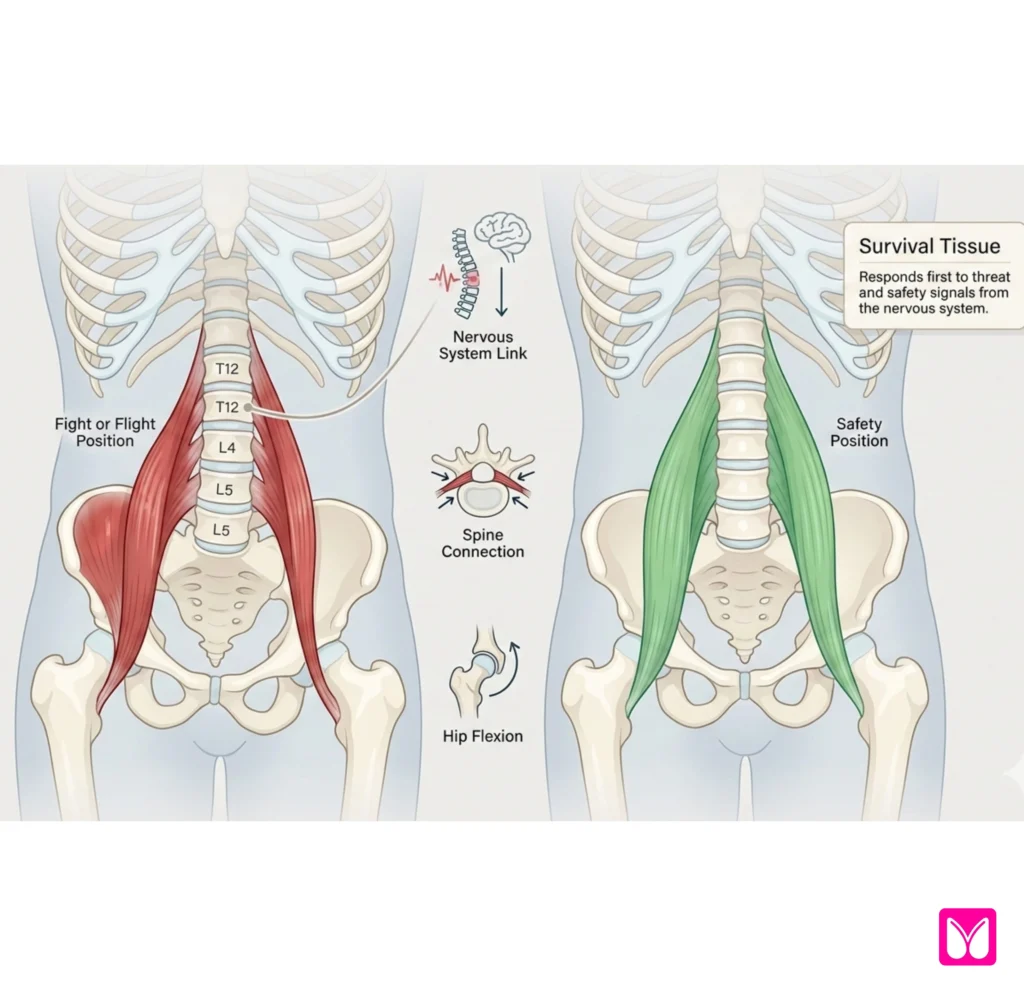
It’s also intimately connected to your fight-or-flight response.
What most yoga gets wrong:
Traditional hip openers try to “stretch” the psoas by pulling it. This often triggers a protective contraction because the psoas is survival tissue—it prepares you to run, fight, or curl into protection.
The somatic truth:
The psoas releases when your nervous system feels safe enough to let go of the “ready to flee” position.
The approach:
Instead of forcing your hips open:
- Lie on your back with knees bent, feet flat
- Notice if your lower back is arched (psoas holding)
- Very gently, press one foot into the floor while sensing the psoas
- Do not stretch—just sense where it’s working, where it’s bracing
- Breathe into the sensation
- Let it soften in its own time
This is the difference:
You’re not targeting flexibility. You’re communicating with your survival system.
3. Fascial Unwinding: When Your Body Leads the Way
No shapes. No rules. Pure somatic intelligence.
This is where somatic yoga completely diverges from traditional practice.
In fascial unwinding:
- There is no “correct” position
- You move based on internal impulse, not external instruction
- Your body makes micro-movements that look “weird” to an observer
- You might shake, spiral, twist in ways that don’t match any yoga pose
- You’re following fascial tension patterns as they release
What this looks like:
You might start in child’s pose, then feel an impulse to shift your hips slightly left. Then your shoulder wants to rotate. Then your head wants to turn. Then everything goes still for two minutes.
To an outside observer, it looks random.
To your nervous system, it’s precise.
This is a real-time regulation. This is trauma completing its cycle. This is your body finally being allowed to do what it’s been trying to do for years.
Most yoga teachers will never teach you this because it can’t be standardised, photographed, or sold as a sequence.
But this is where profound healing happens.
The Direct Rebuttal (Why Mainstream Wellness Is Wrong)
What Big Wellness Says:
“Hold this pose for 30 seconds to reduce stress.”
“Do these 10 poses for anxiety relief.”
“Practice this sequence daily for nervous system healing.”
The implied message: If you do the poses correctly and consistently, your nervous system will heal.
What Somatic Yoga Reveals:
If you hold a pose while your nervous system feels unsafe, you are practising tension, not releasing it.
Time holds no meaning without internal permission.
The shape achieved means nothing without somatic awareness.
Consistency means nothing if you’re reinforcing protective patterns.
The Efficiency Verdict
Let me be direct:
5 minutes of true somatic regulation outperforms 60 minutes of power yoga, yin yoga, or aesthetic “gentle” yoga in terms of trauma recovery and nervous system health.
Not because those other styles are “bad.” They serve different purposes.
However, if your goal is nervous system regulation, trauma healing, or resolving chronic tension patterns, somatic intelligence is non-negotiable.
You can do a thousand child’s poses. But if you’re dissociating in every single one, your nervous system hasn’t learned anything new.
Alternatively, you can spend 5 minutes in one position, tracking internal sensations with fierce presence, allowing micro-movements, and following fascial impulses—and create lasting change.
One is the yoga theatre. The other is nervous system communication.
The Choice to Actually Heal (Not Just Perform Wellness)
The Final Truth
Stop collecting poses.
Stop chasing the “perfect” gentle yoga sequence.
Stop waiting for the right teacher, the right app, the right environment.
Start mastering how your nervous system receives safety.
That’s real yoga.
That’s real healing.
That’s what the ancient texts were pointing toward all along.
The Path Forward
If you’re ready to stop performing relaxation and start actually regulating:
- Stop forcing shapes. Start tracking sensation.
- Stop holding time. Start following internal impulses.
- Stop ignoring discomfort. Start dialoguing with it.
- Stop dissociating. Start embodying.
This is harder than following a pose list. It requires presence, patience, and the courage to feel what you’ve been avoiding.
But it’s the only path to lasting change.
Your Nervous System Is Waiting
It’s been trying to tell you something for years, maybe decades.
Through that tight jaw. Through those tense shoulders. Through that shallow breath and broken sleep.
It’s not broken. It’s brilliant.
It created these patterns to protect you. And now it’s ready to let them go—if you’re willing to listen.
That’s what somatic yoga actually is: Learning to listen to the wisdom your body has been screaming at you all along.
Not with your mind. With your cells. With your fascia. With your breath. With your nervous system.
Frequently Asked Questions
1. How is somatic yoga different from yin yoga or restorative yoga?
ANS: Yin and restorative yoga focus on long holds and passive stretching, which can be valuable. But they don’t necessarily engage somatic awareness or nervous system communication. You can do yin yoga while completely dissociated. Somatic yoga requires active internal awareness and following your body’s impulses, rather than holding predetermined shapes.
2. Can I practice somatic yoga if I have trauma?
ANS: Yes—in fact, somatic approaches are specifically trauma-informed. Unlike traditional yoga that might push you past your window of tolerance, somatic practice respects your nervous system’s pace. However, working with a trauma-informed somatic practitioner is ideal, especially when starting.
3. How long does it take to see results?
ANS: Unlike pose-based yoga, where you might see flexibility gains in weeks, somatic nervous system changes can be felt immediately (a sense of relief, better sleep that night) but take months to stabilise. You’re retraining decades of patterns—this requires patience and consistency.
4. Do I need special training to practice somatic yoga?
ANS: While working with a trained somatic practitioner is ideal, you can begin practising somatic awareness on your own. The key is shifting from “doing poses correctly” to “tracking internal sensation.” Start by simply noticing where you’re holding tension during any movement—that’s the beginning of somatic intelligence.
5. Is somatic yoga “real” yoga according to traditional texts?
ANS: Absolutely. Patanjali’s Yoga Sutras focus on cessation of mental fluctuations (Vṛtti Nirodha), which requires body awareness and nervous system regulation—the core of somatic practice. Modern pose-focused yoga is actually a departure from traditional approaches, not somatic ones.
Ready to experience what your body has been trying to tell you? Discover practices that honour your nervous system’s wisdom—not just pose shapes that look good on Instagram.
About This Article
This article reflects the philosophical inquiry, lived practice, and critical perspective of Nandini Sharma, founder and guiding voice behind Mindfullyoga. As a long-term student of the Yoga Sutras, Hatha Yoga Pradipika, and somatic movement therapy, Nandini is the author of the philosophical and experiential insights presented in this work.
Her writing draws from years of personal practice, study, and observation of how modern wellness culture intersects with nervous system health and the original intent of yoga as a path toward genuine healing.
Content Strategy & SEO Optimization:
The structure, formatting, and search optimization of this article were supported by Emmanuel Okafor, Content Strategist, to ensure these insights remain accessible and discoverable, without altering the philosophical voice or conclusions of the author.
This content is intended for educational and reflective purposes only and does not replace personalized medical or therapeutic advice.

Emmanuel Okafor
Emmanuel Okafor is a skilled SEO specialist and content writer with hands-on experience in optimizing websites for visibility, traffic, and authority.Emmanuel has contributed to the growth of several startups across various niches, including AI, technology, health, and mental well-being. He is passionate about storytelling, digital marketing, and helping brands meaningfully connect with their audience online.