
-
 by
Emmanuel Okafor
by
Emmanuel Okafor - December 30, 2025
- 0 Comments

Table of Contents
Let me tell you a story that changed everything I thought I knew about prenatal yoga.
It was March 2024, and Emily joined our online session, tears streaming down her face as she clutched her 16-week ultrasound report.
She had just been rushed to the hospital after a yoga session. Her pregnancy was fine, thank God. But the doctor’s words still echoed in her mind.
“You did a full wheel pose?” the doctor had asked, disbelief clear in her voice. “At four months pregnant? Who told you that was safe?”
Emily had followed a YouTube video. A popular one. Over 2 million views. The instructor never mentioned pregnancy modifications. Emily thought that if she could do the pose before pregnancy, she could also do it during pregnancy.
She was wrong.

I had seen this story too many times before.
Dedicated yogini.
Healthy pregnancy.
But lack of proper guidance almost cost her everything.
What happened next is why I’m writing this comprehensive guide today.
We didn’t just help Emily recover. We rebuilt her entire understanding of safe prenatal yoga from the ground up, from scratch. Not with complicated restrictions that made her afraid to move. Just with the right knowledge, the right modifications, and the right respect for what her body was creating.
Thirty days later, Emily was practising daily again. But this time, safely. For those new to yoga entirely, starting with basic yoga poses for beginners can help build the foundation you’ll need for a safe prenatal practice.
Her energy returned.
Her back pain disappeared.
Her confidence in her changing body grew stronger every single day.
She called me after her delivery with news that made me cry, too—smooth labour. Healthy baby girl. The doctor credited her modified yoga practice with her excellent stamina during labour and delivery.
“I thought I had to choose between yoga and my baby’s safety,” she told me through happy tears. “The problem wasn’t yoga. I did not know which poses to avoid during pregnancy.”
That is exactly why we created this guide to safe prenatal yoga at home.
Why Most Pregnant Women Get Prenatal Yoga Safety Wrong (And How to Get It Right)
Before I tell you which yoga poses to avoid during pregnancy, let me tell you what this guide won’t do:
I won’t ask you to stop practising yoga completely. I won’t give you a fear-based list without explaining the why. I won’t ignore the incredible benefits of prenatal yoga when done correctly, and I won’t treat all nine months the same way
Because that’s not how safe prenatal yoga at home works.
Let me be honest with you: Prenatal yoga is not dangerous. But it is specific.
The difference between a yoga practice that supports your pregnancy and one that puts you at risk is not luck.
It’s knowledge.
It’s awareness.
It’s understanding how your body changes each trimester and which poses honour those changes.
The Truth About Pregnancy and Yoga That Nobody Explains Properly

Here’s what happens to most pregnant women when they try to continue their yoga practice:
First Trimester: You feel fine. Your body looks the same. You think you can do everything you did before. You push through poses that compress your abdomen.
Second Trimester: Your belly grows. You try to modify on your own. You avoid lying on your back because someone told you to, but you’re not sure why. You do deep twists without realising the risk.
Third Trimester: Everything feels harder. You’re afraid to do anything. Or worse, you’re still doing poses that were safe in month 4 but dangerous in month 8.
I’ve watched this pattern repeat itself across hundreds of expecting mothers in our online classes. And the problem is always the same:
They’re trying to learn about prenatal yoga safety from general yoga content that isn’t specifically designed for pregnancy. Many pregnant women continue practising yoga at home without understanding the critical modifications needed during pregnancy.
Let me tell you something critical: Your body during pregnancy is not the same body you had before conception.
Your joints are looser (thank you, relaxin hormone). Your centre of gravity shifts dramatically. Your blood volume increases by 50% Your abdominal muscles are stretching and separating. Your baby needs a consistent oxygen flow. Your blood pressure regulation changes
A yoga practice that doesn’t account for these changes isn’t only ineffective but also potentially harmful. It’s potentially dangerous.
The Day Everything Changed: How One Student Taught Me the Real Risks
In June 2023, a prenatal yoga teacher trainee in our online program taught me a lesson I’ll never forget.
Brittany was a certified yoga instructor. Eight years of experience. She had trained hundreds of students. When she got pregnant, she thought she knew exactly what to do.
Good teacher.
Strong practice.
But dangerous assumptions.
She had tried everything:
- Continued her regular Ashtanga practice (modified breathing, but kept the poses)
- Did full inversions “because her body was used to them.”
- Practised intense core work to “stay strong.”
By her second trimester, something was wrong.
Severe abdominal pain.
Diastasis recti (abdominal separation) that her doctor said was “the worst she’d seen.”
Risk of early labour.
She was put on modified bed rest. No yoga. No teaching. Just worry and fear.
When she came to me after her delivery (thankfully, a healthy baby boy), she said something I’ll never forget:
“I thought being an experienced yogi meant I could trust my body’s signals during pregnancy. But pregnancy signals are different. What felt fine was actually causing damage. I didn’t know what to look for.”
Let me tell you what happened next, because this is exactly what separates dangerous prenatal yoga practice from safe prenatal yoga at home.
The Three Principles That Keep You and Your Baby Safe
We didn’t create an overcomplicated system. We distilled eight years of working with over 3,000 pregnant women into three clear principles:
Principle 1: What Was Safe Before Pregnancy May Not Be Safe During Pregnancy
Your body is fundamentally different now. Stable ligaments are now elastic. Core muscles that were engaged are now stretched. Blood that circulated easily now needs to work harder.
That advanced pose you loved? It may compress your vena cava (the major vein that returns blood to your heart). That deep twist? It could restrict blood flow to your uterus. That intense core work? It could worsen abdominal separation.
Principle 2: Every Trimester Has Different Rules
Months 2 and 8 are not the same. What’s safe in your first trimester becomes risky in your third. The poses you need to avoid change as your baby grows.
Most pregnancy yoga guides provide a single blanket list. That’s lazy and potentially dangerous. We’ll break this down properly.
Principle 3: “Listening to Your Body” Isn’t Enough
This is a controversial statement, but it’s true. During pregnancy, your body’s normal warning signals can be delayed or masked by hormones.
You might feel fine doing a pose that’s compressing blood flow to your baby. You might feel strong while doing a pose that creates excessive intra-abdominal pressure. You may not feel the damage until it’s too late.
This is why knowledge comes before intuition during pregnancy.
Now, let me show you exactly which poses to avoid and why.
Poses to Avoid During Pregnancy: The Complete Trimester-by-Trimester Guide
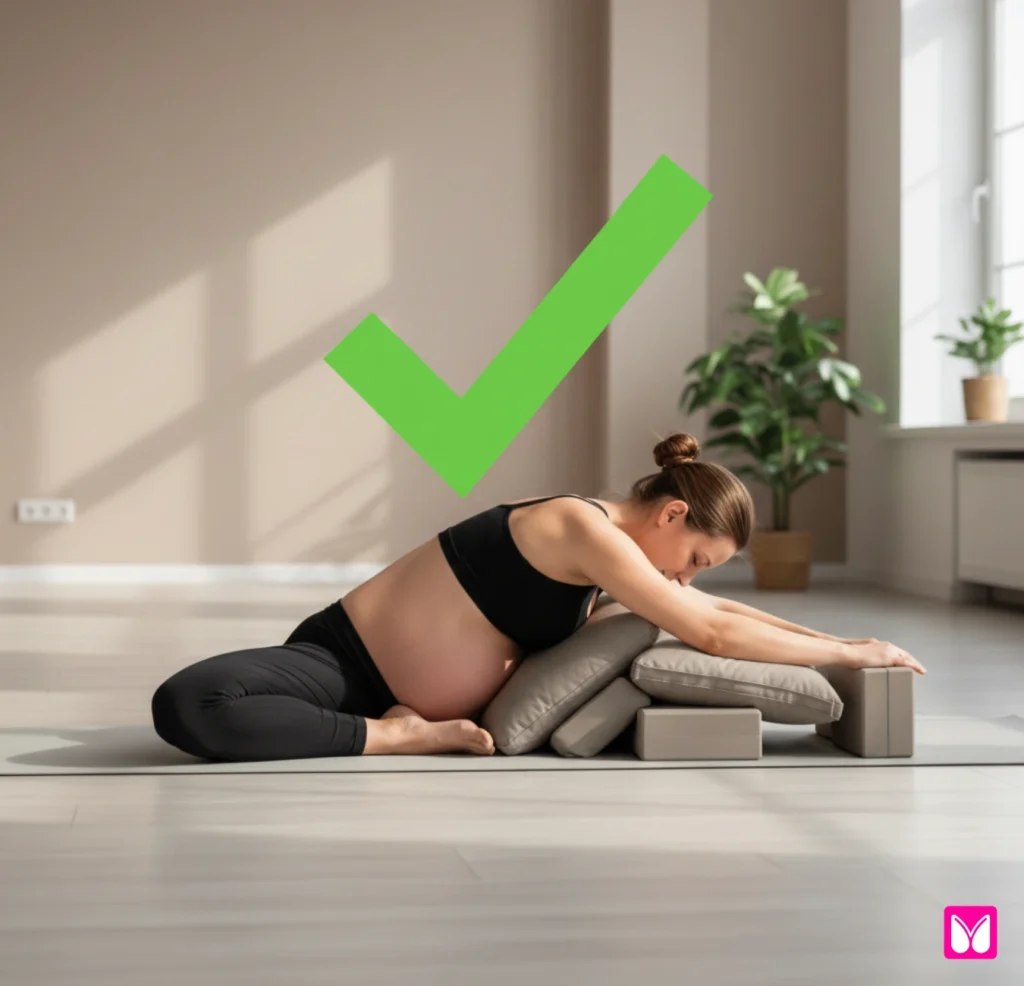
First Trimester (Weeks 1-12): The Foundation Phase
Your belly isn’t showing yet. You might not even feel pregnant. This is the most dangerous time for assumptions.
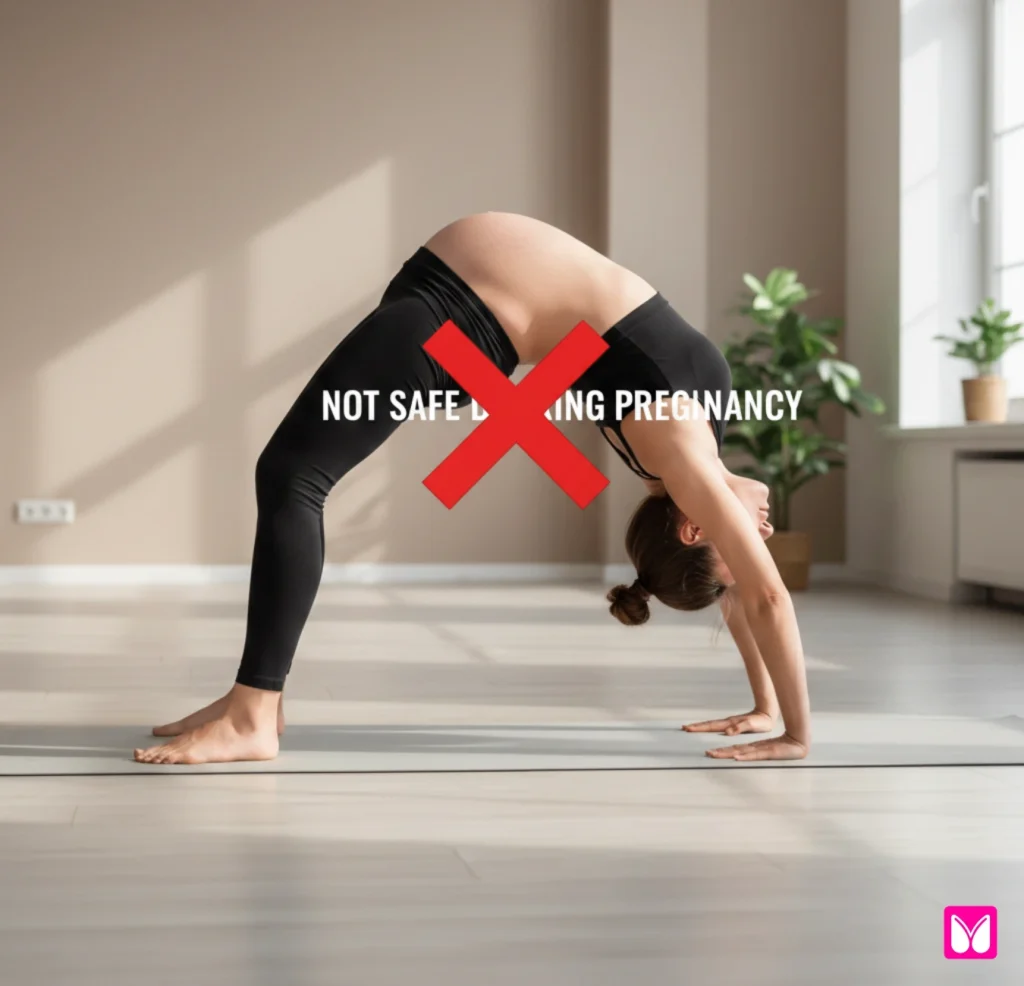
Deep Backbends to Avoid
Full Wheel Pose (Chakrasana / Urdhva Dhanurasana)
Why avoid: Creates intense abdominal stretching and intra-abdominal pressure. Compresses the lumbar spine excessively.
What happens: It can restrict blood flow to the developing embryo. Increases the risk of implantation issues in early pregnancy.
Camel Pose (Ustrasana) – Full Expression
Why avoid: Deep backbends put pressure on the kidneys (already working overtime during pregnancy). Creates excessive arch in the lower back when relaxing, which loosens your ligaments.
What happens: It can cause severe lower back pain that lasts throughout pregnancy, and potentially cause kidney stress.
Bow Pose (Dhanurasana)
Why avoid: Compresses the entire front body, including your abdomen, where your baby is beginning to grow.
What happens: Direct pressure on the uterus. Restricted blood flow. Unnecessary risk during the crucial first trimester.
Safe alternative: Gentle supported bridge pose with a block under your sacrum. Cat-cow stretches for spinal mobility.
Deep Twists to Avoid
Full Revolved Triangle (Parivrtta Trikonasana)
Why avoid: Deep spinal twists compress your internal organs, including your uterus. Closed twists (twisting toward your bent leg) are especially risky.
What happens: Reduces oxygen-rich blood flow to your baby. It can cause dizziness due to changes in blood pressure.
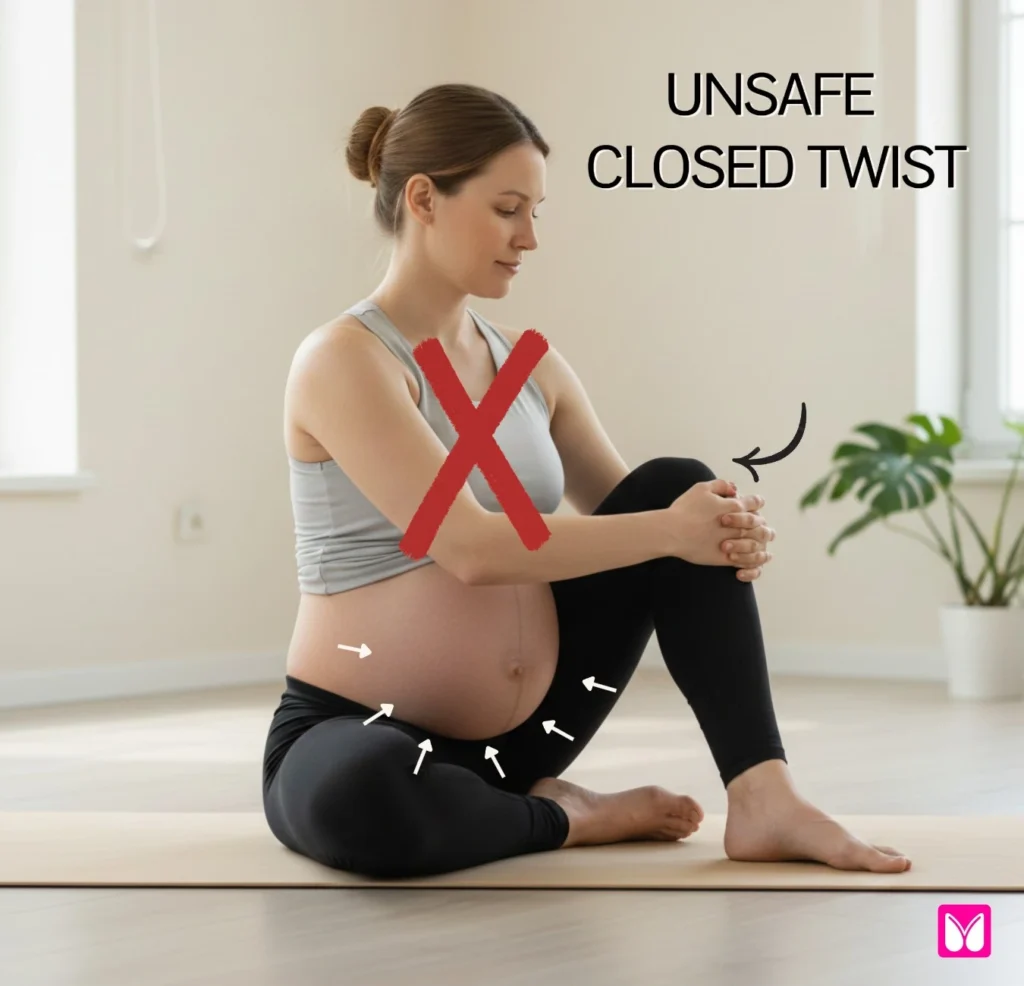
Seated Spinal Twist (Ardha Matsyendrasana) – Deep Variation
Why avoid: Compresses the abdomen and restricts the space your uterus needs to expand.
What happens: It can cause cramping. Creates unnecessary pressure during the critical phase of organ development.
Revolved Chair Pose (Parivrtta Utkatasana)
Why avoid: Combines compression with balance challenges. Adds unnecessary fall risk.
What happens: If you lose balance, you risk falling onto your abdomen. Even without falling, the twist compresses your growing uterus.
Safe alternative: Open twists only (twisting away from your bent leg). Gently seated twists with hands on opposite knees, keeping your belly open.

Core-Intensive Poses to Avoid
Boat Pose (Navasana)
Why avoid: Creates intense intra-abdominal pressure. Engages your rectus abdominis (the six-pack muscles), which are beginning to stretch and separate.
What happens: Accelerates diastasis recti (abdominal separation). It can cause an umbilical hernia. Creates downward pressure on your pelvic floor.
Plank Holds – Extended Duration
Why avoid: While modified planks are fine, holding a plank for 30 seconds or more creates sustained abdominal pressure.
What happens: Worsens diastasis recti. Increases the risk of prolapse if you have any pelvic floor weakness.
Crow Pose (Bakasana)
Why avoid: Requires intense core engagement plus balance on your hands—high fall risk.
What happens: If you fall, you fall forward onto your belly. Not worth the risk, even if you’ve done this a thousand times.
Safe alternative: Modified plank with knees down (20 seconds max). Side plank with bottom knee down. Pelvic floor engagement exercises
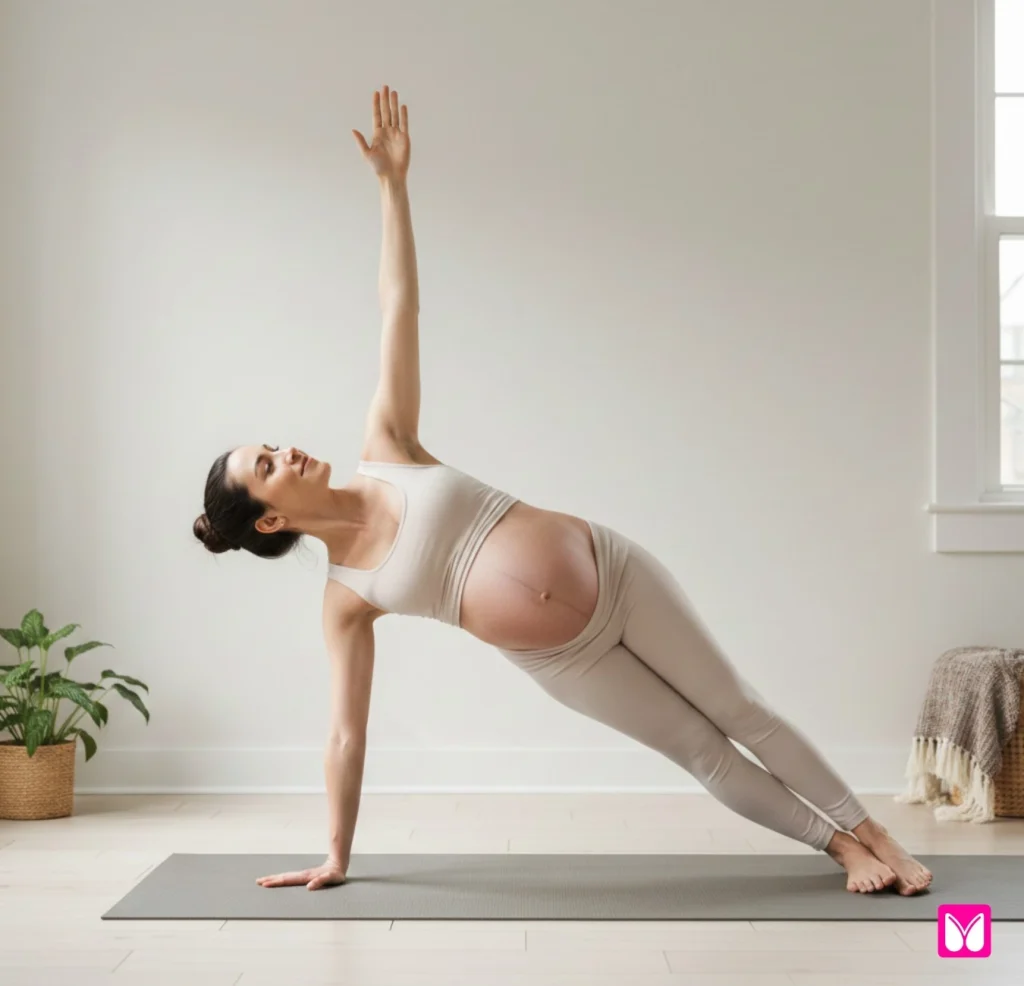
Abdominal Compression Poses to Avoid
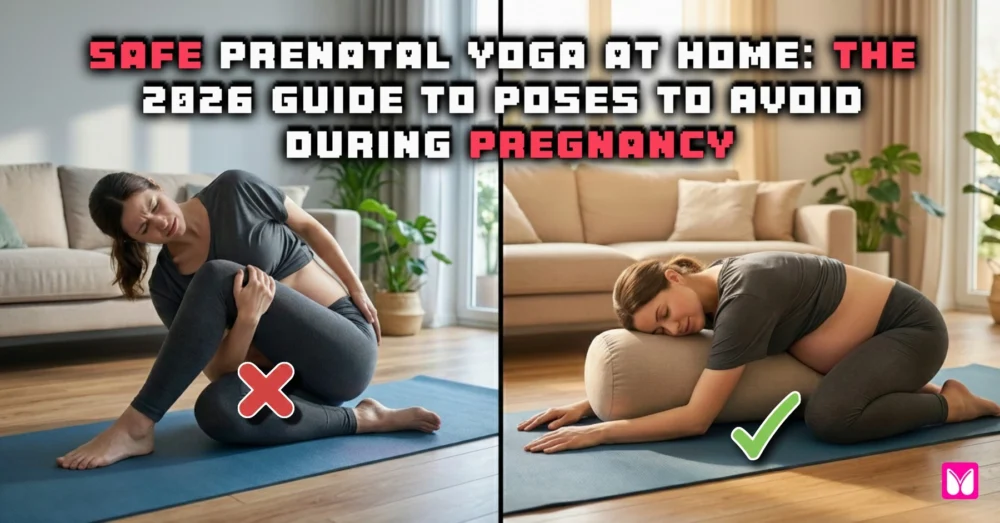
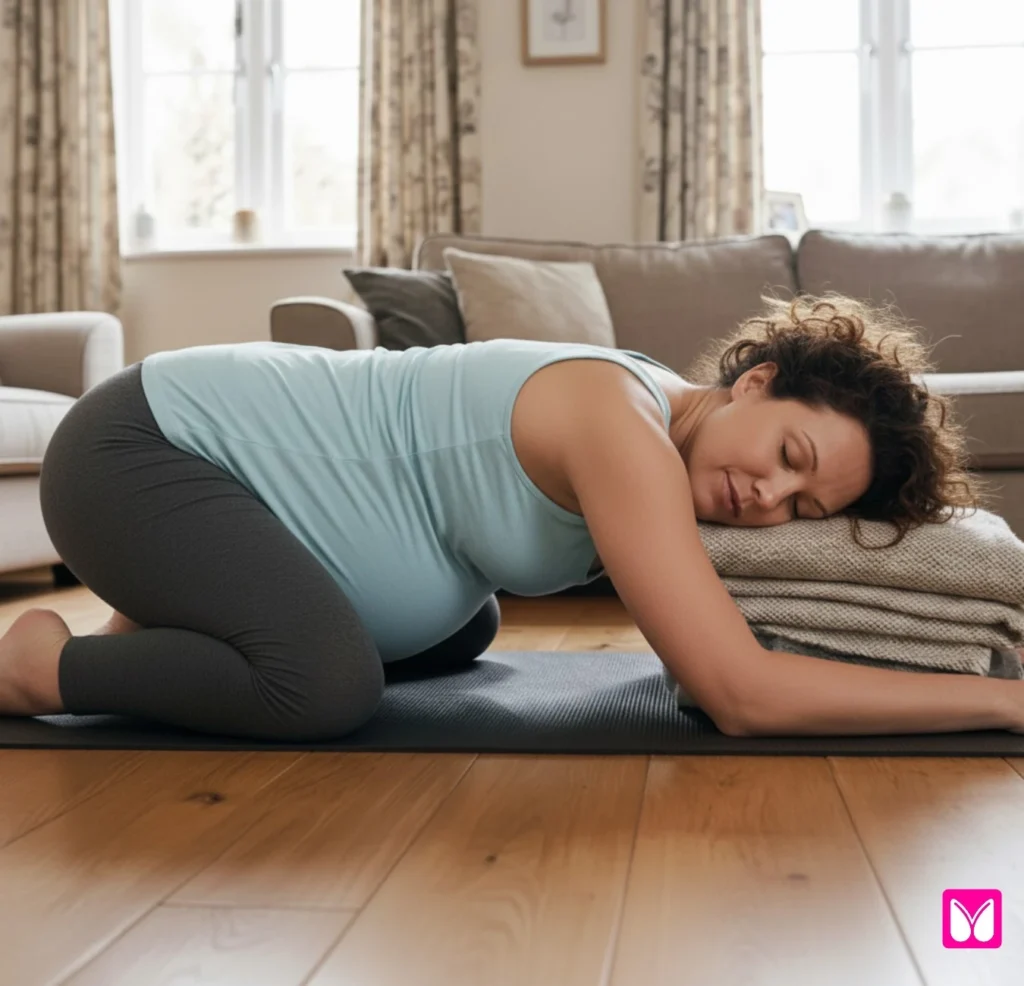
Child’s Pose with Knees Together
Why avoid: As your uterus grows (even in the first trimester), the knees-together child’s pose compresses your abdomen.
What happens: Uncomfortable pressure. Restricted breathing.
Note: Wide-knee child’s pose (knees apart, belly between thighs) is perfectly safe and actually recommended.
Belly-Down Poses (Cobra, Locust, Bow)
Why avoid: Once you’re pregnant, lying on your belly creates direct pressure on your uterus.
What happens: Unnecessary compression. Discomfort. Why risk it?
Safe alternative: Cat-cow pose for back extension. Modified cobra from hands and knees (rather than belly-down).
Second Trimester (Weeks 13-27): The Expansion Phase
Your baby is growing rapidly. Your belly is showing. This is when most pregnant women realise they need to make more serious modifications.
All First Trimester Restrictions PLUS These Additional Poses to Avoid
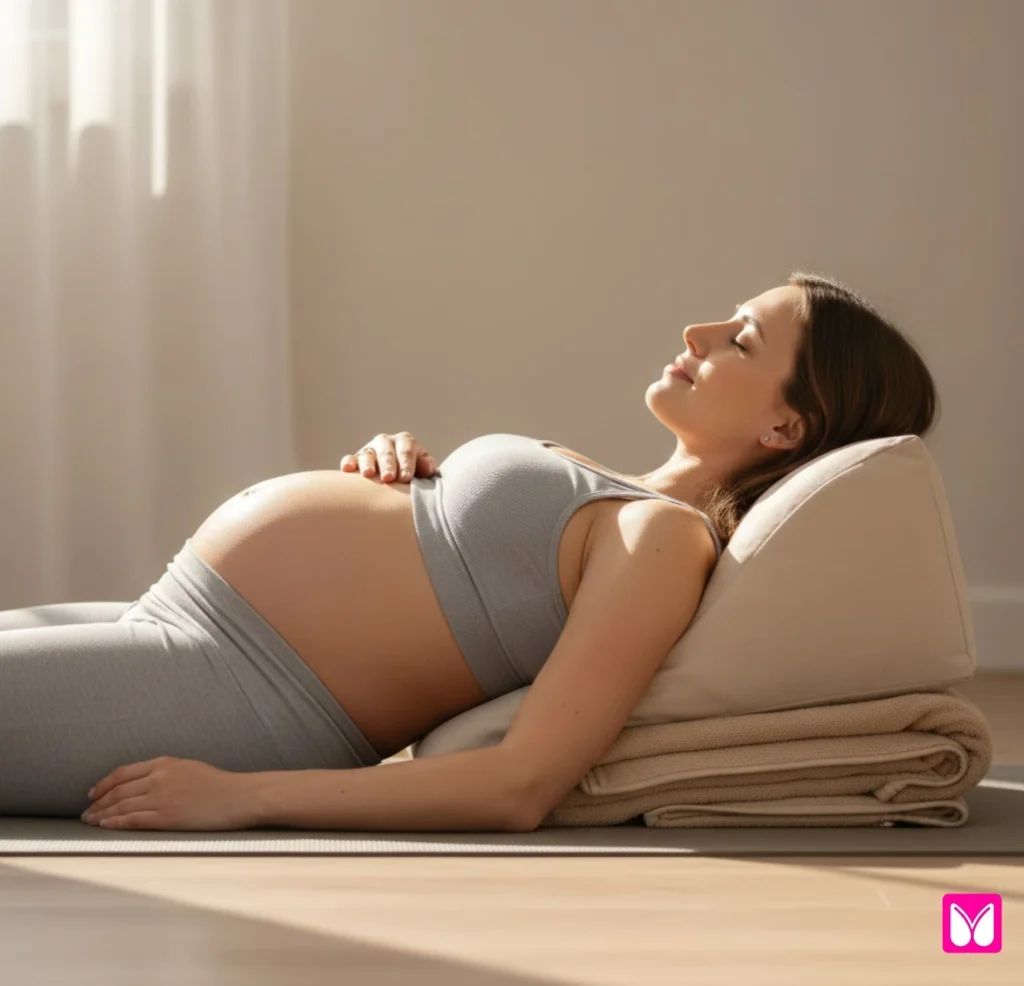
Any Pose Lying Flat on Your Back After 16 Weeks
Why avoid: Your growing uterus can compress your vena cava (the large vein that returns blood to your heart) when you lie flat.
What happens: Supine hypotensive syndrome. Dizziness. Nausea. Reduced blood flow to your baby. Some women feel fine (which is why it’s dangerous—you might not feel the reduced blood flow to your baby).
Poses to avoid:
- Supine leg raises
- Lying twists
- Regular Savasana (corpse pose on your back)
- Any ab work on your back
Safe alternative: Always use a wedge or folded blankets to elevate your upper body at least 30 degrees—such as Side-lying Savasana (preferred on the left side)
Full Inversions (Headstand, Shoulderstand)
Why avoid: Your centre of gravity has shifted. Your balance is off. Your blood pressure regulation is different. Even if you practised inversions daily before pregnancy, the risk now outweighs the benefits.
What happens: Risk of falling. Blood pressure changes can cause dizziness and pressure on your neck due to your increased body weight.
Safe alternative: Legs up the wall (with your back at a 45-degree angle, not flat). Downward dog (if comfortable). Supported bridge pose.
Deep Hip Openers with Pressure (Pigeon Variations)
Why avoid: Not all hip openers are bad, but aggressive pigeon pose creates pelvic instability when your ligaments are already loosened by relaxin.
What happens: SI joint pain that can last throughout pregnancy and postpartum. Pelvic instability. Potential symphysis pubis dysfunction (SPD).
Safe alternative: Gentle figure-four stretch lying on your side. Supported squat positions. Goddess pose against a wall.
Hot Yoga – Complete Avoidance Required
All Bikram and Hot Yoga Practices
Why avoid: Raising your core body temperature above 102°F (38.9°C) during pregnancy is associated with an increased risk of neural tube defects, especially in the first trimester, but this concern persists throughout pregnancy.
What happens: Your baby cannot regulate its own body temperature independently. Your increased temperature becomes your baby’s increased temperature. Dehydration. Dizziness. Increased heart rate.
Safe alternative: Room temperature yoga. Focus on breath work for internal heat rather than external heat. If you’re curious about hot yoga benefits outside of pregnancy, read our detailed analysis on hot yoga benefits and risks.
Third Trimester (Weeks 28-40): The Preparation Phase
Your body is preparing for labour. Your baby is getting into position. This is not the time to push limits.
All Previous Restrictions PLUS These Critical Additions
Standing Balances on One Leg
Why avoid: Your centre of gravity is dramatically shifted forward. Your balance is compromised. Fall risk is highest in the third trimester.
What happens: Falls during pregnancy can cause placental abruption (a medical emergency). Even without falling, the instability creates stress on your pelvis and lower back.
Poses to avoid:
- Tree pose (Vrksasana) without support
- Warrior III (Virabhadrasana III)
- Half-moon (Ardha Chandrasana)
- Eagle pose (Garudasana)
Safe alternative: All balancing poses with hand on the wall or chair. Wide-stance standing poses with both feet grounded.
Deep Squats and Sudden Position Changes
Why avoid: In late pregnancy, deep squats can encourage your baby to descend before you’re ready (if you’re before 37 weeks). Sudden position changes can cause dizziness due to fluctuations in blood pressure.
What happens: Premature labour signals. Dizziness and falls. Excessive pelvic pressure.
Exception: After 37 weeks, deep squats are actually beneficial for labour preparation, but with support and supervision.
Jumping or Jarring Movements (Jump-Throughs, Jump-Backs)
Why avoid: Impact creates stress on your already-taxed pelvic floor. Relaxin has loosened your joints. The risk of injury is high.
What happens: Pelvic floor dysfunction. Incontinence issues postpartum. SI joint or pubic symphysis injury.
Safe alternative: Step through between poses. Move slowly and deliberately. Embrace the gentler pace.
Intense Pranayama (Breath Retention, Kapalabhati)
Why avoid: Breath retention reduces oxygen to your baby. Rapid breathing exercises (such as kapalabhati) can create abdominal pumping that’s too intense during pregnancy.
What happens: The baby responds to reduced oxygen by exhibiting decreased movement or a decrease in heart rate and abdominal pressure, resulting from rapid breathing.
Safe alternative: Gentle ujjayi breathing. Natural breathing with awareness. Humming breath (Bhramari) for calm.
How to Practice Safe Prenatal Yoga at Home: Your Complete Guide
Now that you know what to avoid, let me show you how to establish a safe and beneficial prenatal yoga practice in the comfort of your own home.
Setting Up Your Safe Space
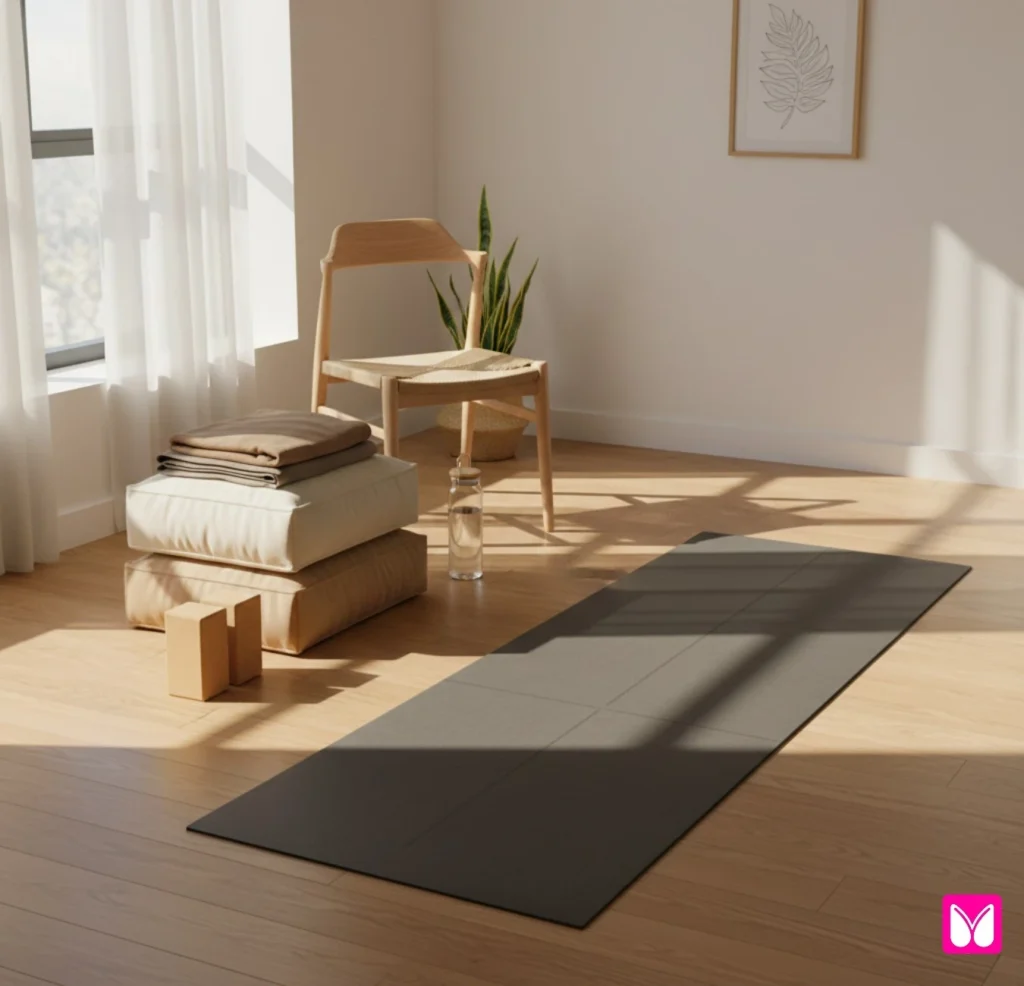
What You Need:
- Yoga mat (non-slip is crucial with your changing balance)
- 2-3 firm pillows or bolsters
- 2 yoga blocks or sturdy books
- A wall for support
- A sturdy chair
- Blankets for support and warmth
Safety Checklist Before Every Practice:
- Clear the space of any obstacles
- Ensure good ventilation (but not overly cold)
- Have water nearby (stay hydrated)
- Keep your phone accessible for emergencies
- Practice when someone else is home, especially in the third trimester
The Golden Rules of Safe Prenatal Yoga at Home
Rule 1: If It Doesn’t Feel Right, Stop Immediately
Ignore the “push through” mentality. During pregnancy, discomfort is your body’s clear warning system.
Stop if you experience:
- Any sharp pain
- Dizziness or lightheadedness
- Shortness of breath (beyond normal pregnancy breathlessness)
- Uterine contractions or cramping
- Vaginal bleeding or fluid leakage
- Reduced fetal movement after practice
Rule 2: Modify From Day One
Don’t wait until you “feel” pregnant to start modifying. Your body begins to change from the moment of conception.
Always modify:
- Use blocks to bring the floor closer to you
- Take a wider stance for better balance
- Rest whenever you need to
- Skip poses that feel wrong, even if they’re “allowed.”
Rule 3: The 80% Intensity Rule
If you could do a pose at 100% intensity before pregnancy, aim for 80% during pregnancy. And in the third trimester, aim for 60%.
This isn’t about being weak. It’s about being wise.
Your body is already working incredibly hard, growing a human. Your yoga practice should support that work, not compete with it.
Rule 4: Breathe Naturally Throughout
If you can’t maintain natural, comfortable breathing, the pose is too intense.
Never hold your breath (this reduces oxygen to your baby).
Never force rapid breathing (this creates abdominal pressure).
Keep your breath smooth, steady, and relaxed.
The Best Poses for Safe Prenatal Yoga at Home
Let me share with you the poses that are not only safe but also actively beneficial during pregnancy.
Safe Poses for All Trimesters
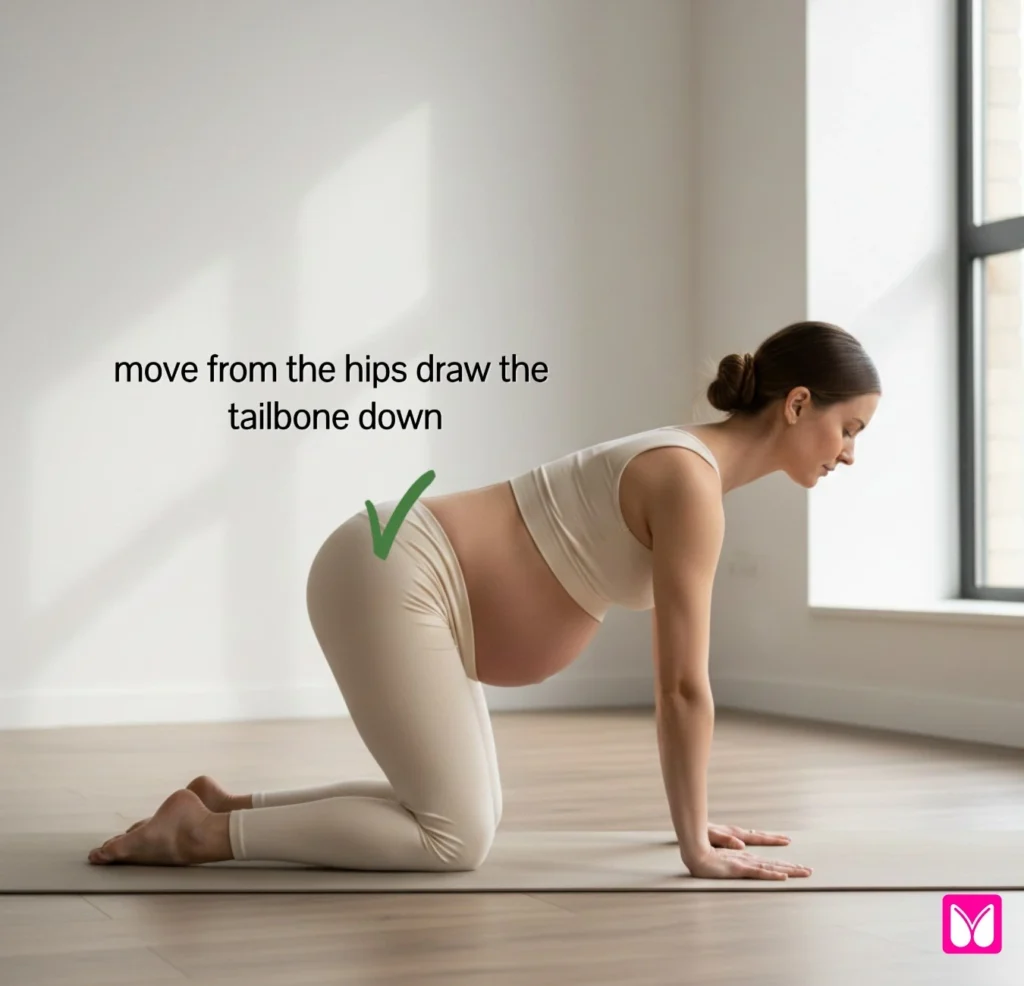
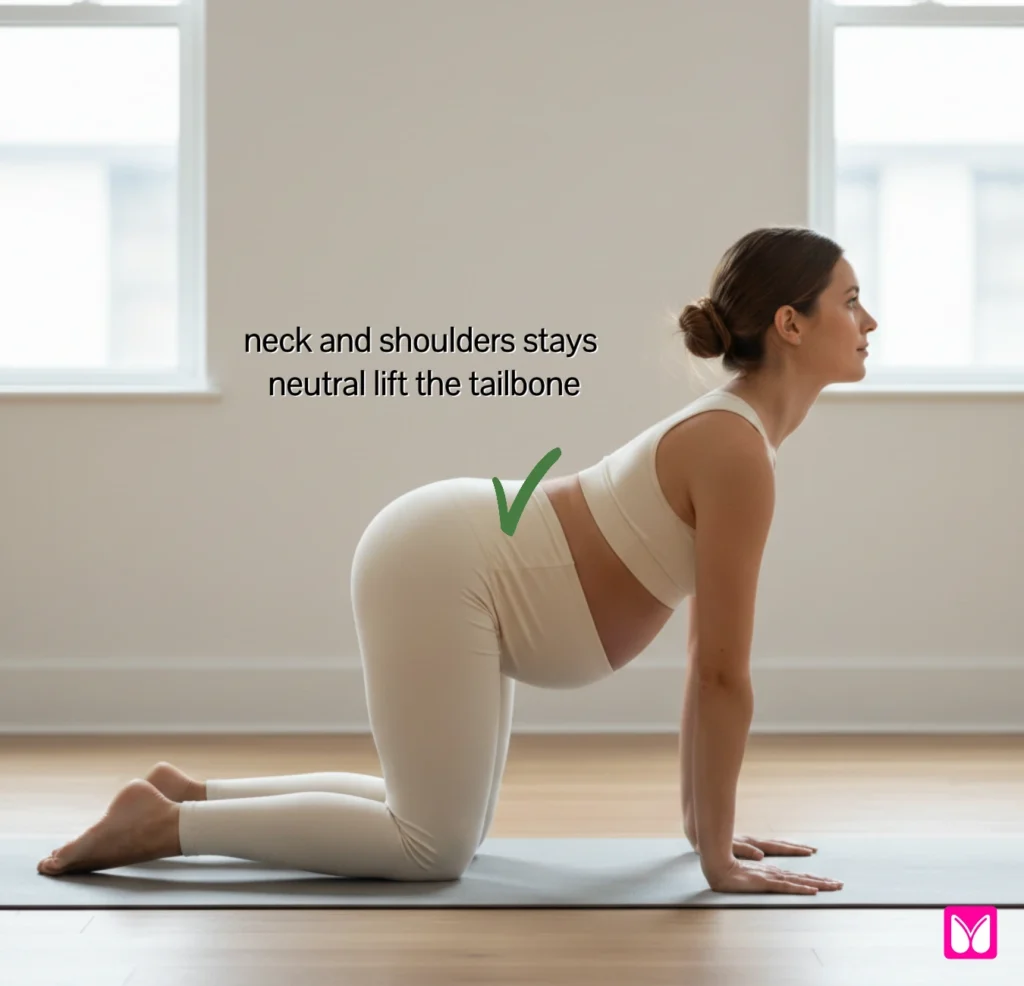
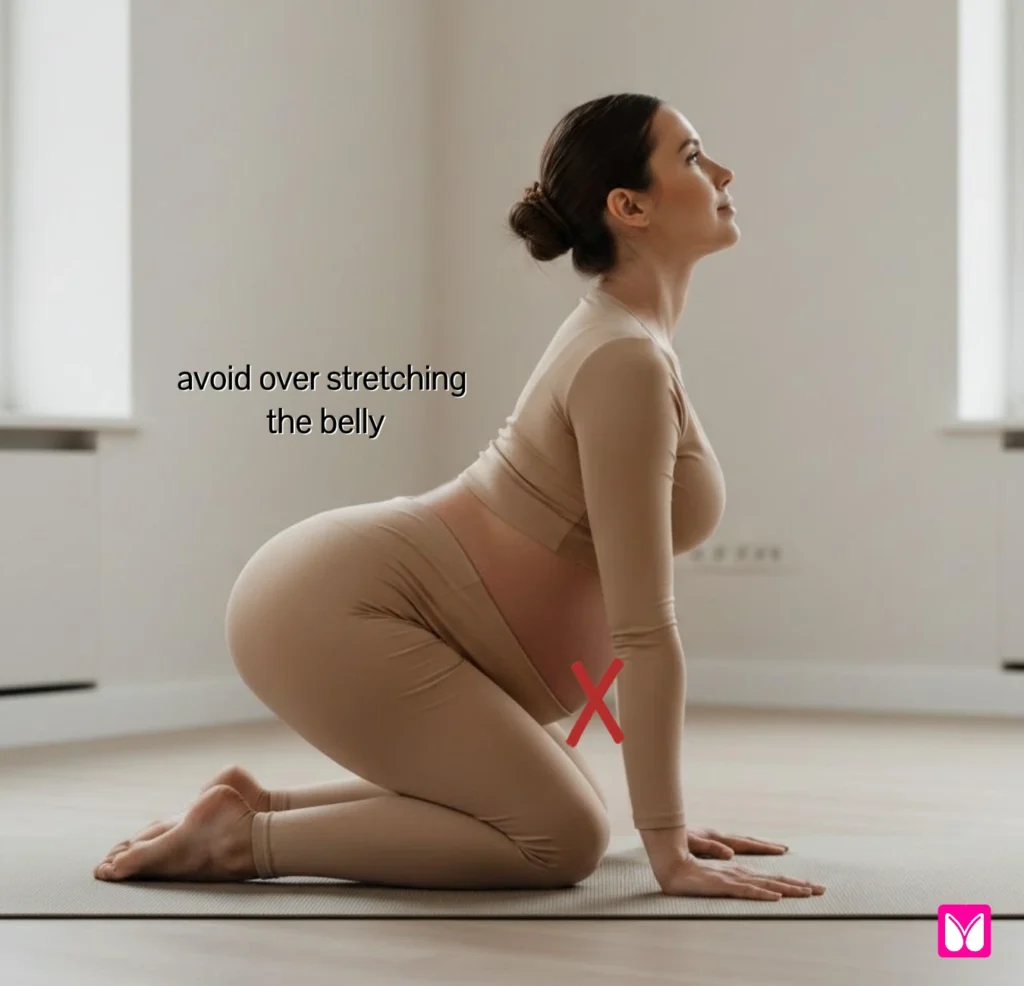
Cat-Cow Pose (Marjaryasana-Bitilasana)
Why it’s perfect: Gently mobilises your spine without compression. Relieves back pain. Creates space for your growing belly.
How to do it safely:
- Hands under shoulders, knees under hips
- Move slowly with your breath
- Keep movements gentle—no excessive arching or rounding
- Do this daily. It’s genuinely helpful for back pain and baby positioning.
Warrior II (Virabhadrasana II)
Why it’s perfect: Builds leg strength for labour. Opens hips. Improves stamina—both feet on the ground (stable).
How to do it safely:
- Take a wider stance than usual for better balance
- Don’t sink as deeply into the lunge in the third trimester
- Use a wall behind you if needed
- Keep your torso upright (don’t lean forward)
Goddess Pose (Utkata Konasana)
Why it’s perfect: Opens hips. Strengthens legs. Prepares your pelvis for birth. You can lean against a wall for support.
How to do it safely:
- Feet wide, toes turned out
- Squat only as deep as comfortable
- Engage your pelvic floor as you hold
- After 37 weeks, this pose is especially beneficial
Side-Lying Stretch
Why it’s perfect: Safe for all trimesters. Stretches your side body without compression. Can be done in bed.
How to do it safely:
- Lie on your left side (best for circulation)
- Extend your bottom arm overhead
- Gentle side bend, reaching your fingers away
- Breathe into the stretch
Seated Forward Fold with Wide Legs
Why it’s perfect: Stretches hamstrings and back safely. Creates space for your belly.
How to do it safely:
- Sit with legs wide apart
- Fold forward between your legs (not over them)
- Use a bolster or pillows under your chest for support
- Only go as far as comfortable
Creating Your Daily Safe Prenatal Yoga Routine at Home
You don’t need an hour-long practice. Consistency beats duration during pregnancy.
The 15-Minute Daily Flow:
- Centring (2 minutes): Sit comfortably, connect with your breath, and baby
- Warm-Up (3 minutes): Gentle neck rolls, shoulder rolls, wrist circles, ankle circles
- Cat-Cow (2 minutes): 10-15 rounds, moving with your breath
- Standing Sequence (5 minutes): Warrior II (each side), Goddess Pose, Wide-Leg Forward Fold
- Hip Openers (2 minutes): Seated butterfly, figure-four stretch on your side
- Cool Down (1 minute): Side-lying twist (gentle), resting on your left side
The Signs You’re Practising Safely:
- You feel energised, not exhausted, after practice
- You can maintain conversation-level breathing throughout
- You feel no pain, just a gentle stretching sensation
- Your baby moves normally during and after practice
- You feel calm and connected to your body
What Real Pregnant Women Say About Safe Prenatal Yoga at Home
Let me share what happens when expecting mothers practice yoga safely.
Meera, Mumbai (First Baby, Age 29)
Before understanding safe prenatal yoga:
- Severe lower back pain starting at 18 weeks
- Anxiety about movement and exercise
- Weight gain beyond the healthy range due to inactivity
After practising safe prenatal yoga at home:
- Back pain was reduced by 80% within three weeks
- Energy levels improved dramatically
- Smooth 6-hour labour with minimal intervention
- Baby girl born healthy at 39 weeks
“I was terrified to do yoga after my friend’s complications,” she told me. “Learning which poses to avoid and which to embrace changed my entire pregnancy. I felt strong, confident, and so connected to my daughter throughout the pregnancy.”
Lakshmi, Hyderabad (Third Baby, Age 35)
Before understanding proper modifications:
- Severe diastasis recti from previous pregnancies
- Pelvic floor weakness and incontinence
- Assumed she “knew” what to do since this was baby number three
After following the trimester-specific guidelines:
- The diastasis gap did not worsen during pregnancy
- Maintained pelvic floor strength
- Easiest labour and fastest recovery of all three births
“With my first two babies, I did whatever felt okay. I didn’t know about avoiding ab work or back-lying poses. I paid the price with separated abs and pelvic floor issues. This time, I did it right. The difference was night and day.”
Ananya, Bangalore (First Baby, High-Risk Pregnancy, Age 32)
Before safe prenatal yoga at home:
- Pregnancy-induced hypertension starting at 24 weeks
- Stress and anxiety are affecting sleep and health
- Doctor-imposed activity restrictions
After modified, gentle prenatal yoga practice:
- Blood pressure stabilised with medication and gentle yoga
- Improved sleep quality
- Reduced to the medium-risk category by 32 weeks
- Healthy baby boy born at 38 weeks
“My doctor initially said no exercise. But when I showed her the gentle, modified prenatal yoga sequence, she approved it. The breathing practices helped my blood pressure more than I ever imagined. My yoga practice was medically beneficial.”
These aren’t exceptional outcomes. This is what happens when pregnant women practice yoga with proper knowledge, appropriate modifications, and respect for their changing bodies.
Expert Guidance: What Doctors and Yoga Therapists Say
Dr Kavita Sharma, OB-GYN with 18 years of experience in Mumbai, shares this about prenatal yoga:
“I recommend prenatal yoga to all my patients with healthy pregnancies. But I’m very specific: they need to work with instructors who understand pregnancy physiology, or they need to follow evidence-based modifications. The biggest risk I see is pregnant women continuing their pre-pregnancy practice without appropriate changes.”
Radha Venkatesan, Certified Prenatal Yoga Therapist (RPYT) with the International Association of Yoga Therapists, adds:
“Safe prenatal yoga at home is absolutely possible, but knowledge is essential. The poses to avoid aren’t arbitrary—they’re based on biomechanics, cardiovascular changes, and hormonal shifts during pregnancy. When practised correctly, prenatal yoga reduces labour complications, improves outcomes, and supports postpartum recovery.”
The science backs this up:
The science backs this up. The American College of Obstetricians and Gynaecologists (ACOG) recommends that pregnant women with uncomplicated pregnancies engage in at least 150 minutes of moderate-intensity aerobic activity per week, including activities like prenatal yoga.
A 2023 study in the Journal of Obstetrics and Gynaecology found that women who practised modified prenatal yoga had:
- 25% reduction in pregnancy-related lower back pain
- Improved labour outcomes (shorter first stage of labour)
- Lower rates of cesarean delivery
- Better postpartum mental health scores
But the same research emphasised: “Benefits were seen only in groups following pregnancy-specific modifications. General yoga classes showed no significant benefit and some increased risks.”
Your Trimester-by-Trimester Practice Guide
Let me give you a clear roadmap for what to focus on each trimester.
First Trimester Focus: Foundation and Awareness
Primary Goals:
- Maintain fitness without overexertion
- Build awareness of your changing body
- Establish a sustainable practice pattern
- Manage early pregnancy symptoms (nausea, fatigue)
Best Practices:
- Gentle morning yoga (helps with nausea)
- Focus on breathing and meditation
- Maintain strength without intense core work
- Listen to fatigue signals (first-trimester exhaustion is real)
Red Flags to Watch:
- Any spotting or bleeding (stop all yoga, call doctor)
- Severe nausea during practice (try different times of day)
- Extreme fatigue (rest more, practice less)
Second Trimester Focus: Strength and Connection
Primary Goals:
- Build strength for the demands of late pregnancy
- Open hips and pelvis for birth
- Maintain cardiovascular health
- Connect with your growing baby through movement
Best Practices:
- Standing poses for leg strength
- Modified lunges and squats
- Gentle hip openers
- Longer practice sessions (you have more energy now)
Red Flags to Watch:
- Round ligament pain (sharp pains in the lower abdomen—normal, but stop and rest when they occur)
- Pubic symphysis pain (modify or avoid wide-leg poses)
- Braxton Hicks contractions during practice (rest, hydrate, try again later)
Third Trimester Focus: Preparation and Comfort
Primary Goals:
- Manage discomfort (back pain, hip pain, swelling)
- Prepare the body for labour
- Encourage optimal baby positioning
- Maintain mobility as you grow larger
Best Practices:
- Cat-cow daily (helps baby get into optimal position)
- Squats after 37 weeks (with support)
- Pelvic floor awareness work
- Restorative poses for rest and recovery
Red Flags to Watch:
- Any signs of preterm labour before 37 weeks (stop immediately, call the doctor)
- Severe swelling or sudden weight gain (could indicate preeclampsia)
- Decreased fetal movement (call the doctor immediately, regardless of yoga practice)
Common Questions About Safe Prenatal Yoga at Home
Can I start yoga for the first time during pregnancy?
Yes! However, start with prenatal-specific classes or guidance, rather than general yoga. Your body is different from that of a non-pregnant beginner. Mayo Clinic confirms that starting exercise during pregnancy is safe for most women, even if you weren’t active before conception
I practised advanced yoga before pregnancy. Can I continue?
Your practice needs to evolve. Even if you were doing handstands and deep backbends before conception, your body’s needs have changed.
Think of it this way: You’re not becoming less of a yogi. You’re becoming a different kind of practitioner—one who honours what their body needs right now.
Advanced doesn’t mean intense during pregnancy. Advanced means intelligent, responsive, and sustainable.
How do I know if a pose is too much?
Trust these signals:
- Difficulty breathing comfortably
- Dizziness or lightheadedness
- Pain (sharp or aching)
- Pressure in your abdomen or pelvis
- Sense of straining or holding breath
- Feeling like you’re “surviving” rather than breathing easily
If any of these occur, ease out of the pose immediately.
Is it safe to practice prenatal yoga every day?
Yes, gentle to moderate prenatal yoga can be practised daily. In fact, consistency is more beneficial than occasional intense practice.
Daily practice might look like:
- 15-20 minutes of gentle movement
- 10 minutes of breathing and meditation
- Cat-cow and hip openers before bed
Listen to your body. Some days, yoga is 5 minutes of breathing. Other days, it’s a full 30-minute flow. Both are valuable.
What if my doctor says “no exercise”?
Some high-risk pregnancies do require complete rest. Always follow your doctor’s orders.
However, if your doctor says “no exercise,” ask specifically:
- “Is gentle stretching okay?”
- “Can I do breathing exercises?”
- “Are there any modified movements you’d recommend?”
Sometimes “no exercise” means “no cardio or intense activity,” but gentle prenatal yoga is approved. Get clarity.
If your doctor approves gentle movement, you can often do:
- Breathing practices (pranayama)
- Gentle stretching while seated or lying on your side
- Meditation andvisualisationn
When should I stop my prenatal yoga practice?
Continue until labour if you’re comfortable, and your doctor approves.
Many women practice gentle yoga in early labour—cat-cow, hip circles, squats with support.
Stop only if:
- You don’t feel like it, honour your intuition.
- You have medical complications that require rest
- You’re experiencing signs of labour and need to focus inward
After birth, wait for your doctor’s clearance before resuming (typically 6 weeks for vaginal birth, 8-12 weeks for cesarean).
Building Your Personal Safe Prenatal Yoga at Home Practice
Here’s your step-by-step guide to establishing a sustainable and safe practice.
Step 1: Assess Your Starting Point
Before you begin:
- Get your doctor’s clearance for prenatal yoga
- Honestly assess your pre-pregnancy fitness level
- Note any pre-existing conditions (back pain, joint issues, etc.)
- Identify your primary pregnancy symptoms
Step 2: Gather Your Resources
You need:
- This guide (bookmark it, revisit it each trimester)
- Supportive props (blocks, pillows, blankets)
- A journal to track how different poses feel
- Optional: A prenatal yoga app or video series (ensure they follow these safety guidelines)
Step 3: Start Small and Consistent
Begin with:
- 10 minutes daily rather than 60 minutes once a week
- 5-6 basic poses you feel confident with
- Focus on breathing as much as physical poses
- Gradual increases in duration as you feel ready
Step 4: Create Your Weekly Rhythm
A balanced week might include:
- 3-4 days of 15-20 minute flowing practice
- 2-3 days of 10-minute gentle stretching
- 1-2 days of complete rest or meditation only
- Daily breathing practice (even if just 5 minutes)
Step 5: Track and Adjust
Keep notes on:
- Which poses feel good (do more of these)
- Which poses feel uncomfortable (modify or skip)
- Energy levels before and after practice
- Any symptoms or concerns that arise
- Baby’s movement patterns related to your practice
Step 6: Plan for Each Trimester
Create three practice plans:
- First trimester: Focus on establishing routine and gentle maintenance
- Second trimester: Build strength and stamina
- Third trimester: Emphasise comfort, baby positioning, and labour preparation
Review and adjust your practice every 4-6 weeks as your body changes.
The Poses to Actually Embrace During Pregnancy
While we’ve focused on what to avoid, let me share with you the poses you should actively incorporate. These aren’t just “safe”, they’re beneficial.
For Back Pain Relief
Supported Child’s Pose (Wide-Knee Version)
How it helps: Gently stretches your lower back. Takes pressure off your spine. Calms your nervous system.
Do it daily, as needed. Place a bolster or several folded blankets under your chest for comfort.
Cat-Cow
How it helps: Mobilises the entire spine. Relieves pressure on the lower back. Encourages the baby into the optimal position in the third trimester.
Do 10-15 rounds, 1-2 times daily. This single pose can reduce back pain by 60-70% if done consistently. For additional relief, explore our guide on yoga for lower back pain for seniors, which includes gentle modifications suitable for pregnancy as well.
For Hip Opening and Labour Preparation
Butterfly Pose (Baddha Konasana)
How it helps: Opens hips. Stretches inner thighs. Increases flexibility in the pelvic area.
Sit with your feet together, soles touching, and your knees out to the sides. Don’t push your knees down. Let gravity do the work. Hold for 2-5 minutes.
Supported Squat
How it helps: Opens the pelvis. Strengthens legs. Encourages optimal baby positionin—preparesthee bodyy for labour positions.
After 37 weeks, hold for 30-60 seconds daily. Use a chair or wall for support. This can help the baby descend and engage in your pelvis.
For Stress Relief and Connection
Side-Lying Savasana
How it helps: Safe deep relaxation. Optimal circulation for the baby. Reduces stress hormones. Improves sleep quality.
Lie on your left side. Pillow under head. Pillow between knees. An optional pillow supporting your belly. Stay for 10-20 minutes.
Practice daily, especially before bed. Pairing your physical practice with sleep meditation for anxiety can further improve your rest quality during pregnancy
Legs Up the Wall (Modified)
How it helps: Reduces swelling in legs and feet. Gentle inversion benefits without risks. Calms the nervous system.
Sit sideways to a wall. Lie back and swing your legs up the wall. Your back should be at about a 45-degree angle (not flat). Use a folded blanket under your upper back. Stay for 5-10 minutes.
Perfect for the end of the day when your feet are swollen.
What to Do If You’ve Already Done “Unsafe” Poses
If you’re reading this and thinking, “Oh no, I’ve been doing deep twists / lying on my back / doing intense core work,” take a breath.
First: Most of the time, if you’ve been doing these poses without any symptoms, you and your baby are likely fine.
Second: The key is what you do from this moment forward.
If you’ve been practising “unsafe” poses without knowing better:
- Don’t panic. Stress is worse for your baby than most yoga poses.
- Stop those poses immediately. Now that you know, adjust your practice.
- If you experience symptoms (such as pain, bleeding, cramping, or dizziness), contact your doctor immediately and mention your yoga practice.
- If you have no symptoms, mention it at your next prenatal appointment. Your doctor can verify that everything is in order.
- Learn and move forward. You know now. Use it going forward.
The reality: Thousands of pregnant women do “unsafe” poses before they know better. Most have perfectly healthy pregnancies. The guidelines exist to minimise risk, not because one “wrong” pose will definitely cause harm.
Now that you know, honour your baby by practising safely from this point forward.
Creating Community and Support for Your Practice
Practising safe prenatal yoga at home doesn’t mean doing it alone; it means doing it with a partner.
Connect with:
Online Prenatal Yoga Communities
- Facebook groups dedicated to pregnancy yoga
- Reddit communities (r/fitpregnancy, r/BabyBumps)
- Instagram hashtags (#prenatayoga, #pregnancyyoga)
Share your experiences. Ask questions. Learn from others’ journeys.
Virtual Classes
- Many studios offer online prenatal yoga classes
- YouTube has excellent prenatal-specific channels
- Apps like Alo Moves, Glo, and Down Dog have prenatal programs
Even if you’re practising at home, a live or recorded class can provide structure and motivation.
Your Partner
- Teach your partner basic massage and stretches that they can assist with
- Practice breathing techniques together for labour preparation
- Have them join you for gentle partner yoga poses
Your Healthcare Team
- Tell your OB-GYN or midwife about your yoga practice
- Ask for specific guidance based on your unique pregnancy
- Report any concerns immediately
You’re not just practising yoga. You’re part of a community of conscious, active, expecting mothers. Tap into that support.
The Bigger Picture: Why Safe Prenatal Yoga at Home Matters
This isn’t just about avoiding a few poses.
This is about honouring your body as it performs the most incredible feat of creation.
This is about preparing for labour with strength, flexibility, and a calm mindset.
This is about building a connection with your baby through mindful movement. This deeper mind-body connection aligns with the principles of yoga for emotional release, helping you process the profound changes of pregnancy.
This is about taking control of your pregnancy experience in a way that’s safe, sustainable, and empowering.
When you practice safe prenatal yoga at home, you’re telling your body: “I trust you. I support you. I’m working with you, not against you.”
You’re telling your baby: “I’m creating the healthiest environment possible for you.”
You’re telling yourself: “I’m strong enough to grow this life and birth this baby.”
That’s what safe prenatal yoga at home really gives you. Not just physical benefits, but mental, emotional, and spiritual preparation for the journey ahead.
Your Next Step
If you’re ready to start (or modify) your prenatal yoga practice safely:
This week:
- Get your doctor’s clearance if you haven’t already
- Gather your props (pillows, blankets, blocks)
- Try the 15-minute daily flow I outlined earlier
- Notice how you feel—energy, comfort, connection with baby
This month:
- Establish a consistent practice rhythm
- Learn which poses feel best for your body
- Modify as needed based on your symptoms
- Track your pregnancy symptoms—notice if yoga helps
Throughout your pregnancy:
- Revisit this guide each trimester
- Adjust your practice as your body changes
- Trust your intuition alongside this knowledge
- Celebrate what your body can do, rather than what it can’t
Safe prenatal yoga at home is one of the most beautiful gifts you can give yourself and your baby during these transformative months.
You now know how to practice safely, the understanding to modify intelligently, and the confidence to honour your body’s needs.
The journey from conception to birth is extraordinary. Let your yoga practice support every step of that journey safely, joyfully, and mindfully.
Your body is not broken. It’s not limited. It’s creating life. And your yoga practice can honour that miracle every single day.
This guide is for educational purposes and should not replace medical advice from your healthcare provider. Every pregnancy is unique. Always consult your doctor before beginning or continuing any exercise program during pregnancy.
About Mindfully Yoga
At Mindfully Yoga, we believe pregnancy is not a time to stop moving; it’s a time to move mindfully.
Our prenatal yoga programs are designed by certified prenatal yoga therapists who understand the unique needs of expecting mothers. We combine traditional yoga wisdom with modern pregnancy science to create safe and effective practices that support you throughout every stage of your journey to motherhood.
Ready to experience the benefits of safe prenatal yoga? Explore our online prenatal classes,s designed specifically for practising at home, with trimester-specific modifications and real-time guidance.
Namaste, and congratulations on your pregnancy journey.

Emmanuel Okafor
Emmanuel Okafor is a skilled SEO specialist and content writer with hands-on experience in optimizing websites for visibility, traffic, and authority.Emmanuel has contributed to the growth of several startups across various niches, including AI, technology, health, and mental well-being. He is passionate about storytelling, digital marketing, and helping brands meaningfully connect with their audience online.