-
 by
Emmanuel Okafor
by
Emmanuel Okafor - February 9, 2026
- 0 Comments

Table of Contents
It was 10:23 AM on a Saturday in Brooklyn, New York.
Rachel Martinez sat on her yoga mat in a warehouse studio in Williamsburg, surrounded by 34 strangers and 12 golden retriever puppies who had absolutely zero interest in downward dog.
She’d paid $65 for this 60-minute puppy yoga session.
She’d driven 47 minutes through Saturday traffic.
She’d arrived with her brand-new Lululemon outfit and her phone fully charged for the “perfect Instagram content” she’d been planning for weeks.
But 23 minutes into the class, something unexpected happened.
A 9-week-old puppy named Biscuit climbed into her lap during child’s pose, curled up against her chest, and fell asleep.
Rachel—who hadn’t cried in public since her grandmother’s funeral three years ago—started crying.
Not sad tears. Relief tears.
Because for the first time in eight months of grinding 70-hour work weeks, battling burnout, and scrolling through everyone else’s “perfect lives” on social media, her nervous system finally whispered:
“You’re safe. You can rest now.”
She texted me four days later:
“I thought puppy yoga was just an Instagram thing. I went for the photos. But that puppy sleeping on me did something therapy couldn’t. I don’t know how to explain it, but something shifted.”
My friend…
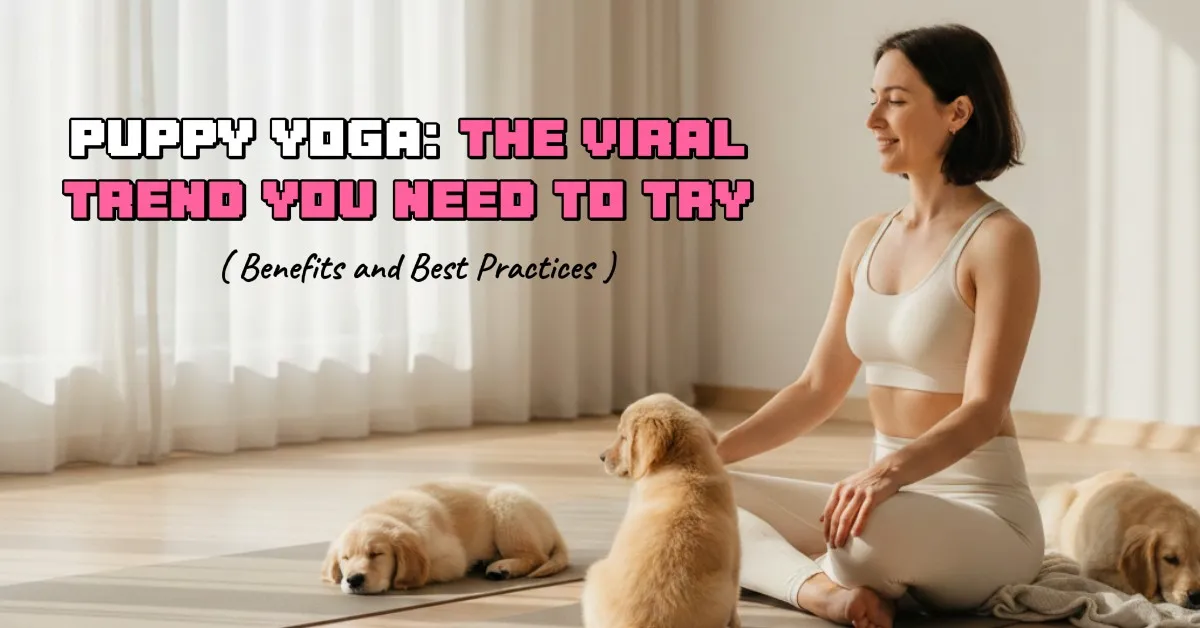
This is the reality of puppy yoga in 2026.
It’s the wellness trend everyone’s talking about. The experience of filling up studios from New York to Sydney. The “cute Instagram moment” that’s actually backed by nervous system science and animal-assisted therapy research.
But here’s what the viral videos won’t tell you:
Puppy yoga is not inherently good or bad. It’s completely dependent on how it’s done.
When done ethically, with proper puppy sourcing, welfare standards, and nervous system-informed instruction, puppy yoga can be a legitimate tool for stress relief, social connection, and joy.
Done poorly with backyard-bred puppies, no rest protocols, and profit-over-welfare priorities, it becomes exactly what critics call it: an “ick” trend that exploits animals for Instagram content.
I’m writing this today not to tell you whether puppy yoga is “good” or “bad.”
Not to shame you for being curious about it.
Not to pretend I have all the answers.
However, as someone who understands both the power of animal-assisted therapy and the responsibility we have to protect animal welfare, I want to provide you with the complete truth about puppy yoga so you can make an informed decision.
Let me be very clear from the start:
If you’re considering trying puppy yoga or if you’re sceptical about whether it’s ethical, you need to know exactly what separates legitimate puppy yoga experiences from problematic ones.
By the end of this guide, you’ll understand:
- What actually happens in a puppy yoga class
- The real puppy yoga benefits (and what’s just marketing hype)
- Where the puppies come from (this matters more than anything)
- The 7-7-7 rule every ethical puppy yoga session follows
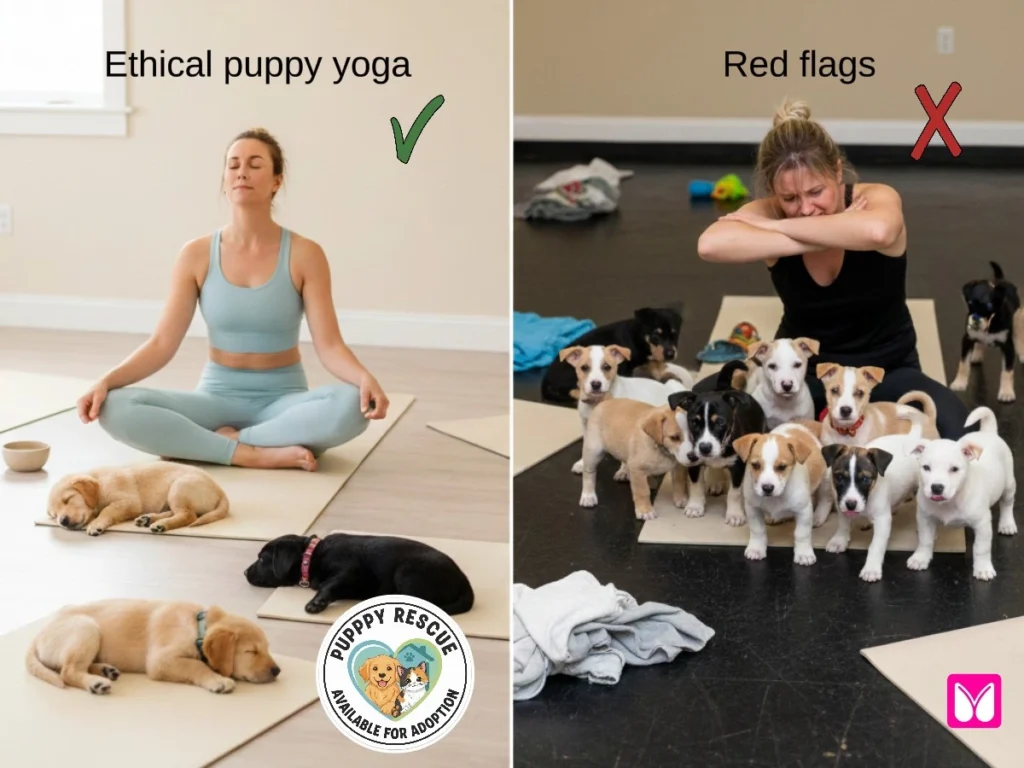
- Red flags that tell you to walk away immediately
- How to find puppy yoga near me that’s actually safe and ethical
- Why “Puppy Pose” might be what you actually need instead
This is the 2026 awareness guide to the viral wellness trend everyone’s trying, but few people truly understand.
Quick Answer: Puppy yoga can be beneficial only when done ethically. This guide explains how to tell the difference, what benefits are real, and safer alternatives if you just want nervous system calm.
The Internet Can’t Decide: Joy or “Ick”?
Why Puppy Yoga Has the Wellness World Divided
Let me show you something interesting.
When you search “puppy yoga reddit,” you’ll find two completely opposite reactions:
Camp 1: “This Was the Best Experience of My Life”
- “I went for my birthday and cried happy tears.”
- “The puppies were so well-cared for and clearly happy.”
- “My anxiety disappeared for the first time in months.”
- “I ended up adopting one of the puppies!”
Camp 2: “This Is Exploitative and Wrong”
- “Those puppies looked exhausted.”
- “This is just using animals as Instagram props.”
- “The studio had no transparency about where puppies came from.”
- “I left feeling gross about the whole thing.”
Here’s what’s fascinating: Both camps are right.
Because puppy yoga isn’t one thing. It’s a spectrum ranging from ethical, welfare-first experiences to problematic operations that prioritise profit over puppy wellbeing.
Why Influencers Love It (And Why That’s Part of the Problem)
The Instagram Factor:
Puppy yoga is content gold. Cute puppies + yoga poses + feel-good vibes = guaranteed engagement.
Wellness influencers share their puppy yoga experiences and achieve 10 times their normal engagement rate.
Brands sponsor puppy yoga events for marketing.
Studios charge premium prices ($50-$ 85 per person) because demand is extremely high.
But here’s the uncomfortable truth:
When living animals are used as “content props,” their welfare can become secondary to the photo opportunity.
Why Animal Welfare Advocates Are Concerned
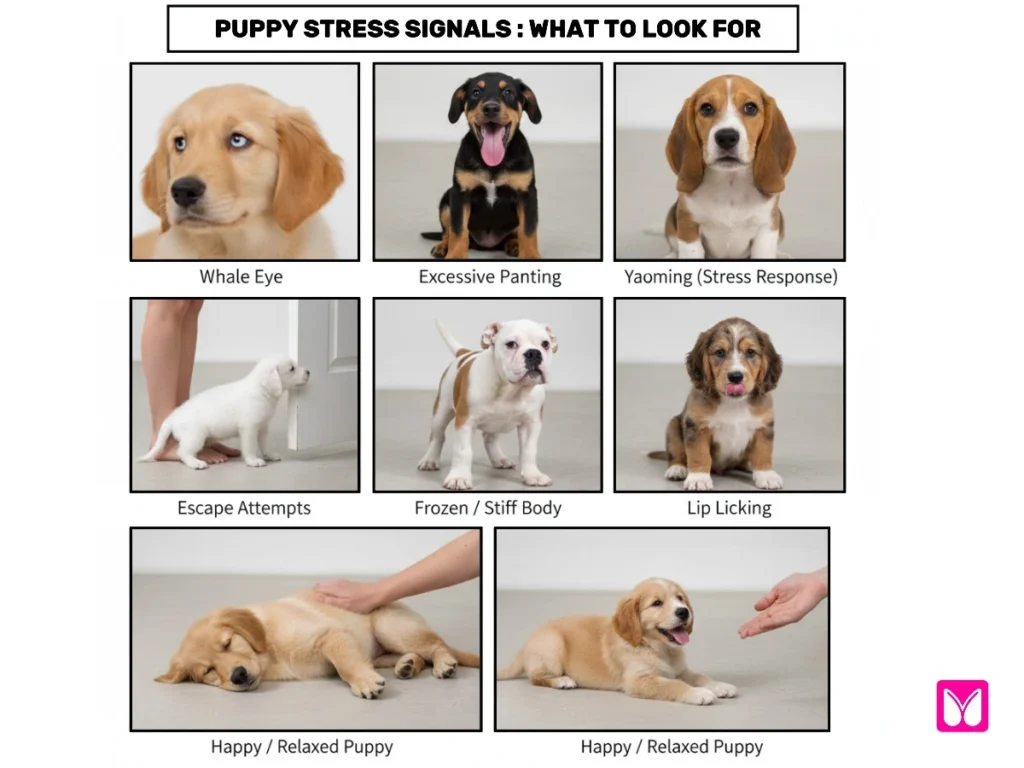
Organisations like the RSPCA, Kennel Club experts, veterinarians, and professional dog trainers have raised legitimate concerns:
Concern #1: Overstimulation
- Puppies need 18-20 hours of sleep per day
- Loud music, constant handling, and crowd energy can overwhelm developing nervous systems
- What looks like “playful energy” might actually be stress behaviour
Concern #2: Unclear Sourcing
- Where do these puppies come from?
- Are they from ethical breeders, rescues, or backyard breeding operations?
- What happens to them after they “age out” of puppy yoga?
Concern #3: The “Work vs. Play” Line
- Healthy puppy socialisation = controlled, predictable exposure in short bursts
- Puppy yoga sessions = 45-90 minutes of unpredictable interaction with strangers
- When does “beneficial socialisation” become “puppy work”?
Concern #4: Long-term Impact
- Early overstimulation can create adult dogs with:
- Heightened stress responses
- Fear-based reactivity
- Anxiety disorders
- Aggression patterns
These aren’t anti-puppy-yoga crusaders trying to ruin fun. These are professionals who understand canine development and nervous system health.
The Emotional Tipping Point
Here’s where it gets complicated:
Rachel (from the opening story) had a genuine, therapeutic experience. The puppy sleeping on her chest triggered a real release of oxytocin and regulated her nervous system.
But in another studio across town, puppies were being passed around like party favours, showing stress signals nobody recognised, rotating through 4 classes per day with no rest.
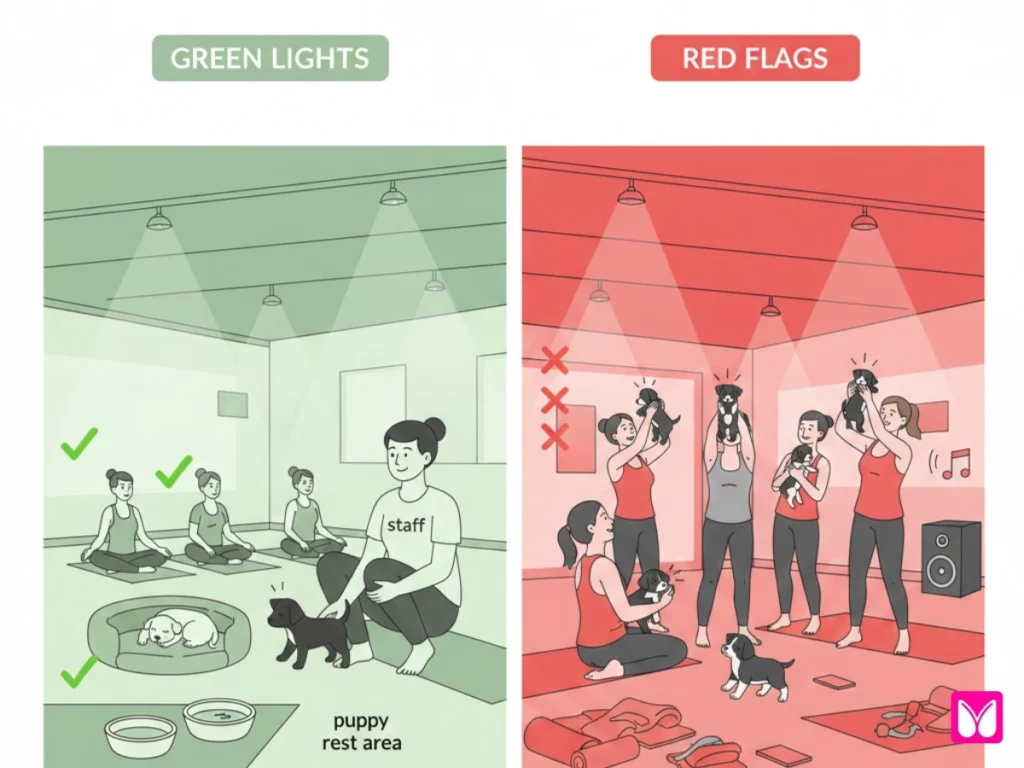
Same trend. Completely different outcomes.
This is why the question “Is puppy yoga ethical?” has no simple yes-or-no answer.
The real question is: “Is THIS SPECIFIC puppy yoga session ethical?”
Where Do the Puppies Actually Come From?
The Question Nobody Asks Before Booking
Before Rachel booked her puppy yoga session, she looked at:
- The studio’s Instagram aesthetic
- The price $65 seemed reasonable.
- Available time slots.
She did NOT ask:
- Where do these puppies come from?
- What happens to them after they’re too old for classes?
- How many sessions per day do they participate in?
- What are the welfare protocols?
She’s not alone. According to reviews of puppy yoga across multiple platforms, fewer than 12% of participants inquire about puppy sourcing before booking.
This is the most important question you can ask.
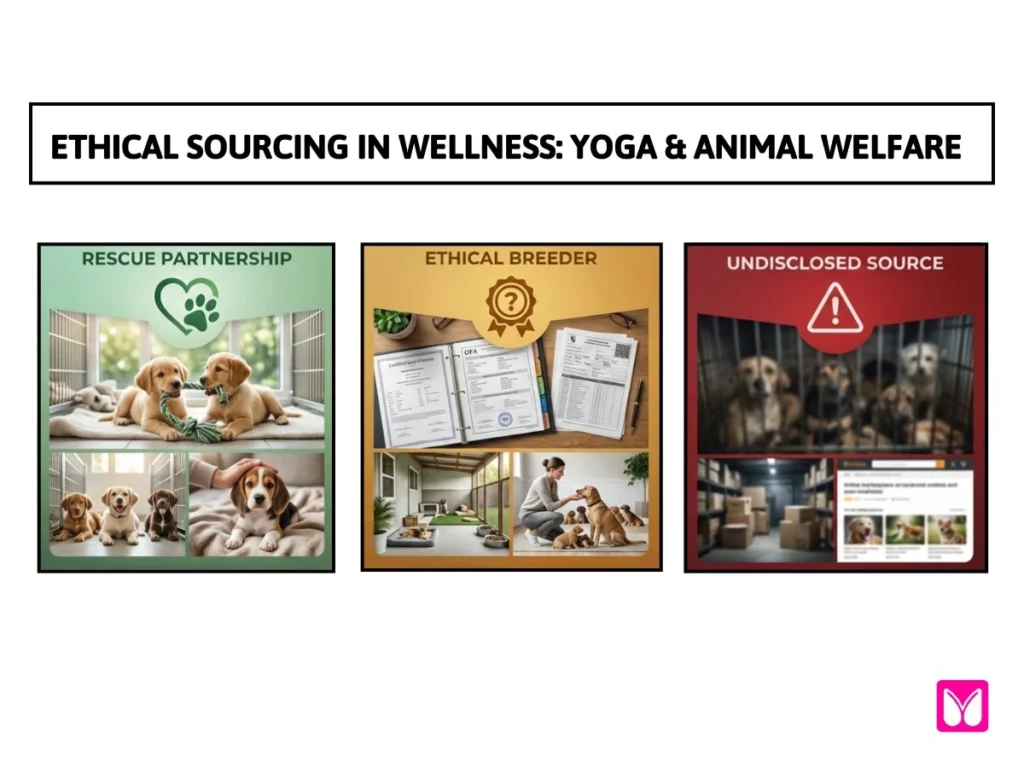
The Three Puppy Sourcing Models
Model #1: The Rescue & Foster Partnership (Gold Standard)
How It Works:
- Studio partners with local animal shelters or rescue organisations
- Puppies are from foster care systems, already being socialised for adoption
- Puppy yoga serves as:
- Controlled socialisation experience
- Public exposure for adoption
- Revenue sharing with the rescue organisation
Example: Puppy Yoga NYC locations, which partner with Animal Haven or ASPCA, often use this model.
What This Looks Like:
- Clear disclosure: “Today’s puppies are from [ Puppy Rescue ]”
- Adoption information provided
- Limited sessions (puppies participate 1-2 times max before adoption)
- Welfare-first approach (if puppy seems overwhelmed, they’re removed immediately)
Puppy Yoga Benefits (Rescue Model):
- Puppies get socialisation they need anyway
- Exposure increases adoption rates
- Revenue supports rescue operations
- Participants can adopt their “yoga puppy.”
Success Story:
A puppy yoga studio in Portland, Oregon, partnered with Oregon Dog Rescue. Over 18 months:
- 127 puppies participated in classes
- 89 were adopted by class participants
- 38 were adopted through the rescue’s normal process (but many adopters found them through yoga exposure)
- Zero welfare complaints filed
This is what ethical puppy yoga looks like.
Model #2: The Ethical Breeder Partnership (Grey Area)
How It Works:
- Studio works with certified, responsible breeders
- Puppies are from planned litters, will go to pre-approved homes
- Puppy yoga serves as socialisation during the critical 8-16 week window
- Transparency about breeding operations
When This Can Work:
- Breeder is certified (AKC, UKC, or equivalent)
- Puppies already need socialization exposure
- Sessions are limited (1-2 per week maximum per puppy)
- Clear protocols for rest, stress monitoring
- Full disclosure to participants about where puppies are from and where they’re going
When This Becomes Problematic:
- “Ethical breeder” claims with no verification
- Puppies used repeatedly across multiple weeks
- No transparency about the breeding operation
- Breeds chosen for “cuteness”, not welfare (brachycephalic breeds struggling to breathe in yoga studios)
The Critical Question:
If a studio uses breeder-sourced puppies, they should answer immediately:
- “What breeder are you working with?”
- “Can I see their certification/credentials?”
- “How many sessions does each puppy participate in?”
- “What’s your rest and welfare protocol?”
If they can’t or won’t answer, that’s a red flag.
Model #3: The Undisclosed/Suspicious Model (Run Away)
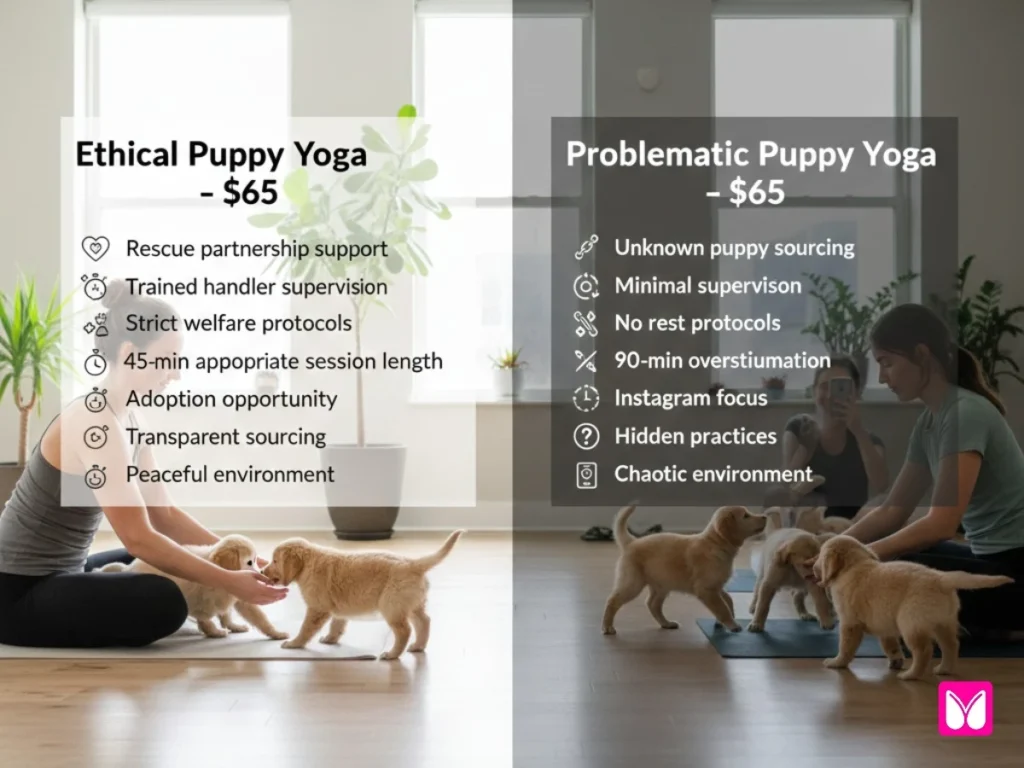
Red Flags:
- No clear answer about where puppies come from
- We work with various breeders” (vague, non-transparent)
- Different breeds every week with no explanation
- Puppies appear in multiple sessions across many weeks
- No visible welfare policy on the website
- Studio defensiveness when asked about sourcing
Why This Matters:
Backyard breeding—unregulated, profit-driven puppy production—is a serious animal welfare issue. Puppies from these sources often:
- Come from mothers bred too frequently
- Lacks proper veterinary care
- Miss critical early socialisation
- Are separated from mothers too early (before 8 weeks)
If a puppy yoga operation sources from backyard breeders, you’re financially supporting animal cruelty, even if the yoga class itself feels joyful.
What Happens to the Puppies After?
In Ethical Operations:
- Rescue puppies: Get adopted
- Breeder puppies: Go to pre-approved homes on schedule
- Clear lifecycle: Puppies participate during the socialization window (8-16 weeks), then move on
In Problematic Operations:
- Unclear what happens after puppies “age out.”
- Puppies might be cycling through multiple studios
- No transparency about long-term welfare
The Question to Ask:
“Where do these puppies go after they’re too old for puppy yoga?”
Ethical operations will have a clear, immediate answer. Problematic ones won’t.
The 7-7-7 Rule: What Every Puppy Yoga Session Should Follow
The Nervous System Science They Don’t Post on Instagram
Let me tell you about a puppy yoga session that went viral for all the wrong reasons.
December 2025. A studio in Los Angeles. An influencer posted a “hilarious” video of “energetic puppies going crazy” during class.
What the video actually showed:
- Puppies frantically jumping, unable to settle
- Loud music blasting
- Participants are constantly grabbing and repositioning puppies for photos
- No visible water access
- 90-minute session (way too long)
- Zero rest areas
Animal behaviour experts who saw the video identified what non-experts missed:
Those weren’t “playful” puppies. Those were overstimulated, stressed puppies showing textbook anxiety behaviours.
This is why understanding the 7-7-7 Rule matters.
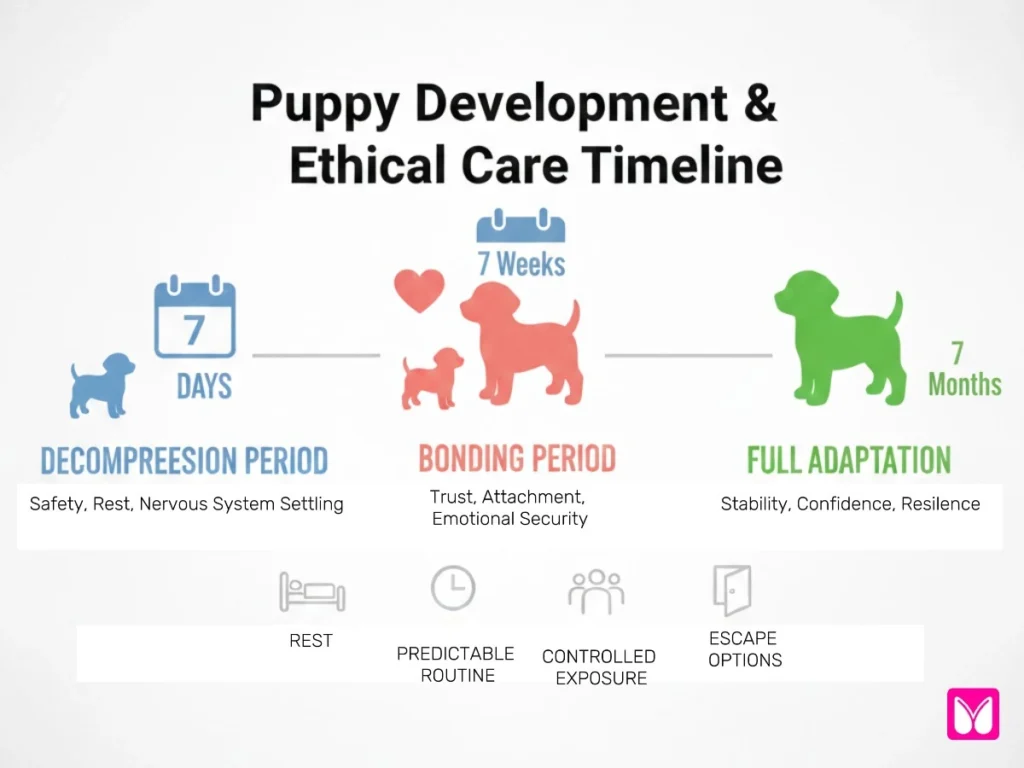
What Is the 7-7-7 Rule for Puppies?
The 7-7-7 Rule is a framework developed by animal behaviourists and rescue organisations to understand puppy adjustment periods:
7 Days: Decompression period (puppy needs to settle into new environment)
7 Weeks: Bonding period (puppy begins trusting and attaching)
7 Months: Full adaptation (puppy’s personality and patterns solidify)
What This Means for Puppy Yoga:
Puppies in new environments (like a yoga studio) need:
- Predictable routines (not chaos)
- Controlled exposure (not overwhelming crowds)
- Rest periods (not continuous stimulation)
- Escape options (ability to leave if overwhelmed)
Healthy Puppy Socialisation Looks Like:
- 5-15 minute exposure periods
- Followed by rest/decompress time
- Predictable, calm interactions
- Ability to opt out
Problematic Puppy Yoga Looks Like:
- 60-90 minute continuous sessions
- Loud music, unpredictable handling
- No rest periods
- Puppies who can’t escape interaction
The Overstimulation Risks Nobody Talks About
Short-term Effects:
- Stress hormone (cortisol) elevation
- Difficulty settling after class
- Digestive upset
- Sleep disruption
Long-term Effects (This Is What Experts Worry About):
Dr Sarah Mitchell, veterinary behaviourist, explains:
“Puppies who experience chronic overstimulation during critical development windows (8-16 weeks) can develop permanently heightened stress responses. What looks like ‘socialisation’ can actually be creating anxiety patterns that manifest in adult dogs as:
- Fear-based reactivity (lunging, barking at strangers)
- Generalised anxiety disorders
- Aggression rooted in overwhelm
- Inability to settle in stimulating environments.”
This doesn’t mean puppy yoga automatically creates anxious dogs.
It means that puppy yoga must be conducted with strict welfare protocols, or it risks negating the benefits of puppy yoga.
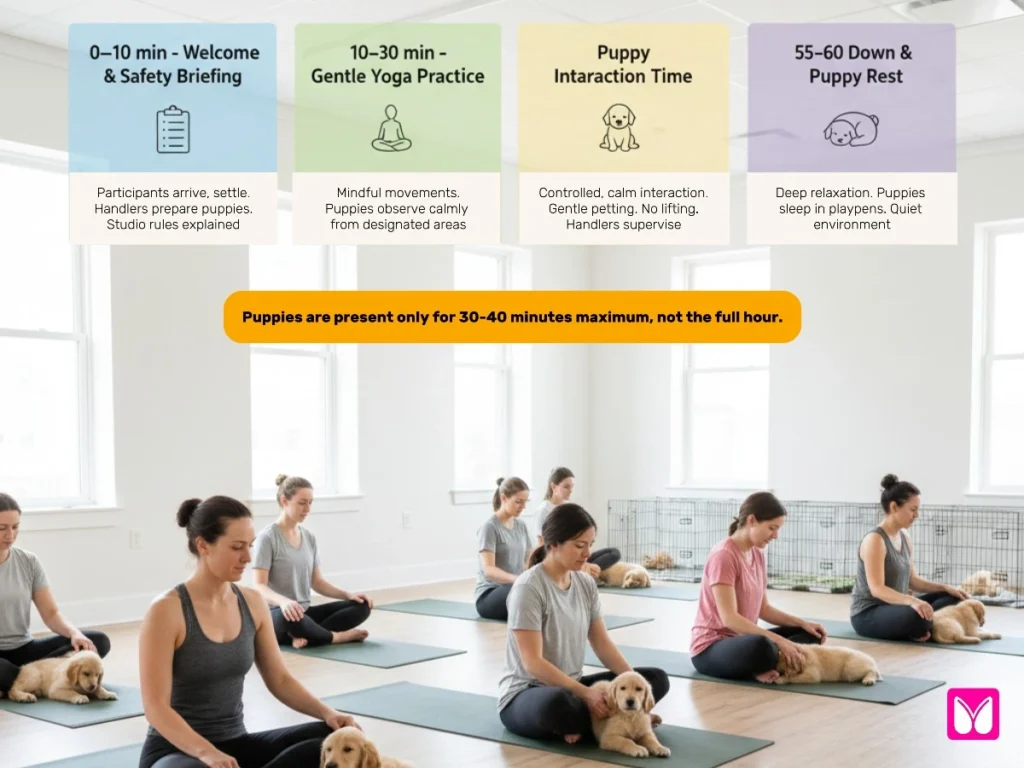
What Ethical Puppy Yoga Sessions Include
Mandatory Elements:
Session Length: Maximum 45-60 minutes (with puppies only present for 30-40 minutes)
Puppy Age: Minimum 8 weeks old (legal requirement in most jurisdictions)
Rest Rule: Sleeping puppies are NEVER disturbed (this is non-negotiable)
Water Access: Always available, visible to puppies
Nap Zones: Designated rest areas where puppies can retreat
Handler Supervision: Trained staff in monitoring puppy stress signals
Handling Rules: Participants were taught proper interaction (no lifting, restraining, or forcing)
Maximum Ratio: Usually 1 puppy per 3-4 participants
Exit Path: Puppies can leave the yoga space freely
What You Should See:
Puppies who:
- Voluntarily approach participants
- Take breaks to rest
- Show “soft” body language (loose muscles, wagging tails, play bows)
- Have access to water and chew toys
- Can opt out of interaction
What You Should NEVER See:
Puppies who:
- Can’t settle or constantly pant
- Show “whale eye” (whites of eyes visible—stress signal)
- Try to escape, but are blocked
- They are being passed around like objects
- They are forced to interact when they’re trying to rest
Before You Book: The Ethical Puppy Yoga Checklist
How to Find Puppy Yoga Near Me That’s Actually Safe
Rachel (remember her?) got lucky. The Brooklyn studio she attended happened to partner with a rescue organisation, followed strict protocols, and prioritised welfare.
But two weeks later, her friend attended a different puppy yoga session in Manhattan and left feeling “gross” about the experience:
- Puppies were clearly exhausted
- No information about where they came from
- Water bowls were empty
- Participants were encouraged to “get that Instagram shot!” even when puppies were trying to rest
- Cost $85 (more expensive than Rachel’s ethical option)
A higher price does not necessarily equal better welfare.
Here’s exactly how to vet a puppy yoga studio before you book:
The Pre-Booking Questions (Ask Via Email or Phone)
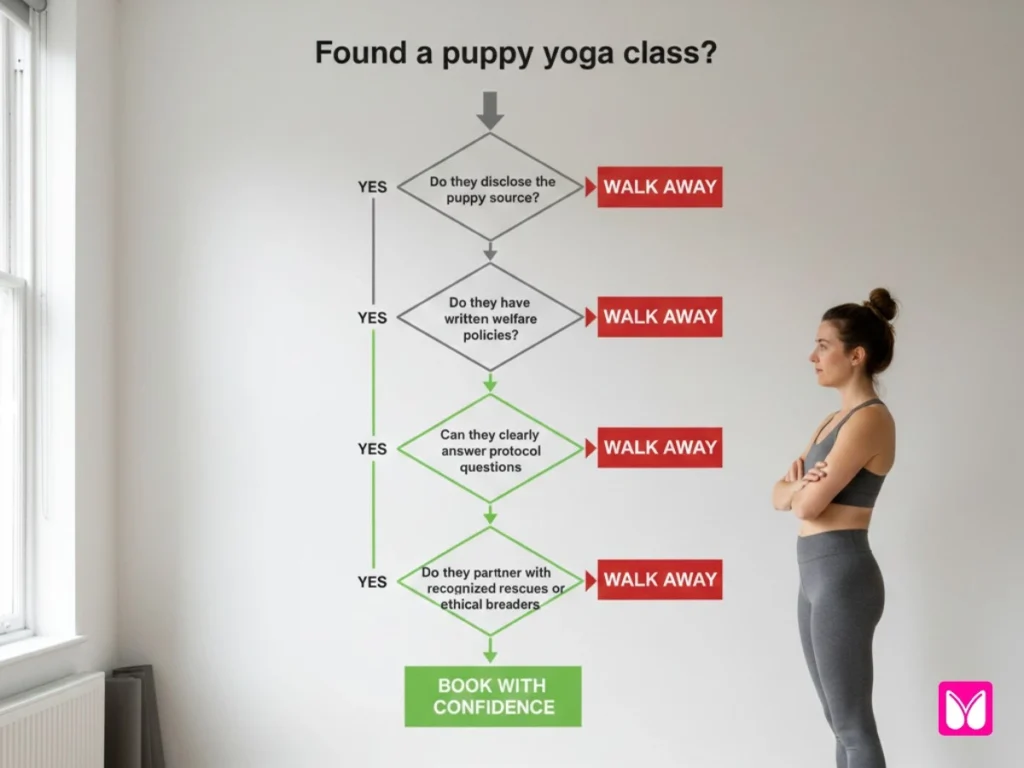
Question #1: Where do your puppies come from?
Acceptable Answers:
- “We partner with [Specific Rescue Organisation Name]”
- “We work with [Named Certified Breeder] for socialisation during the 8-16 week window”
- “All our puppies are rescue/foster puppies being socialised for adoption”
Red Flag Answers:
- “We work with various breeders” (vague)
- “That’s proprietary information” (defensive)
- “They’re from local sources” (non-transparent)
- No answer provided
Question #2: What are your puppy welfare protocols?
Acceptable Answers:
- Should mention: session time limits, rest rules, water access, handler supervision, stress monitoring
- Should provide written policy (reputable studios have this documented)
Red Flag Answers:
- “Our puppies love it, they’re fine!” (dismissive)
- “We’ve never had issues” (no protocols mentioned)
- Vague reassurances with no specifics
Question #3: How many sessions per day do puppies participate in?
Acceptable Answers:
- “Maximum 1 session per day” (ideal)
- “1-2 sessions with 4+ hour breaks between” (acceptable)
Red Flag Answers:
- “3-4 sessions per day” (overscheduling)
- “They participate all day Saturday and Sunday” (welfare violation)
- “It varies” (no clear limits)
Question #4: What happens if a puppy shows stress?
Acceptable Answers:
- “Handler immediately removes puppy to quiet rest area”
- “Puppy is taken out of rotation for the day”
- “We watch for [specific stress signals] and intervene”
Red Flag Answers:
- “That never happens” (unrealistic)
- “They’re just being playful” (dismissive of behaviour)
- No clear protocol
Question #5: Can I see your safety briefing/rules for participants?
Acceptable Answers:
- Provides written guidelines before class
- Mentions: no forced interaction, respect sleeping puppies, proper handling education
Red Flag Answers:
- “We go over it quickly at the start” (insufficient)
- “Just use common sense” (no structure)
- Resistance to sharing information
The On-Site Checklist (What to Look for When You Arrive)
GREEN LIGHTS (Safe to Participate):
Clear signage about where puppies are from (rescue name, breeder info)
Water bowls are visible and filled
Designated “puppy rest zone” with soft bedding
Handler/staff actively monitoring (not just teaching yoga)
Class size appropriate (usually 15-25 people max)
Safety briefing happens before puppies enter
Puppies appear healthy, alert, but not frantic
Participants are educated about proper handling
Music is at a reasonable volume (not blasting)
Clear schedule (yoga portion, then puppy time, then wrap-up)
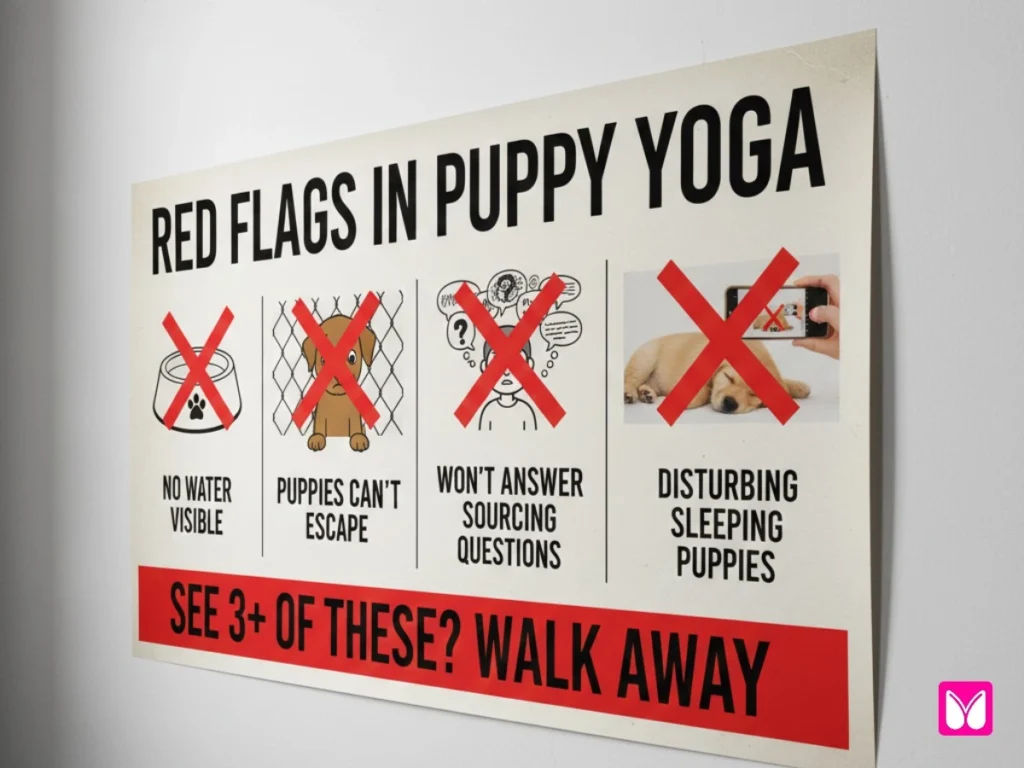
RED FLAGS (Walk Away, Get Refund):
No information about puppy sourcing is visible anywhere
No water is accessible to puppies
Puppies show stress signals (whale eye, excessive panting, trying to escape)
Staff allowing participants to force interaction
Sleeping puppies are being disturbed for photos
Overcrowded space (30+ people in a small studio)
No handler present (only yoga instructor)
Loud, chaotic environment
Puppies appear lethargic or unwell
No clear welfare policy when you ask
If you see 3+ red flags, leave. Request a refund. Report any serious animal welfare violations to the local authorities.
Location-Specific Considerations
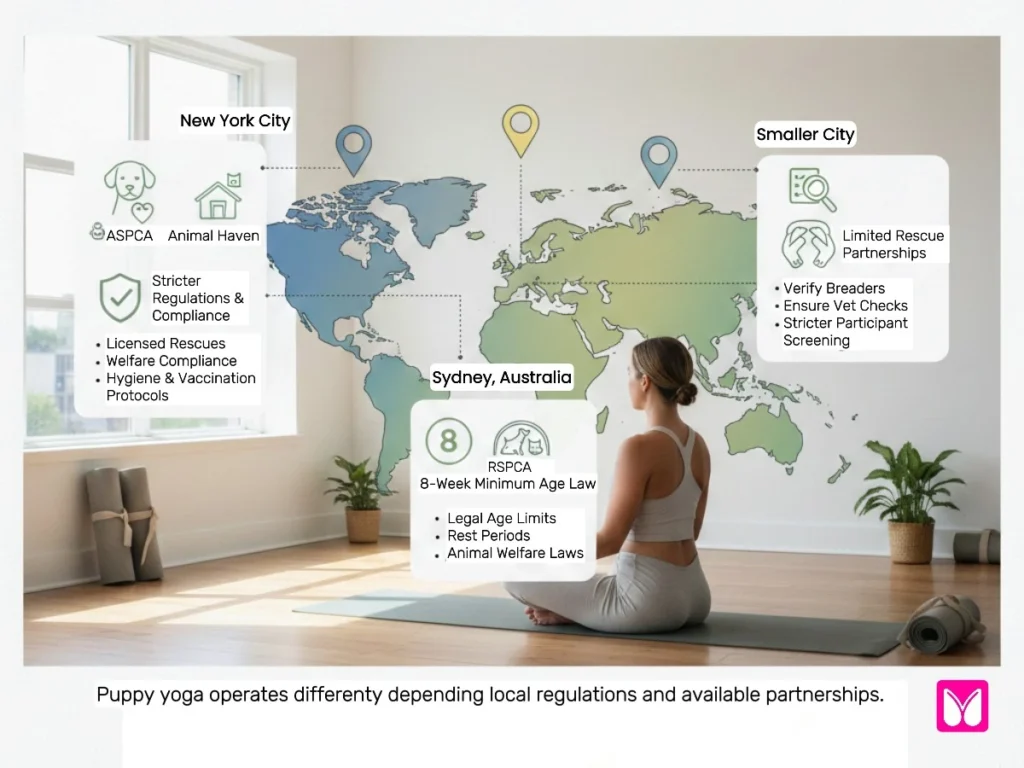
Searching “Puppy Yoga NYC”?
- New York has stricter animal welfare regulations
- Look for studios partnering with ASPCA, Animal Haven, or Badass Brooklyn Animal Rescue
- Expect transparency (it’s legally required)
Searching “Puppy Yoga Sydney”?
- RSPCA Australia has guidelines for animal-assisted activities
- Ethical operations will reference compliance with these standards
- Minimum age should be 8 weeks (legal requirement)
Searching “Puppy Yoga Near Me” (Smaller Cities)?
- May have fewer options, less regulation
- Extra vigilance required
- Ask explicitly about licensing and permits
- Check if the business is registered with local animal control
The Real Puppy Yoga Benefits (And What’s Just Hype)
What Science Actually Says
Let me separate fact from fiction when it comes to Instagram marketing.
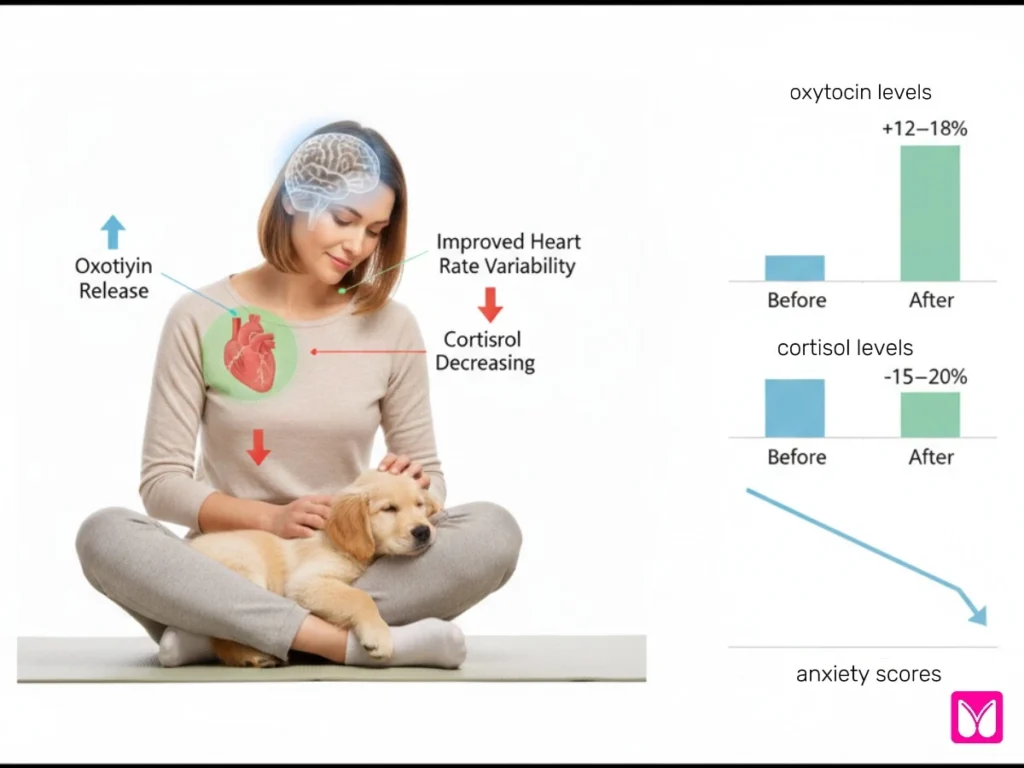
Claim #1: “Puppy Yoga Reduces Stress and Anxiety”
Verdict: TRUE (when done ethically)
The Science:
Animal-assisted therapy research shows measurable benefits:
- Oxytocin (bonding hormone) increases by 12-18% during positive animal interaction
- Cortisol (stress hormone) decreases by an average of 15-20%
- Heart rate variability improves (indicating parasympathetic nervous system activation)
- Self-reported anxiety scores decrease significantly
Study Example: A 2023 study published in Frontiers in Psychology tracked 87 participants in animal-assisted yoga sessions vs. regular yoga sessions. The animal-assisted group showed:
- 34% greater positive mood markers
- 27% greater anxiety reduction
- Longer-lasting effects (benefits persisted 48 hours post-session vs. 6-12 hours for yoga-only)
But here’s the critical caveat:
These benefits occur when:
- Animals are calm and willing participants
- Interaction is gentle and consent-based
- The environment is peaceful, not chaotic
If puppies are stressed, YOUR nervous system picks up on that stress, negating the benefit.
Claim #2: “Puppy Yoga Is Great Exercise”
Verdict: MISLEADING
The Reality:
Puppy yoga is gentle, beginner-friendly yoga that often includes frequent interruptions.
You’re not getting:
- Intense cardio
- Strength building
- Advanced flexibility work
- Deep alignment focus
You ARE getting:
- Gentle movement (better than sitting on the couch)
- Stretching and mild mobility work
- Mindful breathing practice
- Social activity
If your goal is fitness, regular yoga classes are more effective.
If your goal is stress relief and joy, puppy yoga (done ethically) can be transformative.
Claim #3: “It’s Good Socialisation for Puppies”
Verdict: TRUE (with major conditions)
When It’s Beneficial:
- Puppies are in the critical socialisation window (8-16 weeks)
- Sessions are SHORT (30-40 minutes max)
- Controlled exposure to calm, gentle humans
- Puppies can opt out
- Followed by adequate rest
When It’s Harmful:
- Too long, too loud, too chaotic
- Forced interaction
- Multiple sessions per day
- Puppies showing stress
Expert Opinion:
Dr Ian Dunbar, veterinarian and animal behaviourist:
“Socialisation is critical. But quality matters more than quantity. One 30-minute session with calm, respectful humans is infinitely more valuable than three hours of chaos. Puppy yoga can be beneficial for socialisation if done correctly. The problem is most aren’t.”
Claim #4: “You’ll Bond Deeply with the Puppies”
Verdict: PARTIALLY TRUE
What Actually Happens:
You might feel a connection. You might have a moment, as Rachel did with Biscuit.
But you’re one of 20+ people in the room. The puppies are rotating attention. You’re not their person.
The benefit isn’t deep bonding, it’s the presence and release of oxytocin.
That’s still valuable. Just be realistic about expectations.
Claim #5: “It Helps with Depression”
Verdict: SUPPORTIVE, NOT CURATIVE
The Nuance:
Animal interaction CAN support mental health by:
- Providing positive sensory experiences
- Triggering oxytocin release
- Creating social connection opportunities
- Interrupting rumination patterns
But puppy yoga is NOT:
- A replacement for therapy
- A treatment for clinical depression
- A cure for mental illness
It’s a wellness activity that can support mental health in conjunction with professional care.
The Honest Assessment
Puppy yoga benefits that are real:
Stress reduction (oxytocin boost, cortisol decrease)
Social connection (shared novel experiences bond people)
Present-moment awareness (puppies force you out of your head)
Joy and laughter (legitimate nervous system benefits)
Potential adoption pathway (if rescue-partnered)
Puppy yoga benefits that are overstated:
“Life-changing transformation” (it’s a fun experience, not magic)
“Intense workout” (it’s gentle movement)
“Deep spiritual practice” (it’s playful, not profound)
“Cure for anxiety/depression” (supportive, not curative)
The Bottom Line:
Ethical puppy yoga is a legitimate wellness activity with measurable benefits to the nervous system similar to other forms of animal-assisted therapy.
Unethical puppy yoga is exploitation dressed up as wellness.
The difference is entirely in HOW it’s done.
The Alternative: Why Puppy Pose Might Be What You Actually Need
You Don’t Need a Puppy to Regulate Your Nervous System
Here’s something the puppy yoga industry won’t tell you:
The benefits Rachel experienced from oxytocin, including regulation and the feeling of safety, can be accessed without the use of animals.
They can be accessed through Puppy Pose (Uttana Shishosana).
What Is Puppy Pose?
Puppy Pose (Sanskrit: Uttana Shishosana, literally “extended puppy pose”) is a heart-opening, spinal decompression posture that bridges Child’s Pose and Downward Dog.
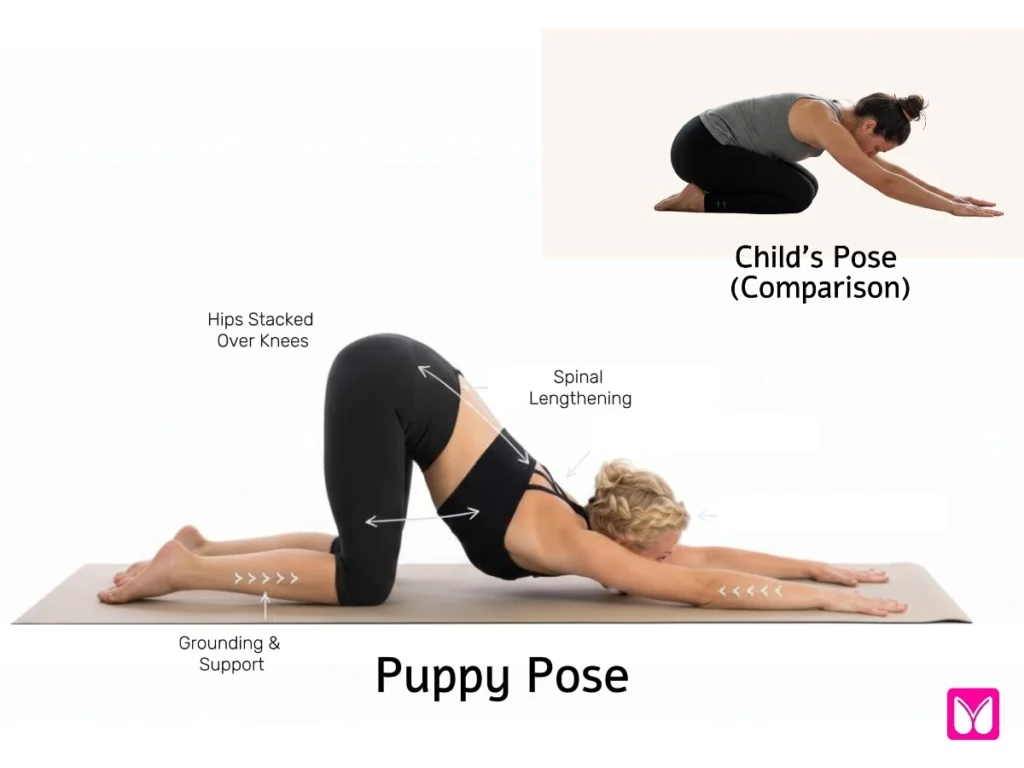
How to Do Puppy Pose:
- Start on hands and knees (tabletop position)
- Walk your hands forward, lowering your chest toward the floor
- Keep your hips stacked over your knees
- Forehead rests on mat or block
- Arms extend forward, heart melts toward earth
- Hold for 5-10 breaths
What’s Happening in Your Body:
- Spinal Extension: Lengthens the entire spine from the tailbone to the crown
- Chest Opening: Stretches intercostal muscles, shoulders, and the heart centre
- Parasympathetic Activation: Forward fold position triggers “rest and digest” nervous system response
- Diaphragm Release: Improves breath capacity
Puppy Pose Benefits (No Animals Required)
Physical Benefits:
- Relieves upper back and shoulder tension (especially from desk work)
- Gently stretches the spine and improves posture
- Opens chest for deeper breathing
- Releases neck strain
Nervous System Benefits:
- Activates vagal tone (same mechanism as animal interaction)
- Triggers oxytocin release through self-soothing position
- Reduces cortisol through forward fold compression
- Calms anxiety through breath regulation
Emotional Benefits:
- Heart opening creates emotional release
- A vulnerable position encourages letting go
- Grounding through connection to the earth
- No performance pressure (just you and your mat)
Puppy Pose vs. Child’s Pose: Which to Choose?

Child’s Pose (Balasana):
- More restorative (full rest position)
- Hips on heels, arms alongside the body or extended
- Complete nervous system shutdown
- Best for: Deep rest, overwhelm, need to “hide”
Puppy Pose (Uttana Shishosana):
- More active (hips stay elevated)
- Heart-opening component
- Spinal lengthening focus
- Best for: Shoulder tension, chest tightness, mild anxiety
When to Use Each:
- Feeling anxious and wired? → Puppy Pose (active release)
- Feeling exhausted and depleted? → Child’s Pose (complete rest)
- Feeling emotionally closed? → Puppy Pose (heart opening)
- Feeling overwhelmed? → Child’s Pose (containment)
The Real Reason Puppy Yoga Matters (And Why Puppy Pose Might Matter More)
What Both Practices Teach Us
Let me take you back to Rachel one more time.
Six weeks after her puppy yoga experience, I asked her: “Do you still go to puppy yoga?”
Her answer surprised me:
“I went twice more. Both times were lovely. But I realised something: I was chasing that feeling Biscuit gave me that moment of complete calm.
Then my regular yoga teacher taught us Puppy Pose. And I had the same feeling. Not identical, but close.
What I learned is: I don’t need puppies. I need practices that let me feel safe enough to soften. Puppy yoga taught me what that feels like. Now I can access it myself.”
This is the highest potential of puppy yoga:
Not as a destination, but as a doorway.
A doorway back to your body.
A doorway back to presence.
A doorway back to remembering that joy and regulation are available—even without the perfect Instagram moment.
The Integration
If Puppy Yoga Opened Something for You:
Phase 1: Experience puppy yoga (ethical version)
Phase 2: Notice what you felt: safety, softness, presence, joy
Phase 3: Explore practices that create similar states:
- Puppy Pose for heart opening
- Child’s Pose for deep rest
- Gentle yoga for nervous system regulation
- Somatic movement for body awareness
Phase 4: Return to puppy yoga occasionally as a “joy reset,” but build sustainable practices you can access daily
The Responsibility
If you choose to participate in puppy yoga, you have a responsibility:
To the Puppies:
- Only book ethical operations
- Report welfare violations
- Walk away from red flags
- Spread awareness about what ethics looks like
To Yourself:
- Don’t chase external fixes for internal regulation
- Learn to create safety in your own nervous system
- Use puppy yoga as exploration, not dependency
To the Industry:
- Vote with your dollars (support ethical studios only)
- Leave honest reviews
- Educate friends considering puppy yoga
- Demand transparency
So… Should You Try Puppy Yoga?
The Honest Answer
Try puppy yoga IF:
You’ve vetted the studio and confirmed ethical practices
You understand this is a fun experience, not a cure
You’re genuinely curious about animal-assisted wellness
You can afford it without financial stress
You’ll be mindful of puppy welfare during the session
You’re open to the experience being imperfect (puppies might not interact with you)
Skip puppy yoga IF:
The studio won’t answer sourcing questions
You see red flags in reviews or policies
You’re expecting it to “fix” mental health challenges
You’re only going for Instagram content
You have severe dog allergies
The cost causes financial strain
Try Puppy Pose (the yoga posture) IF:
You want nervous system benefits without animal dependency
You have upper back/shoulder tension
You’re building a sustainable home practice
You need heart opening and emotional release
You want practices you can access anytime, anywhere
The Final Word
Puppy yoga is neither inherently good nor bad.
It’s a wellness trend that, like all trends, exists on a spectrum from ethical to exploitative.
Your job is to be discerning.
Ask questions. Demand transparency. Walk away from red flags. Support only ethical operations.
And remember:
The oxytocin you felt when that puppy curled up in your lap? The nervous system regulation? The moment of pure presence?
Those are accessible through practices you can build yourself.
Puppy yoga can be the introduction.
But practices like Puppy Pose, gentle yoga, somatic movement, and mindful breathing are the foundation.
One is a trend. The other is a path.
Both have value. Just know the difference.
Frequently Asked Questions About Puppy Yoga
Q: Is puppy yoga ethical?
A: Puppy yoga is not inherently ethical or unethical; it depends entirely on how it’s done. Ethical puppy yoga includes: rescue/ethical breeder sourcing, limited session times (45-60 min max), strict rest protocols, trained handlers, and transparent welfare policies. Unethical operations hide sourcing information, overwork puppies, and prioritise Instagram moments over animal welfare.
Q: Where do puppies from puppy yoga go afterwards?
A: In ethical operations, rescue puppies are adopted (often by class participants), and breeder puppies go to pre-approved homes on schedule. Puppies typically participate only during their 8-16 week socialisation window, then move on. If a studio can’t answer this question clearly, that’s a major red flag.
Q: What is the 7-7-7 rule for puppies?
A: The 7-7-7 rule describes puppy adjustment periods: 7 days to decompress, 7 weeks to bond, and 7 months to fully adapt. For puppy yoga, this means puppies need predictable routines, controlled exposure, adequate rest, and the ability to opt out of interaction not chaotic, overwhelming environments.
Q: Is puppy yoga safe for puppies?
A: Puppy yoga can be safe when studios follow strict protocols: puppies minimum 8 weeks old, sessions limited to 30-40 minutes of interaction time, mandatory rest periods, stress signal monitoring, and trained handlers present. It becomes unsafe when puppies are overworked, overstimulated, or showing stress signals that are ignored.
Q: What are puppy yoga benefits for humans?
A: Research-backed benefits include: 12-18% increase in oxytocin (bonding hormone), 15-20% decrease in cortisol (stress hormone), improved heart rate variability, anxiety reduction, and social connection. However, these benefits only occur when puppies are calm and willing participants—stressed puppies create stressed humans.
Q: How do I find puppy yoga near me that’s ethical?
A: Before booking, ask: Where do puppies come from? What are welfare protocols? How many sessions per day do puppies participate in? Ethical studios will answer immediately and provide written policies. Look for rescue partnerships, transparent sourcing, clear rest rules, and positive reviews mentioning animal welfare.
Q: Can I adopt a puppy from puppy yoga?
A: If the studio partners with rescue organisations, yes, many participants adopt their “yoga puppy.” This is actually one of the strongest indicators of an ethical operation. Studios using breeder puppies typically do not offer adoption (puppies are reserved for pre-approved homes), but should clearly communicate this policy.
Q: What’s the difference between Puppy Pose and puppy yoga?
A: Puppy Pose (Uttana Shishosana) is a yoga posture that provides heart opening, spinal decompression, and nervous system regulation, no animals required. Puppy yoga is a class format that combines gentle yoga with interactive play with puppies. Both can reduce stress, but Puppy Pose is a sustainable daily practice while puppy yoga is an occasional experience.
Q: Is puppy yoga worth the cost ($50-85)?
A: If it’s an ethical operation and you’re seeking a joyful, novel experience with legitimate stress-relief benefits, yes. If you’re expecting intense exercise, deep spiritual practice, or a cure for mental health challenges, no. Consider it equivalent to a massage or spa day, supportive wellness, rather than a transformation.
Q: What should I wear to puppy yoga?
A: Comfortable, fitted yoga clothes you don’t mind getting dirty (puppies may have muddy paws or accidents). Avoid loose clothing that puppies can step on. Tie long hair back. Remove jewellery that puppies might chew. Expect the possibility of puppy-related stains.
Take the Next Step: Your Choice Matters
You now know more about puppy yoga than 95% of people who book sessions.
You understand:
- Where puppies come from matters more than anything
- The 7-7-7 rule and why protocols protect developing nervous systems
- Red flags versus green lights in studio operations
- Real puppy yoga benefits versus marketing hype
- How Puppy Pose offers similar nervous system benefits without animals
What you do with this information is up to you.
If you choose to try puppy yoga:
- Only book ethical operations
- Ask every question on the checklist
- Trust your gut if something feels off
- Be willing to walk away and request a refund if you see welfare violations
If you choose Puppy Pose instead:
- Start with 5 breaths and build from there
- Focus on heart opening and letting go
- Notice the nervous system shifts
- Build a practice that’s always available
Both are valid choices.
Just choose consciously.
Your nervous system—and the puppies—deserve nothing less.
This article reflects the philosophical inquiry, lived practice, and critical perspective of Nandini Sharma, co-founder and guiding voice behind Mindfullyoga. As a long-term student of the Yoga Sutras, Hatha Yoga Pradipika, and somatic movement therapy, Nandini is the author of the philosophical and experiential insights presented in this work.
Her writing draws from years of personal practice, study, and observation of how modern wellness culture intersects with nervous system health and the original intent of yoga as a path toward genuine healing. The exploration of puppy yoga through the lens of animal welfare, nervous system science, and ethical responsibility represents her commitment to examining wellness trends with both openness and critical discernment.
Content Strategy & SEO Optimization:
The structure, formatting, and search optimization of this article were supported by Emmanuel Okafor, Content Strategist, to ensure these insights remain accessible and discoverable, without altering the philosophical voice or conclusions of the author.
Disclaimer:
This content is intended for educational and reflective purposes only and does not replace personalized medical, therapeutic, or veterinary advice. If you have specific health concerns, allergies, or conditions that may affect your participation in puppy yoga or any physical activity, please consult with qualified healthcare professionals before attending classes.
The animal welfare guidelines and studio vetting recommendations provided in this article are based on research, expert consultation, and industry best practices, but individual experiences may vary. Always use your own judgment, ask questions, and prioritize both your safety and the welfare of animals when participating in or evaluating puppy yoga activities.
This article does not constitute veterinary advice. Concerns about specific puppy welfare should be directed to licensed veterinarians or animal welfare organizations.
Continue Your Wellness Journey:
1. Somatic Yoga for Beginners: What It Really Is
Discover the nervous system practice that creates lasting regulation without relying on external experiences. Learn how slow, mindful movement rewires your stress response from the inside out.
2. Yoga for Emotional Release: What Science Says
Understand why yoga works for emotional processing and trauma release. Discover the specific poses and practices that foster genuine healing—grounded in research and somatic awareness.
3. Is Yin Yoga a Waste of Time? The Truth About Slow Practice
If you’re drawn to the slower, gentler aspects of puppy yoga, Yin yoga might be your sustainable path. Learn why “doing nothing” is actually the deepest nervous system work.

Emmanuel Okafor
Emmanuel Okafor is a skilled SEO specialist and content writer with hands-on experience in optimizing websites for visibility, traffic, and authority.Emmanuel has contributed to the growth of several startups across various niches, including AI, technology, health, and mental well-being. He is passionate about storytelling, digital marketing, and helping brands meaningfully connect with their audience online.