


-
 by
Emmanuel Okafor
by
Emmanuel Okafor - December 20, 2025
- 0 Comments

The $11 Billion Question Nobody’s Asking
Picture this:
You’re three weeks into hot yoga.
You walk into that 105-degree room, and something magical happens.
Poses that seemed impossible last month? You’re nailing them. Your hamstrings, those stubborn, tight hamstrings, are finally releasing.
The sweat is pouring, your heart is pounding, and you feel… alive. Purified. Transformed. Hot yoga benefits, right?
Your instructor smiles knowingly. “This is detoxification,” she says. “You’re releasing years of toxins.”
You believe it. Why wouldn’t you? You can feel it working.
But here’s what I need to tell you, and I promise, I’m not here to shame your practice or rain on your parade.
After spending a decade studying both classical yoga texts and modern fascia science, after watching countless students injure themselves chasing that heated high, I’ve discovered something troubling:
That magical feeling? It’s not what you think it is.
The promises of detoxification, superior flexibility, and “mind-body connection” are built on a fundamental misunderstanding of how the body actually works.
Let me explain why the heat you think is helping you might be the very thing holding you back.
What Hot Yoga Benefits Actually Mean (And Why You Believe It)
The hot yoga industry has perfected its pitch. You’ve heard these promises:
- Lightning-fast flexibility gains – touch your toes in weeks, not months
- Serious detoxification – sweat out years of accumulated toxins
- Mental toughness – if you can handle 90 minutes in a sauna-like room, you can handle anything
- Cardiovascular conditioning – heart-pumping intensity that rivals a run
- That lean, toned physique – the one you see in all the Instagram posts
And here’s the thing: these hot yoga benefits are real.
You genuinely do get more flexible faster.
You genuinely do feel mentally stronger.
The sweat is definitely real.
I’m not here to tell you you’re imagining these benefits.
I’m here to tell you what’s actually happening and why it’s not what the $11 billion yoga industry wants you to understand.
Key Takeaways
- Hot yoga benefits feel real because they are real physiologically
- Faster flexibility comes from reduced nervous system protection
- Mental clarity often comes from stress chemistry, not calm awareness
- Feeling better does not always mean healing is happening
The One Question That Changes Everything
Before we go deeper, you need to understand what yoga was actually designed to do.
Ancient yogis had one clear goal, stated plainly in the Yoga Sutras (yoga’s foundational text): Vṛtti Nirodha, the stilling of mental fluctuations.
In plain English? Teaching your mind to be genuinely calm, not just distracted or temporarily quiet.
Think of your mind like a snow globe. Most of the time, it’s a constant state of being, thoughts swirling, emotions spinning, worries floating everywhere. Real yoga is about letting that snow settle naturally so that you can see clearly.

The question nobody’s asking about hot yoga is this:
Does the intense heat help your mental snow globe settle… or does it just shake it harder, leaving you too exhausted to notice?
That distinction between genuine stillness and temporary distraction is everything.
Let Me Make the Best Case for Hot Yoga First (Because Fairness Matters)
I practice something called Purvapaksha in my analysis – it’s the principle of presenting the opposing view at its strongest before challenging it.
Not as a rhetorical trick, but because intellectual honesty demands it.
So let’s talk about what hot yoga practitioners genuinely experience, and why it feels so powerful:
The Flexibility Rush Is Real
When you’re in that heated room, your muscles feel like butter, and these are the hot yoga benefits.
Poses you couldn’t touch a month ago are suddenly accessible.
Students achieve splits in weeks that might take months in a regular class.
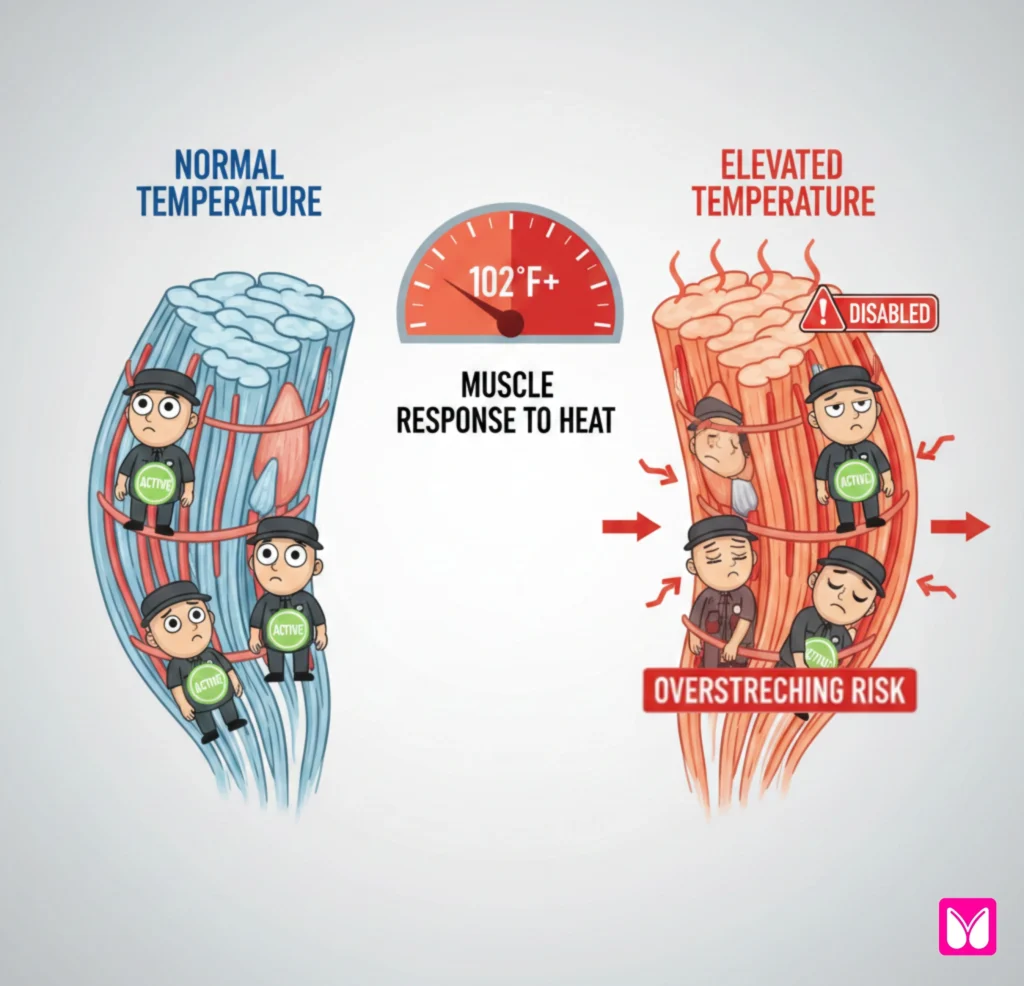
Why this happens: When your tissue temperature rises above 102°F, something fascinating occurs in your nervous system. Your muscle spindles are these tiny sensors that tell your brain, “Stop! We’re stretching too far!” They temporarily quiet down. It’s as if your body’s safety alarm is turned down.
The opening feels profound because it is profound. You’re accessing a range of motion you’ve literally never experienced before.
The Mental Clarity Feels Transcendent
Complete 90 minutes in 105-degree heat, and you’ll feel a sense of accomplishment that’s hard to match. A clarity emerges, a focus that cuts through mental fog.
Why this happens: Intense heat triggers a cascade of stress hormones—adrenaline, endorphins, the whole cocktail.
This neurochemical rush creates feelings that are remarkably similar to those of deep meditation: present, focused, and even euphoric.
The Community Is Powerful
There’s something about shared suffering that bonds people.
Hot yoga rooms create genuine camaraderie. You’re all in it together, pushing through together, surviving together.
This social reinforcement is real and valuable.
The Cultural Programming Runs Deep
We’ve been conditioned since childhood: sweat equals purification, difficulty equals growth, “no pain, no gain” is the path to transformation.
Hot yoga hits all these deeply embedded beliefs. It feels like it must be working because it’s hard, as evidenced by the sweat. After all, you’re conquering something difficult.
These aren’t placebo effects. They’re genuine physiological and psychological phenomena.
But now comes the critical question…
The Turning Point: What Does This Actually Mean?
Are these heat-induced effects moving you toward genuine mental stillness—or are they temporarily overriding mental turmoil through physiological stress?
This isn’t a semantic debate. This is the difference between:
- Numbing pain vs. healing the wound
- Temporary suppression vs. lasting transformation
- Distraction vs. genuine peace
Let me show you what’s really happening in that heated room.
Key Takeaways
- Yoga’s original goal is mental stillness, not intensity
- Heat may quiet the mind through exhaustion, not awareness
- Temporary relief and lasting transformation are not the same
- The environment of practice matters as much as the poses
PART I: What Heat Actually Does to Your Body (The Science They Don’t Tell You)
The Flexibility Trap: When “Opening” Becomes Dangerous
Remember those muscle spindles I mentioned—the sensors that tell your brain when you’re stretching too far? Here’s the uncomfortable truth:
Heat doesn’t improve flexibility. It turns off your body’s protective system.
Think of it like this: Imagine your joints have security guards whose job is to say “Stop! Don’t go further!” when you’re approaching your safe limit. Heat essentially puts those security guards to sleep.
A study in the Journal of Strength and Conditioning Research showed that when tissue temperature exceeds 102°F, muscle spindle sensitivity drops significantly. You can stretch further, not because you’ve gotten more flexible, but because your body literally cannot tell when you’re going too far.
Students regularly stretch beyond their structural capacity, repeatedly loading ligaments (the tough bands connecting bones) and joint capsules (the sacs surrounding their joints) that were never meant to bear that level of stress.
Key Takeaways
- Heat suppresses proprioception, increasing injury risk
- Fascia adapts slowly; heat creates mobility without stability
- Many hot yoga injuries appear months or years later
- Sweating is not detoxification — it is temperature regulation
The Fascia Problem: Surface Mobility Without Deep Support
Now let’s talk about fascia, that often-ignored tissue that changes everything.
What is fascia? Imagine a bodysuit made of Saran Wrap, but one that is living and adaptable. It’s the web of connective tissue that wraps around every muscle, every organ, every structure in your body. It’s what holds you together.

Here’s where hot yoga creates a dangerous mismatch:
When you rapidly heat your body, muscle tissue softens and feels pliable. But fascia’s deeper collagen matrix (think of it as the structural framework) doesn’t change that quickly. Healthy fascia remodelling requires slow, progressive loading over time, like how trees grow stronger by gradually adapting to wind.
Dr Robert Schleip, one of the world’s leading fascia researchers, emphasises that safe fascia adaptation needs “slow, progressive loading with adequate recovery periods.”
Hot yoga does the opposite: rapid, repeated loading while your body’s feedback system is compromised.
The result? You develop what biomechanics experts call “hypermobility without stability”—the equivalent of a house with loose hinges. Sure, the doors open wider, but they’re also more likely to fall off.
The Injuries That Announce Themselves Years Too Late
Here’s what makes this particularly insidious: these injuries don’t show up immediately.
Your shoulders start to subluxate (partially dislocate) during chaturanga.
Your SI joint (the connection between your spine and pelvis) destabilises.
Your knees hyperextend backward.
These issues accumulate over months and years, until one day a simple forward fold creates a disc herniation that shouldn’t have been possible.
I’ve seen it happen to dedicated practitioners who thought they were doing everything right.
The Detoxification Myth: Your Sweat Isn’t Cleaning You
Let’s address the elephant in the room: the “detox through sweat” claim.
I need to be direct here: Sweat is not a mechanism for detoxification.
Your kidneys and liver play a crucial role in detoxifying your body. Sweat regulates temperature. That’s it.
The concentration of toxins in sweat is negligible, being less than 1% of what your kidneys eliminate in the same timespan.
You’re not “releasing toxins.”
You’re cooling down.
But here’s what’s actually happening biochemically, and this is where things get troubling:
The Stress Hormone Reality Check
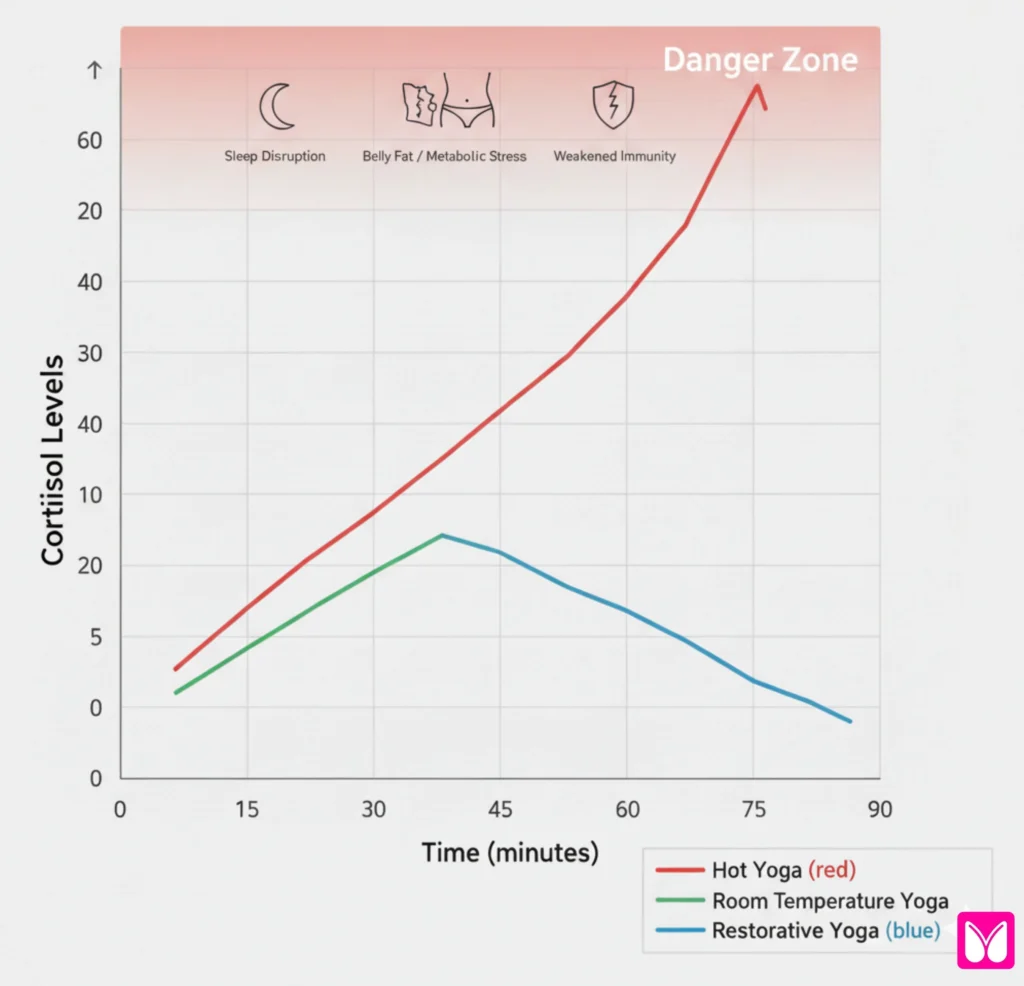
A study in the Journal of Physiological Anthropology found something concerning: prolonged heat exposure during exercise significantly elevates cortisol, your primary stress hormone.
Why? Because your body interprets the combination of physical exertion plus extreme heat as a survival threat.
Your biology doesn’t know you chose to be in that room. It just knows: “We’re overheating while working hard. This is dangerous. Activate emergency protocols.”
Your body responds by flooding your system with cortisol.
What chronic cortisol elevation actually does:
- Weakens immune function (you get sick more often)
- Disrupts sleep quality (even when you feel “tired enough” to sleep)
- Accelerates tissue breakdown (especially problematic when you’re also deep-stretching)
- Increases belly fat storage (ironic, given the weight-loss promises)
- Reduces memory formation and cognitive function
You’re not detoxifying.
You’re creating controlled, repeated stress exposure that your hormonal system must constantly scramble to manage.
This is the opposite of the calm, restorative state that yoga was designed to cultivate.
Mistaking Adrenaline for Vitality
That mental clarity? That sense of purification? That’s your stress response talking.
It’s the biochemical equivalent of mistaking the adrenaline rush of a near-miss car accident for vitality.
Sure, you feel incredibly alive in that moment, but that doesn’t mean it’s good for you.
PART II: What Heat Does to Your Mind (The Philosophical Breakdown)

Now we get to the heart of the issue: what yoga was actually designed to accomplish.
The Survival Response Masquerading as Meditation
The Yoga Sutras define yoga in the second sutra: Yogaś citta-vṛtti-nirodhaḥ—”Yoga is the stilling of mental fluctuations.”
Everything in yoga’s eight-limbed path serves this single purpose. Two critical steps in that path are:
- Pratyahara (sensory withdrawal) – learning to turn your attention inward
- Dharana (concentration) – training your mind to stay focused without force
These aren’t about forcing focus through willpower or intense conditions. They’re about creating an environment where your mind naturally settles, allowing attention to rest without being constantly pulled by external stimuli.
Hot yoga makes this physiologically impossible.
Here’s what happens in your body when the temperature exceeds 100°F:
Your hypothalamus (your brain’s thermostat) activates emergency cooling protocols.
Blood vessels dilate.
Heart rate spikes.
Your sympathetic nervous system: the “fight or flight” branch, takes complete control.
Every system in your body is screaming one message: Deal with this heat. NOW.
The Crucial Distinction: Hijacked Attention vs. True Concentration
The focus you experience in that heated room isn’t meditation. Survival imperatives hijack your attention.
Accurate concentration in yoga means being able to observe thoughts as they arise and dissolve without grasping at them or pushing them away.
It’s effortless, alert, witnessing what the tradition calls Sakshi Bhava (witness consciousness). You’re observing your mind like you’d observe clouds passing across the sky.
Forced attention in hot yoga means that any lapse in focus brings immediate physical discomfort, dizziness, nausea, and exhaustion.
You’re not training your mind to be still. You’re training it to fixate on not collapsing.
The honest work happens in a cool, quiet room, where the mind has nowhere to hide behind the drama of heat. In that stillness, you are forced to meet your mental restlessness, your boredom, your resistance. This is the real practice. Everything else is performance.
Why Comfort Actually Serves Consciousness
This brings us to a counterintuitive truth that makes people uncomfortable:
The conditions for genuine mental transformation are not intense. They’re quiet, stable, and comfortable enough that your nervous system can actually relax.
The Hatha Yoga Pradipika, one of yoga’s foundational texts from the 15th century, states explicitly that practice should occur in a space that is “neither too hot nor too cold.”
This isn’t an arbitrary preference. The ancient yogis understood that extremes of any kind, whether temperature, effort, or sensation, activate defensive responses that prevent the subtle internal work required by yoga.
Modern neuroscience validates this ancient wisdom:
Your prefrontal cortex, the part of your brain responsible for self-regulation, meta-awareness, and observing your own thought patterns, functions optimally when your autonomic nervous system is balanced.
Chronic sympathetic activation (like heat-induced stress) literally reduces your capacity for the self-observation that meditation requires.
The Snow Globe Test
Remember that snow globe metaphor? Let me extend it:
Imagine you’re trying to read something written at the bottom of a snow globe.
If you keep shaking it violently, you’ll never see what’s written there—even if the constant motion makes you feel like you’re “doing something.”
Hot yoga is shaking your mental snow globe harder while making you too physically exhausted to notice it’s still churning.
Real yoga is about learning to stop shaking the globe and let everything settle naturally, so you can finally see what’s been there all along.
The hot yoga practitioner may feel they’ve achieved mental stillness because the volume of thought decreases.
But this is suppression through distraction, not transformation through awareness.
The moment they leave the heated environment, the mental patterns return—unchanged, unexamined, unhealed.
Key Takeaways
- Extreme heat activates fight-or-flight physiology
- Survival focus is not the same as meditation
- Genuine concentration requires nervous system balance
- Yoga works best in conditions that allow stillness, not strain
PART III: Dismantling the Remaining Claims (The Marketing vs. Reality)
Let’s methodically address the other hot yoga benefits with the same rigour:
The “Toning” Illusion: What That Post-Class Glow Really Means
The Promise: Hot yoga creates a lean, toned physique faster than conventional practice.
The Reality: The additional calories burned in a heated room are approximately 50-70 extra calories per session compared to the same practice at room temperature.
That’s less than a banana.
What you’re actually seeing post-class: Temporary fluid loss and muscle pump.
You’re looking at acute dehydration and enhanced vascularity (blood vessels closer to the surface), not fat loss or increased muscle definition.
Here’s the metabolic truth bomb:
Sustainable body composition changes primarily depend on hormone regulation, particularly insulin and cortisol.
Remember that chronic cortisol elevation we discussed? It actively undermines your body composition goals:
- Increases belly fat storage
- Breaks down lean muscle tissue
- Disrupts thyroid function (slowing metabolism)
- Increases insulin resistance (making fat storage easier)
A meta-analysis in Psychoneuroendocrinology found that chronic physiological stress (like repeated heat exposure during exercise) is associated with increased abdominal fat and metabolic dysfunction, independent of how many calories you’re eating.
Translation: The very mechanism that makes hot yoga feel intense is working against your aesthetic goals.
For genuine body composition improvement, you need practices that reduce cortisol, such as strength training, walking, and non-heated yoga, along with adequate rest.
The “Cardio” Misdirection: Why Your Racing Heart Doesn’t Mean What You Think
The Claim: Hot yoga offers cardiovascular conditioning comparable to that of running or cycling.
The Reality: Elevating heart rate through thermal stress is not the same as cardiovascular conditioning through aerobic work.
Think of it this way: Your heart rate also increases when you’re sitting in a sauna. That doesn’t mean you’re getting a cardio workout.
What’s actually happening:
Your heart rate increases primarily because your body is redirecting massive amounts of blood to your skin for cooling.
Your heart has to pump harder to maintain blood pressure while blood vessels in your periphery are dilated.
This is a thermoregulatory response, not an improvement in oxygen delivery to working muscles.
Accurate cardiovascular adaptation requires:
- Progressive overload of your aerobic energy system
- Efficient heart pumping
- Increased mitochondria (your cellular power plants)
- Improved capillary density
A study in the European Journal of Applied Physiology compared cardiovascular responses to exercise in heated versus normal conditions. The findings:
- Heart rate was significantly higher in the heat
- BUT stroke volume (blood pumped per beat) actually decreased
- Perceived exertion was dramatically higher for the same objective workload
Translation: You feel like you’re working much harder, but your cardiovascular system isn’t gaining the adaptive benefits of actual aerobic conditioning.
You’re faking cardiovascular intensity through environmental manipulation—like putting your car in neutral and revving the engine while parked.
The “Mood-Boost” Hook: Endorphin High vs. Lasting Peace
The Experience: Undeniable mood elevation after class, a sense of euphoria and accomplishment.
The Truth: Any intense physical activity triggers the release of temporary endorphins and endocannabinoids.
This is not unique to hot yoga, nor does it necessarily indicate that the practice is moving you toward lasting well-being.
Here’s what matters: baseline shift.
Yoga’s promise has never been about chasing pleasant experiences. The Yoga Sutras explicitly identify attachment to pleasurable states (Raga) and aversion to uncomfortable ones (Dvesha) as two of the five core afflictions that perpetuate suffering.
When your mood depends on regularly delivering an intense experience, whether that’s heated yoga, a long run, or anything else, you’ve created a subtle addiction.
Your baseline state hasn’t improved; you’ve just found a more socially acceptable way to escape it.
Genuine contentment (what yoga calls Santosha) emerges from equanimity—the capacity to remain steady regardless of whether experiences are pleasant or unpleasant.
This is cultivated through practices that train you to observe sensation without reactivity: meditation, slow mindful movement, and yoga practised with attention rather than intensity.
The hot yoga mood boost is real. But it’s pharmacological, not transformational. It’s the feeling of having survived stress—not the profound peace of a nervous system that’s genuinely regulated.
The Verdict: Outstanding Workout, Inefficient Yoga
Let me be crystal clear about something:
Hot yoga is not inherently evil. For individuals who enjoy it, aren’t experiencing injuries, and practice other modalities that balance stress exposure, it can absolutely be part of a varied movement practice.
But let’s be ruthlessly honest about what it is:
An intense physical workout incorporating yoga postures.
It is neither an efficient nor particularly safe method for achieving yoga’s stated purpose.
If your goal is genuine mental stillness (Vṛtti Nirodha), if you want the proven benefits of yoga practice—reduced anxiety, improved nervous system regulation, sustainable flexibility, lasting mental clarity, you need fundamentally different conditions.
Key Takeaways
- Extra calorie burn in hot yoga is minimal
- Elevated heart rate from heat ≠ cardiovascular conditioning
- Mood boosts come from stress hormones, not baseline peace
- Intensity can feel transformative without being sustainable
The Evidence Summary Across All Domains:
Biomechanically: Heat compromises proprioception (your body’s sense of where it is in space) and creates flexibility without stability, setting you up for future injury.
Biochemically, Chronic heat exposure elevates cortisol and creates metabolic stress, contradicting claims of detoxification and improvements in body composition.
Neurologically, Thermal regulation hijacks attention, preventing the conditions necessary for genuine meditative development.
Philosophically, the practice violates yoga’s fundamental design principles by creating intensity where stillness is required.
The Smarter Path: Practices That Actually Transform
The scientifically and philosophically superior path is clear: practices that cultivate genuine stillness without physiological override.
What Actually Works:
Yin Yoga: Long-held, passive stretches (3-5 minutes per pose) that allow fascia to remodel safely while teaching your mind to remain present with discomfort—without the distraction of heat.
Restorative Yoga: Deeply supported poses using props that activate the parasympathetic nervous system (your “rest and digest” response)—this is where healing actually occurs.
Mindful Vinyasa: Movement coordinated with breath at a pace that allows attention to remain internal, building heat naturally through muscular engagement rather than environmental manipulation.
Meditation: Direct training of the witnessing awareness that is yoga’s ultimate goal—sitting with your mind as it is, not as you wish it were.
The Honest Challenge
These practices aren’t “easier.” They’re harder—because you cannot hide behind intensity.
Every mental fluctuation is visible.
Every resistance, every grasping, every moment of boredom or restlessness is right there, demanding to be witnessed rather than overridden by heat and exhaustion.
That’s the honest work. That’s where transformation actually happens.
Your Next Move: Choose Integrity Over Intensity
Your practice deserves better than marketing hype. It deserves the integrity of methods designed to produce the outcomes they claim.
The heat may feel transformative in the same way that any intense experience feels significant in the moment.
But stillness, be it real, cultivated, hard-won stillness, is what actually transforms you.
Not the temporary quiet of exhaustion. The lasting peace of a mind that’s learned to settle on its own.
The choice is yours: Keep chasing the heat-induced high, or start building the conditions for genuine transformation.
One feels more dramatic. The other actually works.
Experience Yoga Without the Heat
If this article resonated, your next step is simple:
explore Mindfullyoga’s yin, restorative, and slow vinyasa practices that is designed to support genuine mental stillness, nervous system balance, and long-term joint health.Start with a non-heated class on Mindfullyoga and feel the difference for yourself.
I
FREQUENTLY ASKED QUESTIONS
1. Can I ever do hot yoga, or is it completely off-limits?
ANS: Hot yoga isn’t forbidden- it’s just not what it claims to be. If you enjoy it as an intense physical workout and aren’t experiencing injuries, it can be part of a balanced movement practice. Just don’t expect it to deliver on yoga’s actual promises of mental stillness and sustainable flexibility.
2. How do I know if hot yoga is causing hidden damage?
ANS: Warning signs include: persistent joint instability, hyperextension habits, injuries that seem to come out of nowhere, sleep disruption despite being “exhausted,” and mental patterns that return unchanged between classes.
3. What’s the best way to transition from hot yoga to more sustainable practices?
ANS: Start with one or two non-heated classes per week. Focus on yin or restorative yoga to rebalance your nervous system. As you develop tolerance for practices without the intensity distraction, gradually shift the ratio. Your body and mind will tell you when something is actually sustainable—it feels less dramatic but more lasting.
4. Will I lose all my flexibility if I stop hot yoga?
ANS: Here’s the paradox: the flexibility you built in hot yoga was partly artificial (reduced proprioceptive feedback). As you transition to room-temperature practice, you’ll lose some superficial range but gain something more valuable—sustainable, stable flexibility with proper joint support. Your body will thank you long-term.
5. Isn’t all this just your opinion?
ANS: The biomechanical effects of heat on proprioception, the hormonal response to thermal stress, and the neurological requirements for genuine meditation are well-documented in peer-reviewed research. The philosophical framework originates directly from classical yoga texts, including the Yoga Sutras and the Hatha Yoga Pradipika. This isn’t opinion, it’s a synthesis of established science and traditional wisdom.
Ready to experience yoga that honours both ancient wisdom and modern science? Discover practices designed for genuine mental stillness and lasting physical integrity—without the thermal stress that compromises both.
This article reflects the philosophical inquiry, lived practice, and critical perspective of Nandini Sharma, founder and guiding voice behind Mindfullyoga. As a long-term student of the Yoga Sutras, Hatha Yoga Pradipika, and classical yogic philosophy, Nandini Sharma is the sole author of the philosophical, ethical, and experiential insights presented in this work.
Her writing draws from years of personal practice, study, and observation of how modern yoga culture intersects, often uncomfortably, with biomechanics, nervous system health, and the original intent of yoga as a path toward Vṛtti Nirodha (mental stillness). This article is part of her ongoing mission to protect the integrity of yoga from reduction into commercial performance or fitness spectacle.
Content Strategy & SEO Optimization:
The structure, formatting, and search optimization of this article were supported by Emmanuel Okafor, Content Strategist, to ensure these insights remain accessible and discoverable amid the noise of the global yoga and wellness industry, without altering the philosophical voice or conclusions of the author.This content is intended for educational and reflective purposes only and does not replace personalized medical or therapeutic advice.

Emmanuel Okafor
Emmanuel Okafor is a skilled SEO specialist and content writer with hands-on experience in optimizing websites for visibility, traffic, and authority.Emmanuel has contributed to the growth of several startups across various niches, including AI, technology, health, and mental well-being. He is passionate about storytelling, digital marketing, and helping brands meaningfully connect with their audience online.