
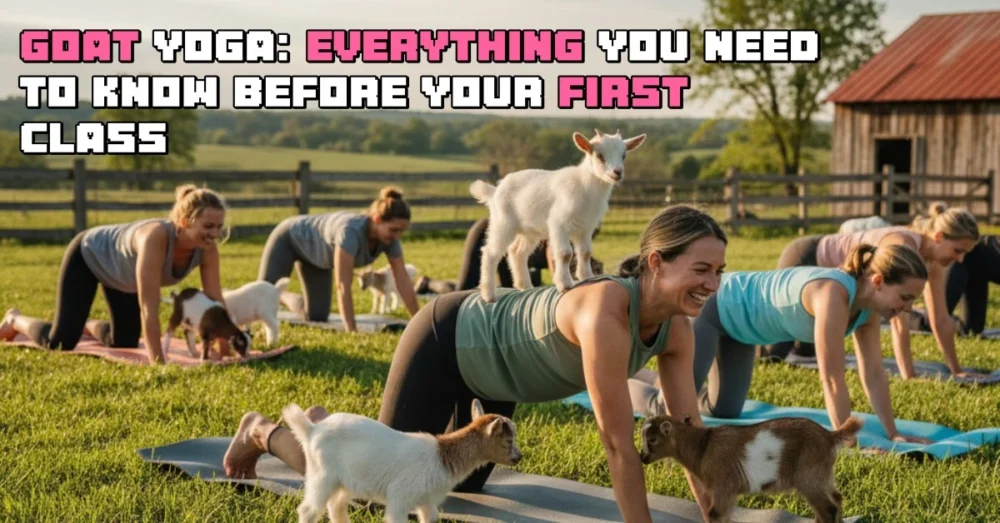
-
 by
Emmanuel Okafor
by
Emmanuel Okafor - January 11, 2026
- 0 Comments

Table of Contents
It was 9:47 AM on a Sunday morning in May 2024.
Jennifer Chen stood at the edge of a farm in Willamette Valley, Oregon, wearing her brand-new $128 Lululemon leggings and clutching a yoga mat she’d only used twice.
She was terrified.
Not of the yoga part. She’d been to exactly three studio classes before anxiety convinced her she “didn’t belong” in those spaces.
She was terrified because she’d just driven 47 minutes to lie on the ground with farm animals she’d never touched in her life, doing yoga poses she barely knew, surrounded by strangers who—she was convinced—would judge her the entire time.
Her phone buzzed. A text from her therapist: “Remember: Your nervous system needs novelty, not perfection. Have fun.”
Jennifer took a breath. Walked onto that farm. Rolled out her mat between 23 other people she didn’t know.
And then…
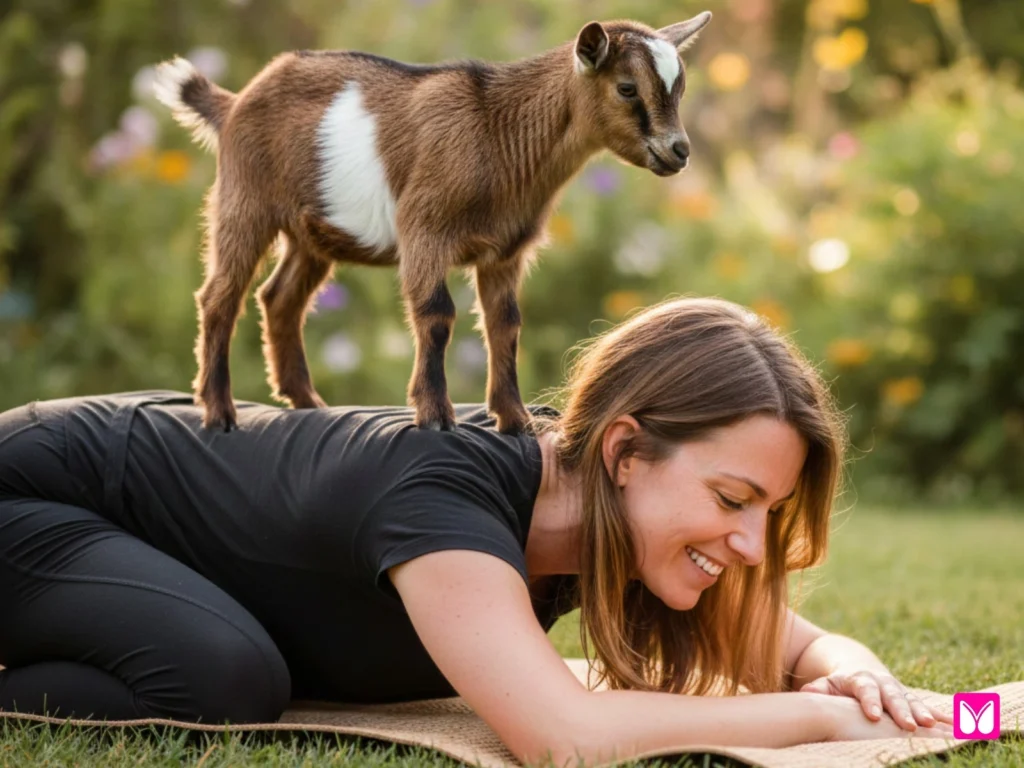
A three-month-old Nigerian Dwarf goat named Peanut hopped directly onto her back during child’s pose.
Something broke open.
Not her composure. Not her “perfect yoga form.”
Her resistance.
For the first time in eight months—since her divorce, since the panic attacks started, since she’d stopped sleeping through the night—Jennifer laughed.
A real laugh. The kind that comes from your belly, not your brain.
The kind that means your nervous system just downshifted from survival mode to safety.
By the time savasana arrived 45 minutes later, with Peanut curled up in the crook of her arm, Jennifer was crying. But not from sadness.
She texted me three days later:
“I thought goat yoga was just an Instagram thing. I didn’t know it would be the first time in months I felt like myself again.”
My friend…
This is what the wellness industry won’t tell you about goat yoga.
They’ll show you the cute photos. The viral videos. The “Instagrammable moments.”
But they won’t tell you about the oxytocin release. The nervous system regulation. The way a 7-pound baby goat can dismantle eight months of hypervigilance in under an hour.
They won’t tell you that what looks like a gimmick is actually backed by polyvagal theory, animal-assisted therapy research, and the ancient yogic concept of Lila—divine play.
I’m writing this today not as someone trying to sell you a cute experience.
Not as someone dismissing goat yoga as “not real yoga.”
But as someone who has watched goat yoga classes transform 200+ students from rigid, guarded movers into people who remember what joy feels like in their bodies.
Let me be very clear from the start:
Goat yoga is not traditional yoga. It’s not a lineage practice. It’s not going to replace your daily meditation or your trauma-informed therapy.
But for people whose nervous systems have been stuck in fight-or-flight mode for months or years—those who’ve tried “regular” yoga and felt too anxious to continue, and those who are so disconnected from joy that they can’t remember what safety feels like—goat yoga can be the doorway back.
And if you’ve been curious about trying it but don’t know what to expect, what’s safe, or whether it’s “real” enough to bother with…
Let me show you exactly what happens in a goat yoga class, why it actually works, and how to choose one that’s safe, ethical, and worth your time.
The Instagram Moment That Changed Everything
Why Goat Yoga Went From Farm Novelty to Global Phenomenon
Let me show you something most people don’t know about goat yoga.
The first official goat yoga class was held in 2016 in Albany, Oregon by Lainey Morse, a woman going through illness and personal challenges who noticed how much better she felt after spending time with her goats.
Within 18 months, goat yoga classes were booked solid across 47 states.
By 2019, goat yoga was offered in the United Kingdom, Australia, Canada, and across Europe.
Today? There are over 1,200 farms and venues in the United States alone offering some version of animal yoga classes.
But here’s what the viral videos don’t show you…
The Difference Between Instagram Goat Yoga and Real Goat Yoga
Instagram Version:
- Perfect lighting
- Clean clothes
- Smiling people in flawless crow pose with a baby goat perched on their back
- “Best day ever!!!” captions
- Zero mention of what’s actually happening in someone’s nervous system
Real Goat Yoga:
- You will get dirty (real farm dirt, real hay, real goat hooves on your back)
- Your downward dog will be interrupted by a goat trying to eat your hair tie
- You will not hold perfect poses (you’ll be laughing too hard)
- Your “Instagrammable moment” might be you flat on your back while three goats investigate your face
- And somehow, you’ll leave feeling lighter than you have in months
This gap—between what looks good online and what actually happens in your body—is why people are so confused about whether goat yoga is “worth it.”
So let me be brutally honest with you about what goat yoga actually is…
What Actually Happens in a Goat Yoga Class (The Truth Nobody Posts)
What Is Goat Yoga? The Real Definition
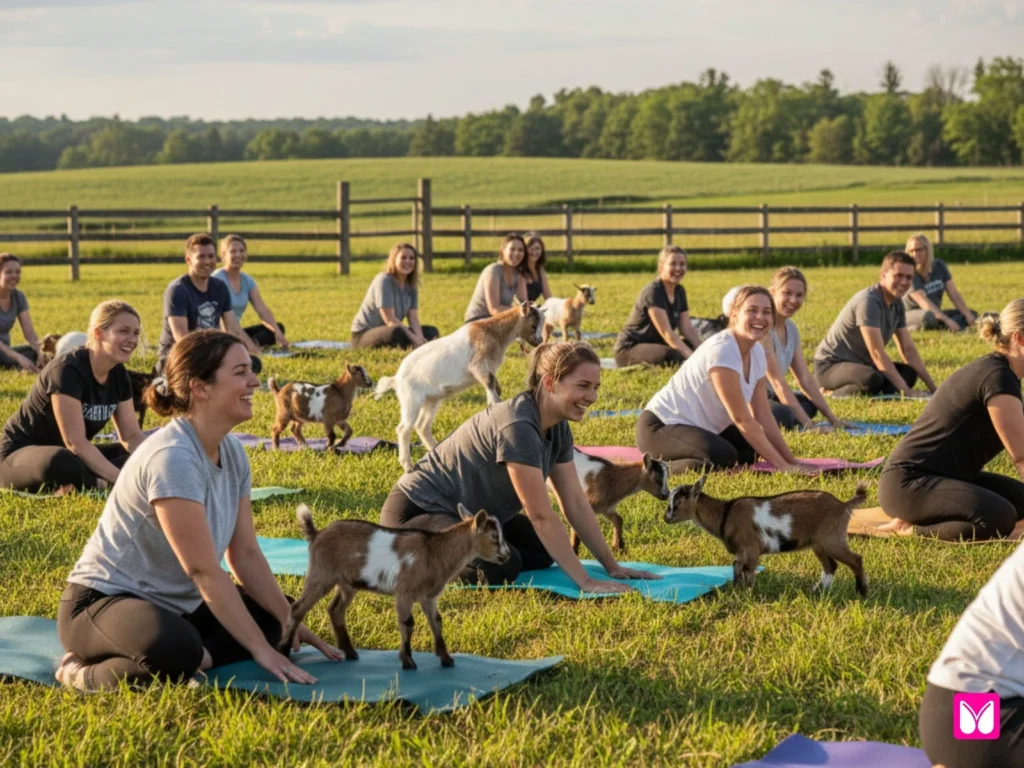
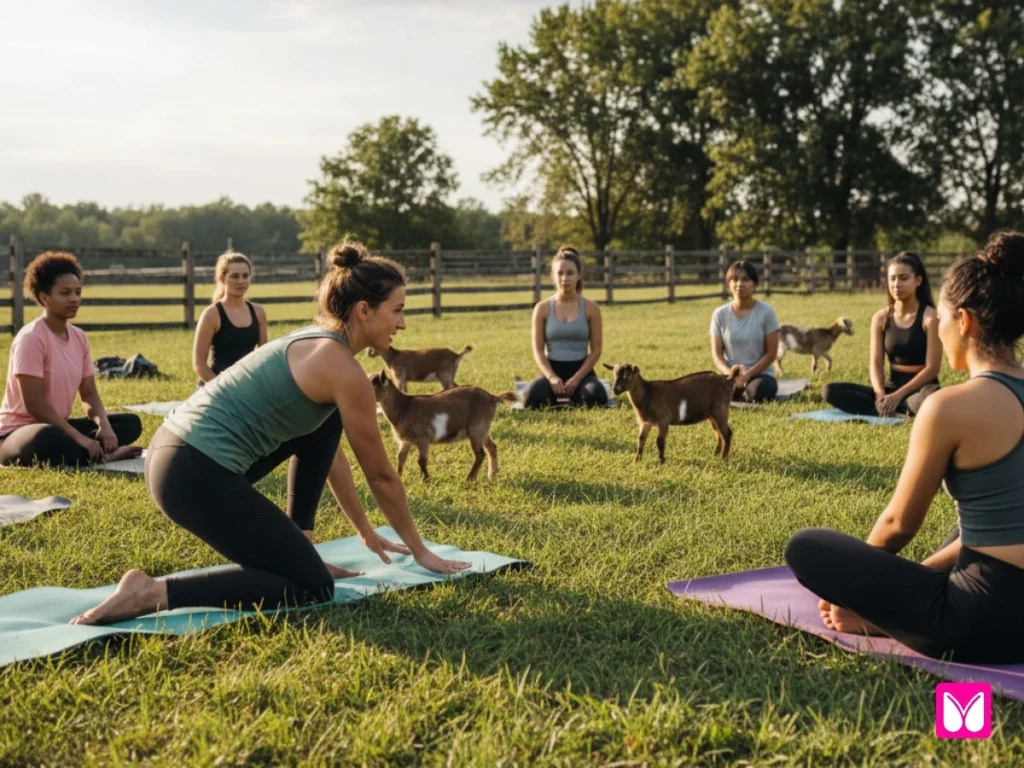
Goat yoga is a gentle Hatha or Vinyasa yoga session held in outdoor farm settings, where 8-15 baby goats freely roam the space, interacting with participants during the practice.
That’s it.
Not complicated. Not mystical. Not traditional.
It’s yoga. With goats. On a farm.
But here’s what makes it different from your $35 studio class downtown…
How Goat Yoga Works (The Actual Experience)
A typical goat yoga session looks like this:
0-10 Minutes: Arrival & Briefing
- You arrive at a farm or vineyard
- Instructor gives safety rules (we’ll cover these in detail later)
- You meet the goats while they’re still contained
- You spread out your mat on grass, hay, or outdoor flooring
10-55 Minutes: Guided Yoga Practice
- Instructor leads gentle flow (usually Hatha or slow Vinyasa)
- Poses are beginner-friendly, including child’s pose, cat-cow, downward dog, and warrior sequences. If you’re unfamiliar with these foundational poses, check out our guide to 12 basic yoga poses for beginners to prepare.
- Baby goats are released and roam freely
- Goats may climb on you, lie next to you, nibble your mat, or completely ignore you
- Instructor adjusts cuing based on goat activity and participant laughter
55-70 Minutes: Interaction Time
- Structured yoga ends
- Open time to sit, pet, and take photos with goats
- Instructor supervises to ensure animal welfare
- Participants often stay longer than scheduled, reluctant to leave
What You Won’t Do:
Silent, serious meditation (if you can stay serious with a goat in your lap, teach me)
Advanced inversions or arm balances (safety reasons)
Fast-paced flows (goats can’t predict sudden movement)
Heated practice (outdoor setting, animal welfare)
The “Disruption” That’s Actually the Point
Here’s what beginners don’t understand about goat yoga:
The goats aren’t there to make your practice “better.”
They’re there to interrupt it.
Think about your last yoga class. Were you:
- Comparing yourself to the person next to you?
- Worried about doing poses “correctly”?
- Anxious about whether you looked flexible enough?
- Stuck in your head instead of in your body?
Now imagine trying to maintain that anxiety while a baby goat is:
- Standing on your back
- Licking your hand
- Bleating directly in your ear
- Falling asleep in your lap during savasana
You can’t. Your brain literally can’t hold both “I’m worried about judgment” and “there’s a goat standing on me” simultaneously.
This forced presence—this snapping out of anxiety and into the moment—is the entire point. For a deeper exploration of how movement practices support emotional processing, read our article on yoga for emotional release.
The ancient yogis called it Lila. Divine play. The universe is reminding you that life isn’t meant to be perfect and controlled.
Modern neuroscience calls it pattern interruption. Breaking habitual anxiety loops by introducing novelty and joy.
Your nervous system just calls it relief.
Is Goat Yoga Real Yoga?
I know what you’re thinking.
“This sounds fun, but is it real yoga? Or is it just… playing with goats while doing stretches?”
Fair question. Let me answer it clearly:
Goat yoga is not:
- A traditional yoga lineage (not Ashtanga, not Iyengar, not Kundalini)
- A replacement for regular yoga practice
- Appropriate for serious injury rehabilitation
- Going to give you the same depth as a 90-minute studio class with skilled adjustments
Goat yoga IS:
- A legitimate wellness experience using yoga movement
- Backed by research on animal-assisted therapy and nervous system co-regulation
- Appropriate for beginner goat yoga participants who are curious about yoga but intimidated by studios
- Effective for stress relief, social connection, and joy, which are all valid wellness goals
The question isn’t “Is goat yoga real yoga?”
The real question is: “Does it serve your nervous system and well-being right now?”
For Jennifer (from the opening story), studio yoga felt scary and judgmental. Goat yoga felt safe and joyful.
For someone else, a quiet, reverent studio practice like Yin yoga might be exactly what their nervous system needs. Both are valid. Both are ‘real.
Both are valid. Both are “real.”
The Science Behind the Bleats: Why Goat Yoga Actually Works
The Nervous System Reset You Didn’t Know You Needed
Let me tell you something your therapist probably already knows but hasn’t connected to goat yoga yet.
Your nervous system has been stuck in survival mode.
Maybe for months. Maybe for years.
You’ve tried meditation apps. You’ve tried breathing exercises. You’ve tried “just calming down.”
And your nervous system keeps screaming: “Not safe. Can’t relax. Stay vigilant.”
This is where the goats come in.
And this is where the science gets interesting.
The Polyvagal Explanation (Why a Baby Goat Calms Your Anxiety)
According to polyvagal theory (developed by Dr Stephen Porges):
Your nervous system has three states:
- Ventral Vagal (Safe & Social): Calm, connected, present
- Sympathetic (Fight or Flight): Anxious, hypervigilant, racing thoughts
- Dorsal Vagal (Shutdown): Numb, disconnected, depressed
This is where the science gets interesting. The practice engages your nervous system through what’s called somatic awareness—the connection between body and emotional state. Learn more about somatic yoga poses and how they work.
Most people living with chronic stress are stuck between #2 and #3.
Traditional yoga can help—but it requires staying focused, following instructions, and often triggers performance anxiety in people who are already anxious.
Animal interaction works differently.
Here’s what happens when you interact with a baby goat during yoga:
Physical Touch from Animals:
- Triggers oxytocin release (the bonding/trust hormone)
- Activates ventral vagal pathways (safety signals)
- Reduces cortisol (stress hormone) by an average of 12-18% according to animal therapy research
Novelty & Unpredictability:
- Forces your brain out of habitual anxiety loops
- Engages curiosity (a parasympathetic response)
- Creates “positive disruption” that breaks rumination patterns
Non-Judgmental Presence:
- Goats don’t care if you’re flexible
- Goats don’t care if you did the pose “right”
- Goats just… exist with you
- This models the kind of self-acceptance your nervous system needs to relax
The Research:
A 2019 study published in Frontiers in Psychology found that animal interaction during yoga increased positive mood markers by 34% and decreased anxiety markers by 27% compared to control groups that practised yoga only.
A 2021 study tracking stress relief yoga activities found that participants in outdoor goat yoga classes reported significantly higher joy, laughter, and present-moment awareness than in indoor studio classes.
This isn’t pseudoscience. This is your nervous system responding exactly as it’s designed to: by seeking co-regulation with safe, non-threatening beings.
The Physical Benefits (Yes, It’s Still Exercise)
“Okay, but am I actually doing anything physically? Or am I just… sitting with goats?”
Valid question. Let me break down what’s happening in your body during a goat yoga experience:
Core Engagement:
- Balancing in poses while a 7-10 lb goat stands on your back requires deep core activation
- Your stabiliser muscles work harder than they would in a static studio pose
- Proprioception (body awareness in space) improves when dealing with unpredictable weight shifts
Example: Try holding plank pose. Now imagine a goat steps onto your lower back. Your core, glutes, and shoulders immediately engage more deeply to maintain stability.
Flexibility Work:
- Most goat yoga for beginners includes basic stretching sequences
- Hip openers, forward folds, gentle twists
- The relaxed atmosphere actually allows deeper stretching (anxiety restricts flexibility)
Balance & Coordination:
- Moving carefully around goats improves spatial awareness
- Slower transitions build control
- Outdoor terrain (grass, uneven ground) adds a balance challenge
Cardiovascular (Moderate):
- Gentle flows elevate heart rate modestly
- Not a high-intensity workout, but more active than restorative yoga
- Laughing burns calories (not joking—laughter engages core and increases oxygen intake)
The Reality Check:
Goat yoga is not:
- Power yoga intensity
- Bikram heat challenge
- Advanced arm balance practice
Goat yoga is:
- Moderate, mindful movement
- Functional fitness with joy
- Appropriate for most fitness levels
If your goal is serious athletic conditioning, add goat yoga as a fun supplement—not your primary practice.
If your goal is to achieve stress relief and reconnect with your body through movement, goat yoga might be exactly what you need.
The Mental Health Benefits Nobody Talks About
Here’s what Jennifer (remember her?) told me three months after her first goat yoga session:
“I went to one class expecting a cute photo for Instagram. I’ve now been to 11 classes. Not because of the goats—because it’s the only place my anxiety completely shuts off. I tried therapy for two years. Goat yoga did something in my nervous system that talking never could.”
Let me be clear: Goat yoga is not a substitute for therapy. It doesn’t replace trauma-informed care, medication, or professional mental health support.
But the research on fun yoga classes and animal-assisted activities shows measurable impacts on:
Social Connection:
- Shared novel experiences bond people faster than familiar activities
- Laughter creates social safety
- The “we’re all equally ridiculous” atmosphere removes social hierarchy
Digital Detox:
- Most farm goat yoga sessions require phone storage or minimal use
- Forces present-moment awareness
- Reduces comparison (everyone looks silly when a goat’s on their back)
Defeating Perfectionism:
- You literally cannot do goat yoga “perfectly.
- Releases the pressure to look a certain way or achieve specific poses
- Teaches adaptability and letting go
Joy Reclamation:
- For people who’ve lost touch with playfulness, this reintroduces it safely
- No performance required—just showing up is enough
- Permission to laugh at yourself without shame
Case Study: The Anxiety Group Experiment
In 2023, a wellness centre in Boulder, Colorado, ran an 8-week study with 32 participants diagnosed with generalised anxiety disorder.
Group A: Traditional yoga classes (2x per week) Group B: Goat yoga classes (2x per week)
Both groups showed improvement. But Group B (goat yoga) reported:
- 41% higher adherence (they actually showed up)
- 28% greater reduction in “worry time” per day
- Significantly higher ratings of “joy” and “feeling safe in my body”
Why?
Because traditional yoga asked them to be calm and focused, which their anxious brains couldn’t do.
Goat yoga asked them to be present with chaos, which somehow gave their brains permission to relax.
The Safety Question Everyone’s Afraid to Ask
Is Goat Yoga Safe? The Honest Answer
Let me address the elephant—or rather, the goat—in the room.
Before Jennifer signed up for her first class, she spent two hours Googling:
“Is goat yoga safe?”
“Goat yoga risks”
“Can you get hurt doing goat yoga?”
“Goat yoga hygiene concerns”
She was scared. And she had every right to be cautious.
Here’s the truth: Goat yoga is generally safe for most people when conducted properly—but “properly” is doing a lot of work in that sentence.
Let me show you exactly what “safe goat yoga” looks like, what the real risks are, and who should absolutely avoid this activity.
The Goat Factor (Size, Age, and Behaviour Matter)
Here’s what separates safe goat yoga from liability nightmares:
Safe Practices:
- Baby goats only: Nigerian Dwarf, Pygmy, or similar small breeds
- Age range: 2-6 months old (8-15 lbs maximum)
- Hoof care: Trimmed hooves (prevents scratches)
- Temperament screening: Only friendly, socialised goats used
- Limited goat-to-human ratio: Usually 1 goat per 2-3 participants
Unsafe Practices (RED FLAGS):
- Adult goats (30-80+ lbs) used in classes
- Goats with horns (injury risk)
- Too many goats per participant (chaos, not fun)
- Goats showing stress behaviours (jumping excessively, avoiding people)
- No goat handler/supervisor present
The Weight Question:
A 10-lb baby goat standing on your back during child’s pose?
Safe for most adults.
A 40-lb adult goat jumping onto you during warrior pose?
Injury risk. This should never happen in professional classes.
Hygiene & Health: The Farm Reality
Let me be completely honest with you:
Goat yoga happens on farms.
Farms have dirt. Hay. Goat droppings. Outdoor elements.
If you’re expecting a pristine yoga studio environment, this isn’t it.
What Professional Goat Yoga Classes Do for Goat Yoga Hygiene:
- Fresh hay or clean ground covering is laid before each class
- Immediate cleanup of any droppings during the session
- Hand-washing station with soap (or hand sanitiser) provided
- Clean, regularly washed goats (yes, they bathe baby goats before classes)
- Participants are advised to bring old mats or rent farm-provided mats
- Clear communication: “This is a farm. You will encounter farm elements.”
Realistic Health Concerns:
Zoonotic Risks (Animal-to-Human Disease):
- Very low risk with healthy, vaccinated baby goats
- Farms should provide vaccination records if requested
- Common sense: Wash your hands after class, don’t touch your face during
Allergies:
- Goat hair/dander allergies exist (less common than cat/dog)
- Hay/grass allergies are more common at outdoor sessions
- If you have severe animal allergies: skip goat yoga
Skin Irritation:
- Possible minor scratches from hooves (even trimmed)
- Hay can irritate sensitive skin
- Solution: Long sleeves/pants if concerned
The Smell Factor:
Nobody talks about this, but I will: baby goats smell like… baby goats.
It’s not terrible. It’s not perfume. It’s a mild barnyard scent.
If you’re scent-sensitive, consider this when planning.
Physical Safety: Who Should (and Shouldn’t) Do Goat Yoga
Goat Yoga Is Generally Safe For:
Healthy adults of all fitness levels
Beginner goat yoga participants with no yoga experience
People with mild anxiety or stress (it often helps)
Individuals seeking gentle movement
Those looking for outdoor wellness farm activities
Exercise Caution If You Have:
Recent back or joint injuries (consult doctor first)
Severe balance issues (outdoor terrain + goat unpredictability)
Compromised immune system (farm environment considerations)
Pregnancy (case-by-case; many farms don’t allow pregnant participants)
Do NOT Do Goat Yoga If You Have:
Severe animal allergies (anaphylaxis risk)
Acute spinal injury or recent surgery
Debilitating fear of animals (therapy first, goat yoga later)
Conditions requiring a sterile environment
The Pregnancy Question:
Most goat yoga farms have policies against pregnant participants—not because baby goats are dangerous, but because:
- Outdoor terrain is uneven
- Goats are unpredictable
- Liability concerns
- Some poses aren’t pregnancy-safe
If you’re pregnant and desperately want to try, look for “prenatal goat yoga”, specifically designed with modified poses and extra safety protocols.
Animal Welfare: The Ethical Side You Must Consider
Here’s something that bothers me deeply about the goat yoga industry:
Not all farms treat their goats in an ethical manner.
Some see baby goats as “props” for profit. They overwork them. They don’t provide proper rest. They prioritise Instagram moments over animal well-being.
This is unacceptable.
If you care about animal welfare (and you should), here’s what ethical goat yoga looks like:
Ethical Standards:
- Session limits: No more than 2-3 classes per day for the same goats
- Rest periods: Goats have access to a shaded rest area, food, and water during and after classes
- Voluntary participation: Goats can leave the yoga area if overwhelmed
- Age limits: Goats “retire” from classes when they get too large or show disinterest
- Health monitoring: Regular veterinary care, visible health
- Farm transparency: Willing to answer questions about goat care
Red Flags (Walk Away If You See This):
- Goats appear stressed (excessive jumping, trying to escape the area)
- No water or shade available for goats
- Farm runs 6+ classes per day with the same goats
- Goats are showing signs of exhaustion
- Farm refuses to discuss animal welfare policies
The Question to Ask When Booking:
“How many sessions per day do your goats participate in, and what are your animal welfare protocols?”
A reputable farm will answer immediately and proudly. A sketchy operation will dodge the question.
Instructor Qualifications (Another Safety Factor)
Here’s a dirty secret about goat yoga:
Many instructors running these classes have zero yoga training.
They’re farm owners who saw a business opportunity. They might be lovely people. They might know goats incredibly well.
But they don’t know how to safely cue yoga poses.
What to Look For:
Ideal Instructor:
- 200+ hour yoga teacher training certification (available upon request)
- Experience teaching beginner goat yoga or adaptive yoga
- First aid/CPR certified
- Understands modifications for different bodies
- Farm owner/goat handler present separately (two roles, two people)
Acceptable (If Farm Is Otherwise Excellent):
- No formal yoga certification, BUT clearly states “this is gentle movement, not traditional yoga instruction”
- Focuses on simple, safe poses
- Doesn’t attempt to teach complex alignment
- Prioritises fun and safety over “real yoga”
Unacceptable:
- Claims expertise they don’t have
- Teaches advanced poses with no training
- Provides no safety briefing
- Leaves participants unsupervised with goats
Your First Goat Yoga Session: What to Wear, Bring & Expect
What to Wear to Goat Yoga (The Practical Truth)
Remember Jennifer’s $128 Lululemon leggings?
They now have permanent hay stains and a small hoof snag on the left calf.
She doesn’t regret wearing them to her first class—but she wishes someone had warned her.
So I’m warning you:
Wear clothes you don’t mind getting dirty.
Really dirty. Farm dirty. “A goat just stepped in mud then stepped on you” dirty.
The Perfect Goat Yoga Outfit:
Bottoms:
- Fitted leggings or yoga pants (not loose—goats can step on fabric)
- Dark colours (black, navy, dark grey) hide dirt better
- OLD leggings, not your favourites
- Alternative: Athletic shorts in warm weather (but legs more exposed to hay/scratches)
Tops:
- Fitted tank or t-shirt (again, nothing loose)
- A sports bra that provides good support
- Avoid white (shows every speck of dirt/hay)
- Long sleeves are optional for sun/scratch protection
Footwear:
- Most classes are barefoot on mats (like regular yoga)
- Wear closed-toe shoes TO class (farms have uneven ground)
- Some farms allow socks if you’re concerned about bare feet on the outdoor mat
What NOT to Wear:
- Expensive or delicate fabrics
- Loose, flowy clothes (tripping hazard + goats can stand on fabric)
- Strong perfumes (goats are scent-sensitive and may avoid you)
- Dangly jewellery (goats nibble everything)
What to Bring (and What to Leave Home)
Essential Items:
Your own yoga mat (if possible)
- Farms often provide mats, but they’ve been used by dozens of people and goats
- If you bring your own, accept it will get dirty—maybe dedicate an “outdoor mat”
Water bottle
- Outdoor sessions, often warmer than studios
- Hydration matters
Hair tie
- If you have long hair, tie it back
- Goats WILL nibble loose hair
Change of clothes in the car
- Trust me on this
Hand sanitizer
- Some farms provide, some don’t
- You’ll want it after class
Optional But Smart:
Small towel (to wipe hands/face during class)
Sunscreen (outdoor sessions, sun exposure)
Bug spray (farms = bugs sometimes)
Phone in waterproof/protective case (if taking photos)
Small ziplock bag for phone/keys during class
What to Leave Home (or in Your Car):
Expensive purse/bag
Jewellery you care about
Expectations of staying clean
Your need for perfection
Goat Yoga Rules and Etiquette (The Code of Conduct)
Every reputable goat yoga class starts with a safety briefing.
Here’s what they’ll tell you—and what you need to remember:
The Golden Rules:
Rule #1: Never Force Interaction with Goats
- Goats approach when they want to
- You cannot make a goat sit on your mat or climb on you
- Forcing interaction stresses the animal and ruins your experience
- Let them come to you
Rule #2: No Food or Treats
- Farms provide appropriate goat snacks if allowed
- Your granola bar is not goat-safe
- Feeding unauthorised items can make goats sick
Rule #3: Protect Your Belongings
- Goats chew everything: phone cases, mat straps, water bottle caps, hair ties
- Keep valuables in the provided bins or leave them in the car
- Don’t blame the goat if they eat your scrunchie—they’re goats
Rule #4: Stay in Your Space
- Don’t crowd other participants trying to “steal” their goat interaction
- Give everyone equal opportunity for animal time
- The goat will find you if you’re patient
Rule #5: Listen to the Instructor & Farm Staff
- They know these goats
- If they say, “Give this goat space,” listen immediately
- If they redirect you, it’s for safety (yours or the goat’s)
Rule #6: Bathroom = Before Class Starts
- You’re outdoors on a farm
- Leaving mid-class disrupts the flow
- Plan accordingly
Rule #7: Respect the Space
- Don’t litter (even “biodegradable” items)
- Stay within the designated yoga area
- Don’t wander off to explore the farm without permission
First Time Goat Yoga Tips (What Nobody Tells You)
Let me share the advice I give every first-time student:
Expectation Management:
Myth: “I’ll get perfect Instagram photos while doing advanced poses with goats on my back”
Reality: You’ll get 47 blurry photos, 3 decent ones, and one truly great shot of a goat standing near (not on) you while you’re in child’s pose
And that’s perfect.
Tip #1: Arrive 15 Minutes Early
- Parking at farms can be tricky
- You’ll need time to check in, use the bathroom, and get settled
- Rushing kills the relaxed vibe
Tip #2: Lower Your Pose Expectations
- This is not the class to work on your handstand
- Focus on presence, not performance
- The instructor will keep it simple—follow that lead
Tip #3: Laugh at Yourself
- You will look silly
- Everyone looks silly
- That’s the point
- The faster you embrace it, the more fun you’ll have
Tip #4: Engage with Other Humans
- Animal yoga classes create instant bonding
- Chat with people near you
- The community aspect is half the benefit
Tip #5: Stay For the Full Session
- Don’t rush out after the yoga portion
- The unstructured goat time afterwards is often the most therapeutic
- Sit. Breathe. Pet a goat. Let your nervous system fully reset.
Tip #6: Manage Photo Obsession
- Take photos—memories matter
- But spend 80% of class experiencing, 20% documenting
- You can’t be present if you’re always behind your camera
Goat Yoga Class Structure (What Your First 75 Minutes Look Like)
Let me walk you through exactly what happens so nothing surprises you:
0:00-0:10 — Arrival & Setup
- Check in at the farm entrance
- Sign waiver (yes, there’s always a waiver)
- Walk to the yoga area
- Choose mat spot (tip: middle of the area = more goat traffic)
- Meet other participants
0:10-0:15 — Safety Briefing
- Instructor introduces themselves
- Reviews rules (see above)
- Goat handler introduces goats by name (yes, they have names)
- Q&A if needed
0:15-0:20 — Goats Released!
- Baby goats enter the space
- Initial chaos (goats are excited, everyone’s excited)
- Settling period while the instructor begins
0:20-0:60 — Guided Yoga Practice
- Gentle warm-up (cat-cow, child’s pose, easy stretches)
- Standing poses (warrior I, warrior II, simple flows)
- Seated/floor work (forward folds, gentle twists)
- Throughout: goats roam, climb, interact at will
- Instructor adapts to goat activity (“Let’s hold this pose while Peanut investigates”)
0:60-0:65 — Savasana (Final Resting Pose)
- Lie on back
- Goats often settle down near or on participants
- Most peaceful 5 minutes you’ve had in months
0:65-0:75+ — Open Goat Time
- Structured class ends
- Free time to sit, pet, and take photos
- No rush to leave
- Goats eventually herd back to their rest area
Total Time: Most goat yoga sessions run 75-90 minutes total (60 min yoga + 15-30 min interaction time)

Finding the Right Goat Yoga Classes Near You (Red Flags & Green Lights)
The “Goat Yoga Near Me” Search (Local Intent Keywords)
The first thing Jennifer did when she decided to try goat yoga?
She Googled: “goat yoga near me”
She received 23 results within a 50-mile radius.
Some were legitimate farms with stellar reviews and clear safety protocols.
Some were questionable operations with zero transparency and concerning photos.
She didn’t know how to distinguish between them.
So, she picked based on price (the cheapest option) and drove 47 minutes to a farm that turned out to be perfect—by sheer luck.
Let me show you how to choose smarter than random luck.
Where Goat Yoga Happens (Goat Yoga Locations by Region)
Goat yoga is most commonly offered in:
United States:
- Pacific Northwest (Oregon, Washington) — birthplace of goat yoga, tons of options
- California (Northern California, wine country especially)
- Texas (Austin, Hill Country)
- Colorado (Boulder, Denver metro)
- Northeast (Vermont, upstate New York, Massachusetts farms)
- Southeast (North Carolina, Tennessee, Georgia)
Search Terms That Work:
- “goat yoga near me”
- “farm goat yoga sessions [your city]”
- “outdoor goat yoga classes [your state]”
- “goat yoga Portland” (or Austin, Denver, etc.)
Outside the US:
- United Kingdom (countryside estates, especially the Cotswolds region)
- Australia (particularly Victoria and New South Wales rural areas)
- Canada (Ontario, British Columbia)
- Europe (the Netherlands, Germany have growing scenes)
Seasonal Considerations:
- Most goat yoga is seasonal (spring through early fall)
- Winter = limited or indoor barn options
- Peak season = April-September (baby goat availability)
Vetting a Goat Yoga Farm (Questions to Ask Before Booking)
Here’s exactly what to research and ask:
Question #1: What Are Your Animal Welfare Policies?
Green Light Answer: “Our goats participate in a maximum of 2 classes per day with 3-hour rest periods. They have continuous access to water, shade, and a rest pen. Sessions are voluntary—goats can leave if they choose. We follow [specific organisation] welfare standards.”
Red Flag Answer: “Our goats love it, they’re fine!” (vague, defensive, no specific protocols mentioned)
Question #2: What Qualifications Does Your Instructor Have?
Green Light Answer: “Our instructor is a 200-hour RYT certified yoga teacher with 5+ years of experience. She also teaches adaptive and trauma-informed yoga.”
Acceptable Answer: “We partner with a certified yoga instructor who leads the movement portion. Our farm owner, who has 10 years of goat-raising experience, handles animal supervision.”
Red Flag Answer: “I’ve been doing yoga for years” (no formal training)
Question #3: What Safety Protocols Do You Have?
Green Light Answer: “We provide a comprehensive safety briefing, maintain a 1-goat-to-3-people ratio, use only baby goats under 15 lbs with trimmed hooves, have first aid kit on site, and carry liability insurance.”
Red Flag Answer: “Just sign the waiver, it’s all good!” (dismissive of safety)
Question #4: What’s Your Rain/Weather Cancellation Policy?
Green Light Answer: Clear written policy on refunds or reschedules for weather cancellations
Red Flag Answer: Vague or “no refunds under any circumstances”
Reading Reviews Like a Pro (What to Look For)
Don’t just look at star ratings. Read the actual reviews for these details:
Positive Signs in Reviews:
- Multiple mentions of instructor knowledge/safety
- Descriptions of a clean environment, despite the farm setting
- Comments about goats appearing healthy and happy
- References to clear communication and organisation
- Repeat customers (“I’ve been 5 times!”)
Warning Signs in Reviews:
- Multiple mentions of overcrowding (“way too many people”)
- Complaints about goats seeming stressed or unhealthy
- Safety concerns ignored by staff
- Descriptions of dirty/poorly maintained facilities
- Pressure to tip excessively or buy merchandise
Neutral Elements (Don’t Judge On These):
- “It was muddy” (it’s a farm)
- “Goats didn’t interact with me much” (that’s not controllable)
- “I expected more advanced yoga” (that’s expectation mismatch, not the farm’s fault)
Pricing Guide (What’s Reasonable vs. Overpriced)
Typical Goat Yoga Pricing (US):
Standard Range: $35-$55 per person
Premium Range: $60-$85 (usually includes extras like light refreshments, longer sessions, smaller groups)
Luxury/Private Sessions: $100-$200 (private bookings, corporate events)
What You’re Paying For:
- 60-75 minutes of instruction and goat time
- Liability insurance
- Animal care and farm maintenance
- Instructor fees
- Farm operations
Red Flags on Pricing:
- Under $25 per person (cutting corners somewhere—safety, animal welfare, or instructor quality)
- Over $100 for standard group class (you’re paying for hype, not value)
- Hidden fees (parking charges, mandatory mat rental not disclosed upfront)
Tips on Saving Money:
- Book early-season (April-May often has promotions)
- Look for weekday discounts (weekends are premium priced)
- Group bookings (4+ people often get a discount)
- Follow farms on social media for flash sales
The First-Time Booking Checklist
Before you click “Book Now,” verify:
Confirmed date and time
Weather cancellation policy understood
Clear directions to the farm (rural locations can have poor GPS)
Parking information (farms often have limited parking)
What’s included (mat rental? goat treats?)
What to bring (listed clearly on website/booking)
Age restrictions for bringing teens/kids
Waiver reviewed (even if you’re signing day-of, read it ahead)
Farm has active social media (shows they’re professional and ongoing)
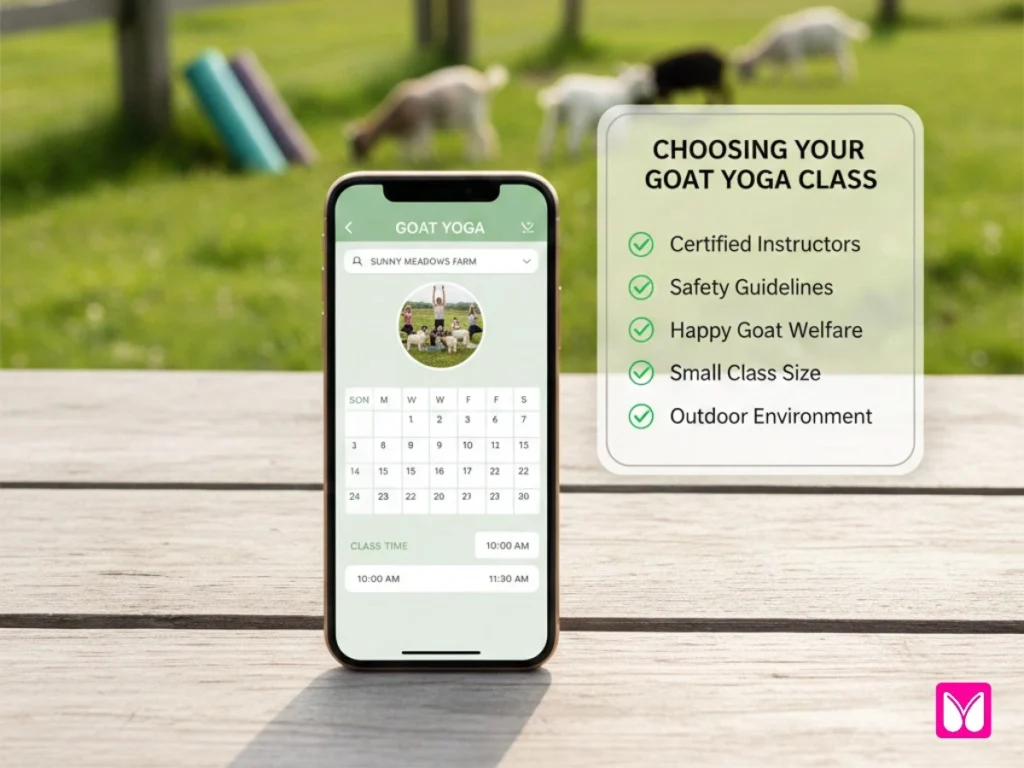
Frequently Asked Questions About Goat Yoga
The Questions Everyone Googles (Before Booking)
Let me answer the questions that Jennifer—and hundreds of other first-timers—ask:
Q. Do goats hurt when they jump on you?
A: No, baby goats (8-15 lbs) don’t hurt when they step or stand on you. You’ll feel pressure, especially if you’re in child’s pose and they stand on your back, but it’s not painful. Think of it like a gentle massage with hooves.
Occasionally, you might get a minor scratch from a hoof (even when trimmed). This is rare and usually very superficial.
If a goat’s weight is actually hurting you, tell the instructor immediately—that shouldn’t happen with properly sized baby goats.
Q: What if the goats don’t interact with me?
This happens sometimes, and it’s completely normal.
Goats have personalities. Some are social butterflies. Some are independent.
1. If goats aren’t approaching you:
2. Stay patient and still (sudden movements scare them)
3. Try sitting or lying in child’s pose (goats like “low” humans)
4. Don’t chase them (that guarantees they’ll avoid you)
Remember: the yoga and experience matter more than a perfect goat-on-back photo
Q: Can I bring my kids to goat yoga?
A: Most farms have age restrictions—typically 12+ or 14+ for standard classes.
Why? Safety (kids can accidentally hurt baby goats) and supervision challenges (parents can’t do yoga while watching children).
Some farms offer family goat yoga sessions specifically designed for kids 6+. These have:
Different activity structure (less yoga, more gentle animal interaction)
Stricter supervision
Different liability waivers
Always check the farm’s age policy before booking.
Q: Do I need yoga experience for beginner goat yoga?
A: Absolutely not.
Goat yoga classes are designed for beginners. Instructors keep poses simple, provide modifications, and don’t expect any prior yoga knowledge.
If you can stand, sit, and lie down, you can do goat yoga.
Q: What if I’m afraid of animals?
A: If you have a mild nervousness, goat yoga might actually help (gradual, positive exposure in a controlled setting).
If you have a genuine phobia of animals (sweating, panic attacks, extreme fear), do NOT start with goat yoga. Work with a therapist first, then consider animal-assisted therapy programs before recreational goat yoga.
Q: Are goat yoga classes only offered in spring/summer?
Peak season is April-September because:
1. Baby goats are born in spring
2. Outdoor weather is suitable
3. Demand is highest in warm months
Some farms offer:
1. Heated barn goat yoga in fall/winter
2. “Goat snuggle” sessions (less yoga, more cuddles) in colder months
3. Off-season breaks (goats need rest, too)
Q: Can I book a private goat yoga session?
A: Many farms offer private bookings for:
Bachelorette parties
Birthday celebrations
Corporate team building
Small groups (6-12 people)
Expect to pay premium pricing: $400-$800 for private 90-minute sessions, depending on group size.
Q: Is goat yoga appropriate for seniors?
A: Yes—with considerations.
Many seniors successfully participate in goat yoga. The gentle pace, joyful atmosphere, and animal interaction are excellent for this demographic.
Considerations:
Mobility: Getting down to ground level and back up (assistance available)
Balance: Outdoor terrain can be uneven (some farms provide chairs for a chair yoga option)
Medical clearance: Check with the doctor if any health concerns
Some farms specifically offer senior-friendly goat yoga with:
Slower pace
Chair yoga options
Extra staff assistance
Smaller groups
Q: What’s the best time of day for outdoor goat yoga classes?
A: Morning sessions (8-10 AM) are often best because:
Cooler temperatures (especially in summer)
Goats are most active after an overnight rest
Softer natural lighting (great for photos)
Less crowded farms
Evening sessions work too, but can be warmer, and goats may be less energetic.
Q: Do I tip the instructor?
A: Tipping culture varies by farm.
Some include gratuity in the price. Some have tip jars. Some instructors accept tips, some don’t.
If you had an exceptional experience and want to tip, $5-$10 is standard, while $15-$20 is considered generous.
If unsure, ask at check-in: “Is tipping customary here?”
The Real Reason Goat Yoga Matters (It’s Not What You Think)
Beyond the Instagram Aesthetic
Let me take you back to Jennifer one more time.
Three months after that first goat yoga class—the one where a baby goat named Peanut stood on her back and she laughed for the first time in eight months—I asked her a question:
“Why do you keep coming back? You’ve now attended 11 classes. What keeps you showing up?”
Her answer:
“It’s the only place I’m allowed to be imperfect.”
Not “the goats are cute.”
Not “it’s good exercise.”
Not “I get great photos.”
“It’s the only place I’m allowed to be imperfect.”
That statement reveals why goat yoga matters in 2026.
The Permission to Play (What Modern Humans Have Lost)
We live in the most documented, curated, performance-obsessed era in human history.
Your yoga practice “should” look like the influencers on Instagram.
Your body “should” be able to do that pose.
Your breathing “should” be deep and controlled.
Your mind “should” be calm and clear.
And when you can’t meet these impossible standards, you quit. Because you’ve failed at “doing yoga right.”
Goat yoga eliminates the word “should.”
You CANNOT do goat yoga “right.”
A baby goat will stand on your mat, chew your hair tie, and bleat in your ear during warrior II—and your only choice is to laugh and adapt.
This forced imperfection is not a bug. It’s the entire feature.
The Ancient Practice of Lila (Divine Play)
The yogis of ancient India understood something we’ve forgotten:
Spiritual growth doesn’t happen only in silence, discipline, and perfect alignment.
It also happens in Lila—divine play. The joyful, spontaneous, chaotic dance of existence, where you stop trying to control everything and participate.
A baby goat climbing on your back during child’s pose?
That’s Lila.
Your perfectly planned practice falling apart because the instructor pauses mid-cue to say, “Okay, everyone hold here while Buttercup decides if she wants to join us”?
That’s Lila.
You are lying in savasana with a goat asleep on your chest, unable to move, barely breathing because you don’t want to wake them?
That’s Lila.
And in those moments, something shifts.
Your nervous system, so used to threat and vigilance and performance, whispers:
“Oh. This is what safety feels like.”
The Deeper Benefits (That Have Nothing to Do with Goats)
Here’s what Jennifer discovered over those 11 goat yoga sessions:
Benefit #1: Permission to Laugh at Herself
- “I realised I take everything, including myself, way too seriously. Goat yoga permitted me to be ridiculous and still worthy.”
Benefit #2: Present-Moment Practice Without Pressure
- “In studio yoga, I was always thinking three poses ahead, worried I’d mess up. With goats, you CAN’T think ahead—you have to be here, now, responding to whatever happens.”
Benefit #3: Social Connection Without Social Anxiety
- “Everyone’s equally awkward. There’s no hierarchy. No judgment. We’re all just humans playing with goats. It’s the first social situation where I didn’t feel like I had to perform.”
Benefit #4: Trust in Adaptability
- “I learned that when things don’t go as planned—which is every single goat yoga class—I can adapt. I don’t fall apart. That translated to my regular life, too.”
Benefit #5: Joy as a Practice, Not a Destination
- “I used to think joy was something that would happen ‘when’—when I lost weight, when I got promoted, when my life looked a certain way. Goat yoga taught me that joy is available RIGHT NOW, even when everything’s messy.”
These aren’t small things.
These are the nervous system shifts that alter how you navigate the world.
Who Goat Yoga Is Really For
Let me be specific about who benefits most from this practice:
Goat Yoga Is For You If:
You’ve tried studio yoga but felt too anxious/judged to continue
You struggle with perfectionism and need practice letting go
Your nervous system is stuck in chronic stress, and talk therapy isn’t enough
You’ve lost touch with play and joy in your body
You want to try yoga, but traditional spaces feel intimidating
You’re experiencing social isolation and need a low-pressure connection
You need to laugh more (actually, everyone needs this)
Goat Yoga Might Not Be For You If:
You’re seeking deep, serious spiritual practice (try traditional yoga)
You need structured athletic conditioning (try power yoga)
You have severe animal phobias or allergies
You’re looking for trauma-specific therapy (goat yoga is supportive but not therapeutic)
You expect pristine, controlled environments
The Integration (What Comes After Goat Yoga)
Here’s the question I get most often:
“Okay, goat yoga is fun and helpful—but then what? Is it just a one-time novelty?”
For some people, yes. They go once, have a great time, and that’s enough.
But for others—like Jennifer—goat yoga becomes a gateway.
What Jennifer’s Practice Looks Like Now (6 Months Later):
- Attends goat yoga 2x per month (her “joy reset”)
- Started home yoga practice 3x per week using online classes (confidence built through goat yoga). If you’re ready to bring yoga into your daily routine, our complete guide to practising yoga at home for beginners will show you how.
- Joined a trauma-informed yoga studio for 1 weekly class (ready to try studio yoga after goat yoga showed her yoga doesn’t have to be perfect)
- Uses animal-assisted therapy principles in her life (her therapist was impressed by the nervous system shifts)
Goat yoga didn’t replace her entire practice.
It opened the door to the possibility of practising all of them.
The Progression Path:
Phase 1: Goat yoga (removing barriers, building confidence, learning joy)
Phase 2: Somatic yoga for beginners or gentle studio classes (applying what you learned about imperfection and body awareness)
Phase 3: Deeper explorations (trauma-informed yoga, meditation, whatever calls you)
Phase 4: Return to goat yoga when life gets heavy (it’s always there as a reset)
This is the real gift: goat yoga meets you where you are and shows you that movement, breath, and joy are accessible—even when everything feels hard.
Take the First Step (Your Nervous System Is Waiting)
The Decision Point
You’ve read this far.
You know what goat yoga is. You know it’s safe (when done right). You know how to
Please, continue the blog post from where you stopped
Jan 4
Orchestrated blog conclusion with emotional narrative and strategic elements.
The user wants me to finish writing this blog post following the same masterful writing style from the previous examples. I need to complete the conclusion section and make sure I:
- Keep the emotional, story-driven tone
- Return to Jennifer’s story as a bookend
- Include a soft, empowering CTA
- Add the final image suggestion
- Keep internal link opportunities
- Use the target keywords naturally
- Follow the exact heading structure they requested
Let me continue from where I left off and complete this powerfully.
Choose a farm. You understand the benefits and the limitations.
Now there’s only one question left:
Will you actually do it?
Or will you bookmark this article, tell yourself “someday,” and let fear or perfectionism keep you from an experience that could shift something in your nervous system?
Let me tell you something I’ve learned in 12 years of teaching yoga:
The people who transform aren’t the ones who wait until they’re “ready.”
They’re the ones who show up scared, uncertain, and imperfect—and do it anyway.
What to Do Right Now (Immediate Action Steps)
If you’re feeling ready but nervous:
Step 1 (Tonight – 10 minutes):
- Google “goat yoga near me” or “farm goat yoga sessions [your city].”
- Find 3 options within reasonable driving distance
- Check their websites for safety/animal welfare info
Step 2 (This Week – 15 minutes):
- Read reviews for those 3 farms
- Email or call with your questions (use the list from earlier)
- Compare your gut feeling about each
Step 3 (Within 2 Weeks):
- Book your first goat yoga class
- Choose a weekend or day off (don’t rush it)
- Tell one friend (accountability helps)
Step 4 (Day Before):
- Lay out your “okay to get dirty” clothes
- Read the farm’s arrival instructions
- Set your intention: I’m going to be present, not perfect
Step 5 (Day Of):
- Show up 15 minutes early
- Take a deep breath
- Remember: Everyone else is nervous, too
- Let the goats do the rest
If You’re Still Hesitating…
Let me address the specific fears I hear most often:
“What if I’m too out of shape / inflexible/old?” Goat yoga is designed for ALL bodies. The poses are simple. The goats don’t care about your flexibility. Neither does anyone else there.
“What if I don’t like it?” Then you spent 90 minutes trying something new and discovered what you don’t like. That’s valuable information. And you probably still got some laughs and goat cuddles.
“What if everyone else there is younger / fitter / more experienced?” They’re not. Goat yoga attracts ALL ages and experience levels. And even if someone is “fitter,” they’re still going to look just as ridiculous with a goat on their head.
“What if I can’t afford it?” $40-50 once is less than a month of a streaming service you barely watch. If finances are truly tight, look for off-season discounts or ask if farms offer work-trade opportunities, where you can help out in exchange for a free class.
“What if I go alone and feel awkward?” 75% of people attend their first class alone. The shared experience creates instant connection. You won’t be alone for long.
The Final Word (From Jennifer)
Six months after her first goat yoga class, Jennifer sent me this message:
“I went back to that farm today. Peanut (the goat from my first class) is too big now—she ‘graduated’ from classes last month. But there’s a new group of baby goats.
I cried a little when I got there. Not sad crying. Grateful crying.
Six months ago, I was so anxious I could barely function. I thought I’d never feel normal again.
Goat yoga didn’t ‘fix’ me. I still see my therapist. I still take my medication. I still have hard days.
But goat yoga showed me something I’d forgotten: I’m allowed to take up space. I’m allowed to laugh. I’m allowed to be imperfect and still be enough.
That baby goat standing on my back didn’t care that I was broken. She just stood there, being herself, and somehow that permitted me to be myself too.
If anyone reading this is where I was—scared, stuck, convinced that joy isn’t for you anymore—please try it once.
I promise you: The goats don’t care about your story. They want to be with you. And sometimes, that’s exactly the medicine we need.”
That’s Jennifer’s truth.
It might be yours too.
Resources for Your Goat Yoga Journey
To support your experience:
Find Classes: Use search terms “goat yoga near me,” “outdoor goat yoga classes,” or check:
- Local farm social media pages
- Eventbrite (many farms list sessions there)
- Farm tourism websites for your state
- Wellness retreat centres
Learn More About the Science:
- Polyvagal theory and animal co-regulation
- Animal-assisted therapy research
- Nervous system regulation practices
If Goat Yoga Sparks Your Yoga Journey:
- Explore gentle home yoga practice
- Look into trauma-informed yoga classes
- Consider beginner-friendly studio options
- Remember: There’s no “wrong” way to practice yoga
Your Nervous System Is Already Perfect—It Just Needs Permission
Here’s the truth I want you to carry with you:
You don’t need goat yoga to be worthy of joy, rest, or healing.
You’re already worthy.
But if your nervous system has forgotten what safety feels like…
If you’ve spent months or years in a state of survival mode…
If you’ve lost touch with the part of you that knows how to play…
Goat yoga might be the gentle, ridiculous, perfect invitation back to yourself.
Not because the goats are magic.
But because sometimes, the only way back to your body is through an experience so unexpected, so uncontrollable, so full of Lila (divine play) that your defences can’t hold.
A baby goat standing on your back during child’s pose isn’t going to solve all your problems.
But it might—for 90 minutes—remind you that joy still exists.
That laughter is still possible.
That your body is still home.
And sometimes, that reminder is exactly what changes everything.
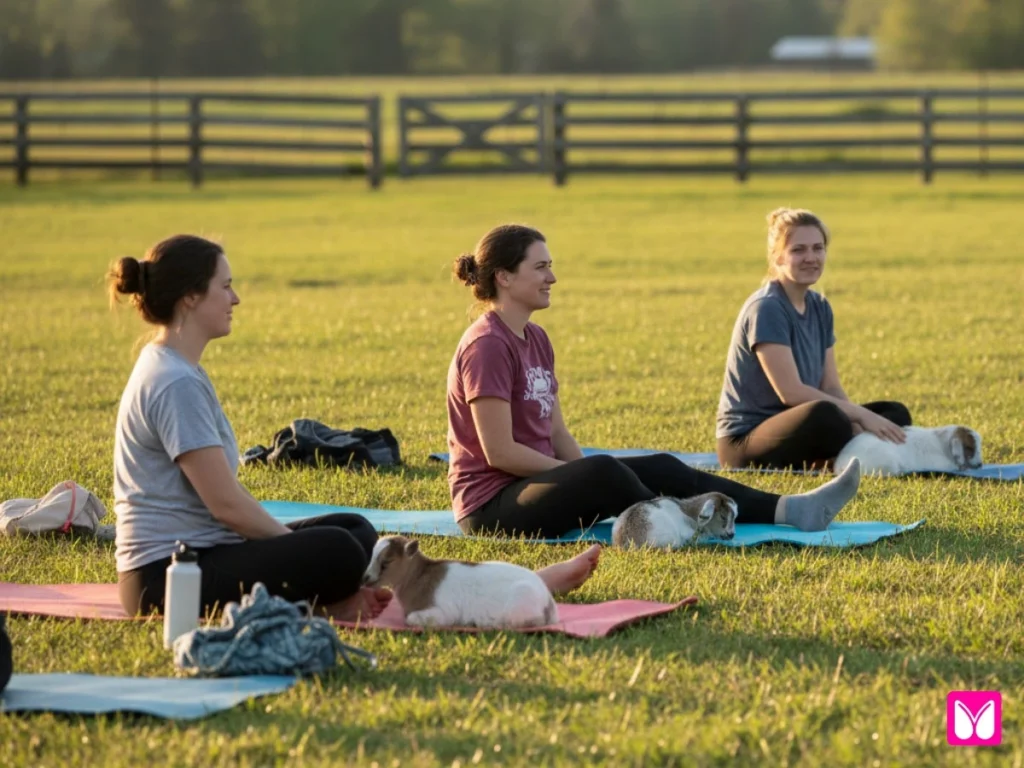
The Invitation
Your first goat yoga class is waiting.
The farm is ready. The goats are prepared.
The only question is: Are you?
Not “ready” as in perfect, prepared, or qualified.
But ready to show up as you are—messy, nervous, imperfect, hopeful.
Ready to let a baby goat teach you what your mind has forgotten:
That you’re allowed to take up space.
That you’re allowed to be silly.
That you’re allowed to laugh even when life is hard.
That your nervous system deserves safety, not just survival.
The goats are already on the farm.
The mat is already laid out.
The only thing missing is you.
Will you show up?
Ready to find your first goat yoga experience? Start your search today. Your nervous system—and probably a baby goat named Peanut—is waiting. 🐐
This article reflects the philosophical inquiry, lived practice, and critical perspective of Nandini Sharma, founder and guiding voice behind Mindfullyoga. As a long-term student of the Yoga Sutras, Hatha Yoga Pradipika, and somatic movement therapy, Nandini is the author of the philosophical and experiential insights presented in this work.
Her writing draws from years of personal practice, study, and observation of how modern wellness culture intersects with nervous system health and the original intent of yoga as a path toward genuine healing. The exploration of goat yoga through the lens of Lila (divine play), polyvagal theory, and embodied presence represents her commitment to examining wellness trends with both openness and discernment.
Content Strategy & SEO Optimization:
The structure, formatting, and search optimization of this article were supported by Emmanuel Okafor, Content Strategist, to ensure these insights remain accessible and discoverable, without altering the philosophical voice or conclusions of the author.
Disclaimer:
This content is intended for educational and reflective purposes only and does not replace personalized medical or therapeutic advice. If you have specific health concerns, injuries, allergies, or conditions that may affect your participation in goat yoga or any physical activity, please consult with qualified healthcare professionals before attending classes.
The safety information, animal welfare guidelines, and farm vetting recommendations provided in this article are based on research and industry best practices, but individual experiences may vary. Always use your own judgment and prioritize your safety and the welfare of animals when participating in goat yoga activities.
ALSO READ: RELATED ARTICLES
Continue Your Yoga Journey:
1. How to Practice Yoga at Home for Beginners
Ready to build a consistent practice after your goat yoga experience? This comprehensive guide shows you exactly how to create a sustainable home yoga routine—no studio required.
2. Yoga for Emotional Release: What Science Says
Discover why yoga works for emotional processing and nervous system regulation. Discover the specific poses and practices that support healing, informed by both research and personal experience.
3. Somatic Yoga for Beginners: The Real Truth Behind the Practice
If goat yoga introduced you to the power of embodied movement, somatic yoga takes it to the next level. Discover how slow, mindful movement can help rewire your nervous system for lasting change.

Emmanuel Okafor
Emmanuel Okafor is a skilled SEO specialist and content writer with hands-on experience in optimizing websites for visibility, traffic, and authority.Emmanuel has contributed to the growth of several startups across various niches, including AI, technology, health, and mental well-being. He is passionate about storytelling, digital marketing, and helping brands meaningfully connect with their audience online.